Pune Rental Yield Compared: Which BHK Makes Your Investment Work Harder?
Pune Rental Yield 2026: Best BHK for Property Investment
SHARE:
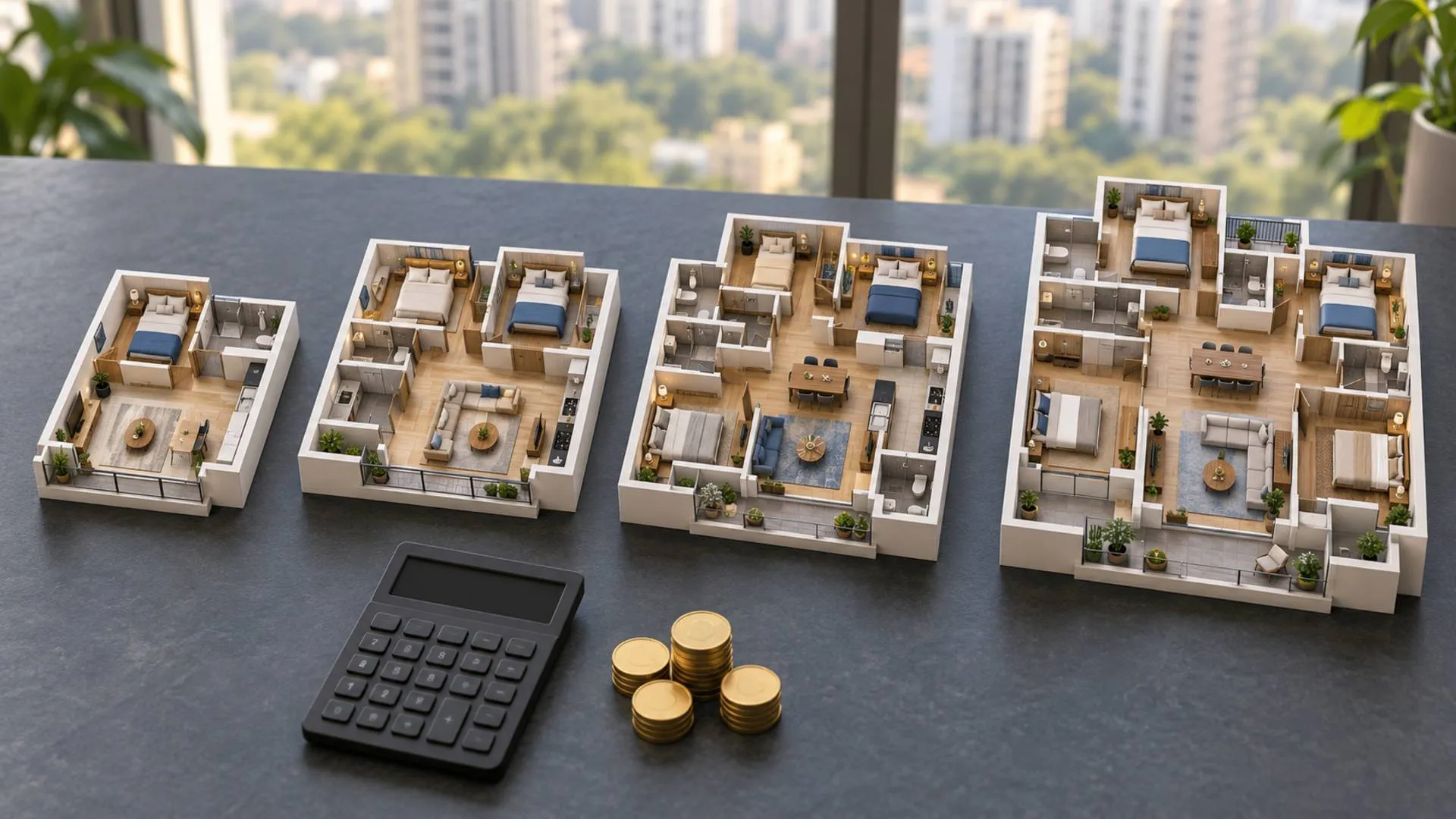
A ₹75000 monthly rent sounds impressive, but if it comes on a ₹3-Cr apartment, the gross rental yield will be merely 3%. A smaller home, fetching ₹20,000 per month on a ₹50-Lakh investment, will yield 4.8%.
This is the nuance that changes the game. The apartment that fetches the highest rent may not yield the highest returns on the money invested in it, especially if it comes with an additional bedroom that may attract a higher-paying guest but will add to the price of the property.
The question now is not about which flat fetches the highest rent; the one with the highest rental yield after factoring in the cost of acquisition, vacancies and other costs will be considered the best buy by Pune property buyers scouting for rental yield in 2026.
The supplied references show two distinct advantages: compact homes can perform well on percentage yield and a well-priced 2 BHK offers good value for money; larger homes will need careful consideration.
Which BHK gives the best rental yield in Pune: 1, 2, 3 or 4 BHK?
A well-priced 1 BHK can deliver the highest percentage yield, while a 2 BHK is a strong starting point for investors seeking broader tenant appeal. A 3 BHK may earn more monthly rent without a higher yield; a 4 BHK requires careful assessment of acquisition cost, achievable rent and vacancy. No configuration wins across every Pune locality.
Giridhar Housing’s September 2026 guide gives 1 BHKs near employment hubs a potential yield edge over larger residential formats. Aishwaryam’s 2026 comparison emphasises the wider tenant appeal and lower entry cost of 2 BHKs relative to 3 BHKs. These are publisher assessments, rather than a comprehensive transaction-based ranking.
First, separate rental income from rental yield
Rental income is the amount collected. Rental yield measures that income against the property’s value or investment cost. Mixing the two can make an expensive apartment appear more productive than it is.
For a straightforward market-value comparison:
Gross rental yield = Annual rent ÷ Property value × 100
For a purchase decision, calculate a second version using the complete acquisition cost, including applicable transaction charges and furnishing expenditure. Keep the denominator consistent when comparing properties.
A simplified net operating yield deducts vacancy and owner-paid operating expenses from rental income before dividing by investment cost. Loan repayments and personal income tax should be assessed separately rather than silently folded into the same comparison.
Pune Realty Hub illustrates the gross calculation with an ₹80 lakh property renting for ₹22,000 monthly: ₹2.64 lakh annual rent produces a 3.3% gross yield. Its guide also distinguishes gross returns from returns after expenses.
The practical implication is simple: a high rent matters only when the price paid leaves room for a worthwhile return.
1 BHK versus 2 BHK versus 3 BHK versus 4 BHK
The following calculation uses hypothetical purchase prices and rents. It demonstrates how the comparison works; it is not a table of verified Pune averages or current quotations.
| Configuration | Assumed property price | Assumed monthly rent | Annual rent at full occupancy | Gross yield |
| 1 BHK | ₹45 lakh | ₹18,000 | ₹2.16 lakh | 4.80% |
| 2 BHK | ₹80 lakh | ₹30,000 | ₹3.60 lakh | 4.50% |
| 3 BHK | ₹1.30 crore | ₹42,000 | ₹5.04 lakh | 3.88% |
| 4 BHK | ₹2.50 crore | ₹70,000 | ₹8.40 lakh | 3.36% |
The 4 BHK earns the highest monthly income, but the 1 BHK produces the strongest percentage return under these assumptions. Change the purchase price or achievable rent, and the ranking can change.
1 BHK: a lower entry price can create a yield advantage. Giridhar Housing associates compact apartments near Kharadi and Hinjewadi with demand from single professionals relative to their purchase cost. That supports investigating a 1 BHK rental yield Pune strategy without assuming every small apartment performs well.
Check whether the apartment works for its likely tenant. Storage, ventilation and a usable kitchen can matter more than decorative amenities. Also budget for re-letting if occupants move frequently.
2 BHK: the balanced candidate. Aishwaryam identifies young professionals and smaller families among the tenant groups seeking two-bedroom homes. Its comparison also places 2 BHK acquisition and maintenance costs below those of comparable 3 BHKs.
This makes a 2 BHK flat Pune search a sensible starting point for a first rental investment. It can accommodate a couple needing a workroom or a smaller family needing a second bedroom. The purchase still needs to be priced correctly.
3 BHK: more rent needs to justify more capital. Suppose the hypothetical 2 BHK above costs ₹80 lakh and rents for ₹30,000, while the 3 BHK costs ₹1.30 crore and rents for ₹42,000. The additional ₹50 lakh produces only ₹1.44 lakh more annual rent—a 2.88% gross return on the extra capital.
That does not make the larger apartment a poor purchase. It makes the reason for buying it important. Future self-use or a particular family tenant market may justify the choice.
4 BHK: evaluate the premium tenant case. NOW Realty’s Baner–Balewadi comparison publishes rental-yield ranges of 3.5–4.5% for 3 BHKs and 3.0–3.8% for luxury 4 BHKs. These are its stated micro-market estimates, not independently established Pune-wide benchmarks.
A luxury home can suit an investor with a specific tenant strategy. It deserves particular scrutiny when rental income is the sole objective.
Hinjewadi, Kharadi and beyond: location changes the result
A Pune rental yield by BHK configuration comparison becomes meaningful only when location and property quality are controlled.
A reasonably priced apartment with an easy office journey can compete effectively with a more expensive address. Conversely, a cheaper property may struggle if the tenant’s daily commute is inconvenient.
SOBHA’s supplied rental-demand guide discusses Hinjewadi, Kharadi, Wakad, Baner, Viman Nagar, Hadapsar and Magarpatta among rental locations. Its article body is framed around 2025, so it provides background rather than a fresh October 2026 yield survey.
For 2 BHK Hinjewadi rental yield, compare homes serving the actual employment phase and office location. For 2 BHK Kharadi rental yield, establish whether the rent premium compensates for the purchase premium.
Pune Realty Hub’s March 2026 table gives Hinjewadi an indicative 4.0–4.5% gross yield and Kharadi 3.2–3.8% for its specified unfurnished 2 BHK category. Its assumptions include apartments of approximately 900–1,050 sq ft carpet area. Those figures should not be transferred to every unit. Pune Realty Hub
Kolte-Patil’s investment guide publishes a different Kharadi indication of 3.5–4.5%. The variation reinforces why investors should use comparable properties rather than choose whichever website displays the highest number.
Wakad, Tathawade, Hadapsar and Undri also deserve investigation, but no locality label establishes the return. Request evidence from the specific society and configuration.
Claims of 5–6.5% returns need matching purchase and rental evidence. At an ₹80 lakh acquisition cost, a 5% gross yield requires approximately ₹33,333 monthly rent; 6% requires ₹40,000. Test whether comparable tenants are actually paying those amounts.
Vacancy and furnishing can overturn the headline yield
A flat produces rent when it is occupied and payments are collected, not when an advertisement goes live.
Consider the hypothetical ₹80 lakh 2 BHK renting for ₹30,000 monthly. At full occupancy, its gross yield is 4.5%. With one vacant month, rent collected falls to ₹3.30 lakh.
Deduct an illustrative ₹60,000 of annual owner-paid operating expenses, and the remaining ₹2.70 lakh produces a 3.38% net operating yield. This excludes personal income tax, financing costs and any additional acquisition expenditure.
Do not double-count maintenance paid separately by the tenant. Equally, do not ignore maintenance payable during vacancy, repair bills, or brokerage when a tenancy changes.
Furnishing introduces another calculation. Suppose an unfurnished apartment rents for ₹28,000 monthly and furnishing costing ₹5 lakh raises achievable rent to ₹35,000.
The extra ₹7,000 a month produces ₹84,000 annually at full occupancy. The furnishing expenditure takes approximately six years to recover through that uplift alone, before replacement, repairs or vacancy.
A furnishing premium is useful only when the extra rent compensates for the extra capital and upkeep. A blanket 25–35% uplift should not be assumed across all Pune homes.
Compare furnished, semi-furnished and unfurnished apartments within the same society. Check the appliance inventory, condition and who pays for servicing. A higher asking rent does not establish a higher completed lease rent.
Choose the investment after checking the tenant
For a first rental investment around ₹50–₹80 lakh, compare a good 1 BHK with the 2 BHKs genuinely available within the complete budget. Keep a reserve for vacancy and repairs rather than spending everything on the purchase.
At ₹80 lakh–₹1 crore, investigate whether a better-located 2 BHK offers stronger returns than a larger apartment with a more difficult commute. The answer should come from quotations and lease evidence.
Team Super Sales’ Pune page identifies technology and manufacturing employment among its investment themes. Its displayed return history is labelled illustrative and references Q1 2025 research, so it should not be treated as a verified 2026 forecast for a particular apartment.
Before buying a rental property in Pune, collect three things:
- A complete acquisition quotation, including planned furnishing.
- Comparable rent evidence showing what is included and how recently the tenancy began.
- A vacancy and expense estimate for the actual apartment and society.
For projects marketed by Saheel, Shubh Developers, or any other builder, apply the same test. Brand recognition can prompt a site visit; it cannot establish rental yield.
A ready apartment allows inspection of the actual home and existing society. An under-construction investment requires a separate timeline because rental income begins only after the property is available and let. Do not count anticipated rent as present income.
Which BHK should investors choose in 2026?
For percentage yield, start by examining well-priced 1 BHKs. For a balance of investment cost and tenant appeal, compare 2 BHKs closely. Move to a 3 BHK or 4 BHK when the achievable rent, tenant evidence and wider ownership objectives justify the additional capital.
The best BHK for investment in Pune is not determined by bedroom count alone. It is the apartment whose realistic rent supports its complete cost, with enough room for expenses and periods without a tenant.
A large monthly rent can catch attention. A well-tested net return is what makes the investment work.