Commercial Shops in Pune 2026: Area Prices and Investment Choices
Commercial Shops in Pune 2026: Area-Wise Prices
SHARE:
A ₹30 lakh shop and a ₹1.4 crore shop are both available in this Pune property search. The more intriguing question is what each address on offer can actually deliver in terms of passing customers, reliable tenants, convenient access or waiting for the local area to develop.
For buyers eyeing up commercial shops for sale in Pune in 2026, there are opportunities for established shopping streets and retail units catering to newer residential communities. However, a prestigious locality name is not necessarily an indicator that every shop within its jurisdiction will be a good investment.
A compact unit at an employment hub could carry a substantial asking price. A bigger shop elsewhere could cost less but would be reliant on a different business model. Floor levels, space on offer, frontage and the likely customer base in the area can be just as important as a postcode.
The right commercial shop can match price, premises and business demand. This area-wise guide looks at the advertised examples and looks at ways to compare them before committing to a purchase.
What is the price of a commercial shop in Pune by area in 2026?
Advertised examples range from ₹29 lakh in Kondhwa and ₹30 lakh in Pimpri-Chinchwad to ₹48 lakh in Kothrud, ₹1.10 crore in Upper Kharadi and ₹1.4 crore in Wakad. These are individual asking prices, not locality averages. Shop size, floor, frontage, possession status and permitted use must be compared separately.
Pune commercial shop prices: what the listings actually show
The following examples provide a starting point for a commercial property search in Pune. They should be treated as advertised offers requiring fresh confirmation, rather than completed transaction prices or valuations.
| Area | Advertised asking price | Advertised size | Area basis | Floor/status where stated |
| Kondhwa | ₹29 lakh | 250 sq ft | Super area | Ground floor; ready resale |
| Pimpri-Chinchwad, Kharalwadi/Pimpri | ₹30 lakh | 200 sq ft | Unspecified | Confirm with seller |
| Loni Kalbhor, Kadam Wasti | ₹32 lakh | 250 sq ft | Super area | Ground floor; ready resale |
| Raviwar Peth | ₹38 lakh | 400 sq ft | Super area | Ground floor; ready resale |
| Vishrantwadi, Airport Road | ₹40 lakh | 247 sq ft | Super area | Ground floor; ready resale |
| Kothrud, Ratnamala Complex | ₹48 lakh | 158 sq ft | Carpet area | Ground floor; ready resale |
| Akurdi | ₹66 lakh | 210 sq ft | Unspecified | Confirm with seller |
| Charholi Budruk | ₹86 lakh | 570 sq ft | Unspecified | Confirm with seller |
| Upper Kharadi, Gera World of Joy | ₹1.10 crore | 147 sq ft | Carpet area | Listed as lower basement; ready resale |
| Wakad, Mahalaxmi Complex | ₹1.4 crore | 326 sq ft | Carpet area | Ready to move |
| FC Road | ₹1.85 crore | 410 sq ft | Saleable area | Ready to move |
| Hadapsar, Bhandari 54 Flores Drive | ₹4.48 crore | 2,076 sq ft | Saleable area | Under construction |
Sources: Magicbricks and its ₹30–40 lakh listings; NoBroker; Square Yards. Prices and availability can change.
The table reveals why a single “commercial shop Pune price” is misleading. These properties differ sharply in usable area and format. A small neighbourhood outlet, a street-facing shop and a larger commercial unit should not be treated as interchangeable investments.
Before comparing rates per square foot, establish whether the denominator is carpet, built-up, super or saleable area. A cheaper advertised rate can conceal less usable space. Ask for the approved plan, measurements and a written explanation of what the quoted area includes.
Established streets or growing neighbourhoods: where should buyers look?
For a shop in Kothrud, Shivajinagar, Karve Road or Camp, the first task is to understand the immediate trading environment. Does the street serve residents, office workers, students, or destination shoppers? Do people stop there, or simply pass through?
Visit competing businesses and observe the pavement outside the property. A shop on a familiar road can still struggle if pedestrians cross on the opposite side, parking is difficult or its entrance is hidden behind another building.
Older commercial buildings deserve particular attention. Electrical capacity, drainage, structural condition, signage rights and access for deliveries may influence which tenants can use the space. A low acquisition price becomes less attractive if substantial work is needed before trading begins.
For a commercial shop in Baner, Wakad, Kharadi, Hadapsar or Viman Nagar, assess the local customer base with equal care. Employment centres and housing communities can create potential demand, but the shop must connect with that demand physically.
An outlet intended for office workers needs convenient access from the offices it serves. A neighbourhood retailer needs occupied homes, repeat customers and practical opening hours. An attractive development brochure cannot establish either condition.
The same principle applies to PCMC commercial property. Buyers considering Pimpri-Chinchwad, Akurdi, Moshi or Charholi should inspect existing occupancy and nearby competition. A growing locality can offer opportunity, but a shop surrounded by unfinished buildings may need patience and a larger financial reserve.
Choose the customer catchment before choosing the locality label. For an owner-occupier, the ideal address depends on the business. For an investor, it depends on the businesses likely to lease the premises.
Why frontage and floor level can outweigh the locality premium
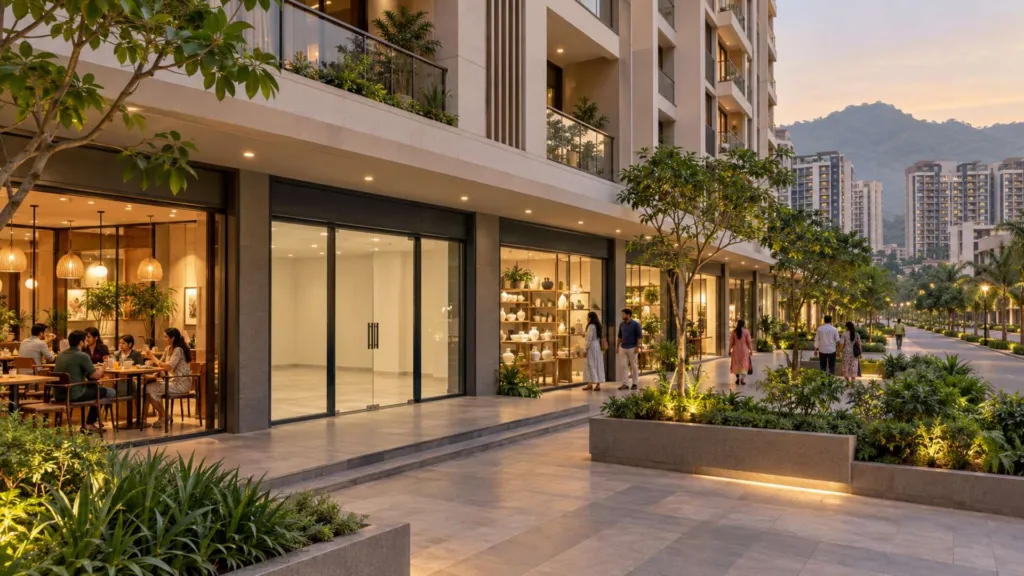
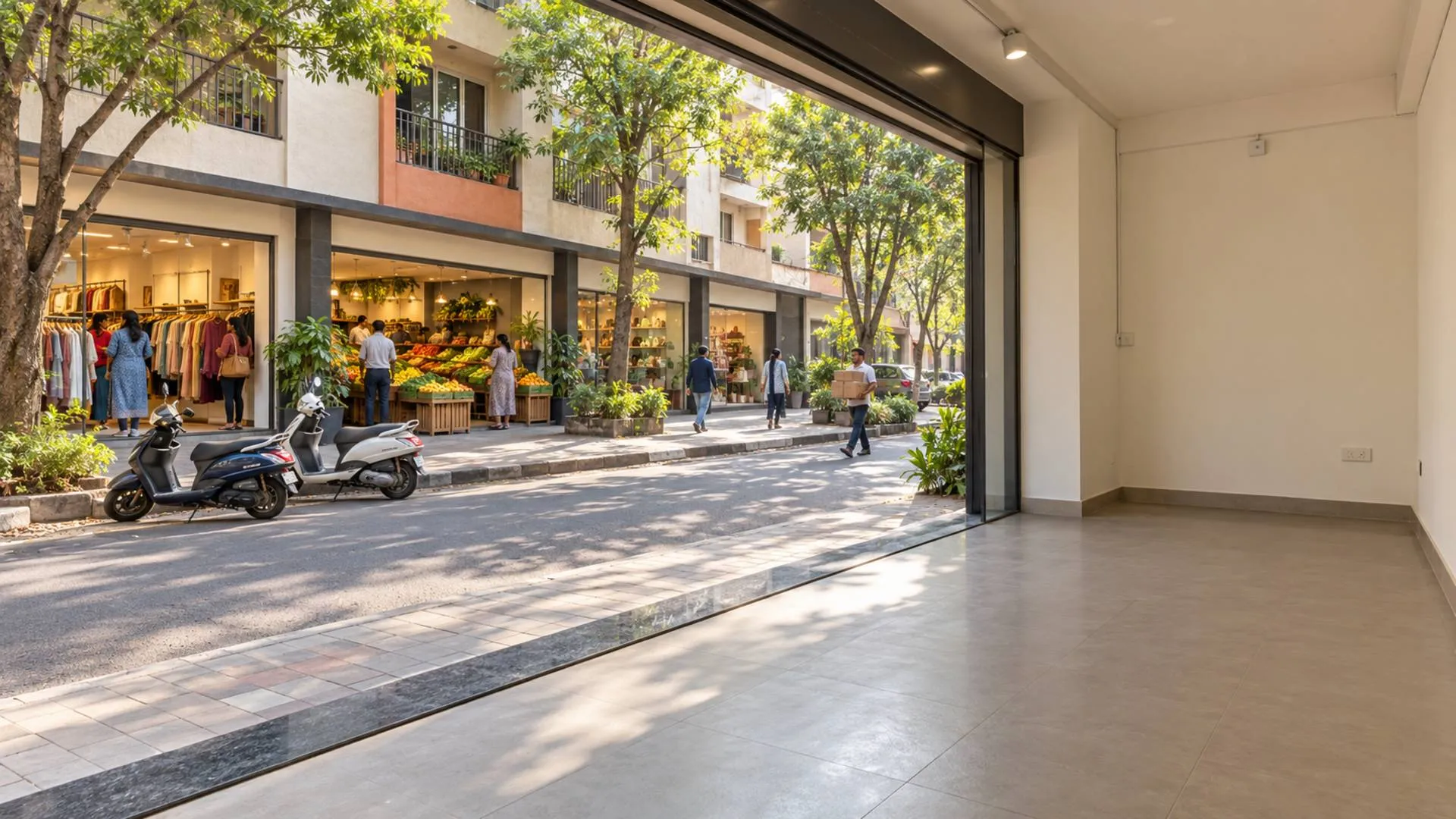
Ground-floor access is particularly relevant for businesses relying on spontaneous visits. A visible entrance, readable signboard and convenient stopping point can help customers discover and enter a shop.
However, ground floor alone is insufficient. A narrow frontage, obstructed display window or awkward internal layout can weaken an otherwise promising property. Corner visibility may help, but only when customers can safely reach the entrance.
Upper-floor commercial space needs a different assessment. Customers may willingly climb stairs for a scheduled appointment, specialist service or destination business. They may be less inclined to do so for a quick convenience purchase.
This is why a ground-floor versus first-floor commercial shop in Pune comparison should begin with intended use. Lower pricing upstairs can represent value for one business and a poor fit for another.
For shops advertised near EON IT Park or another employment destination, inspect the actual route. “Nearby” does not necessarily mean accessible from the relevant gate. Dividers, turning restrictions, crossings and parking arrangements can change the experience.
Count pedestrians during weekday lunch hours, evenings and weekends. Observe how many people enter surrounding businesses, rather than counting every vehicle on the road. Also check delivery access and whether customers can find the address easily.
A practical floor plan should accommodate storage, staff movement and the proposed activity. Restaurants and food outlets require a different infrastructure assessment from salons, pharmacies or service businesses. Confirm permitted use before pricing the fit-out.
What rental income can a commercial shop in Pune generate?
The strongest answer comes from comparable leases and realistic costs, rather than a city-wide yield promise.
Consider a hypothetical ₹1 crore shop renting for ₹35,000 a month. Annual scheduled rent would be ₹4.2 lakh, producing a gross rental yield of 4.2% on the purchase price.
If it remains vacant for two months, collected annual rent falls to ₹3.5 lakh. That reduces the figure to 3.5%, before maintenance, property tax, insurance, repairs and other owner-paid expenses. Acquisition costs would lower the return further when included in the investment denominator.
The useful formula is:
Gross rental yield = annual rent ÷ purchase price × 100.
For a more realistic assessment, calculate income after vacancy and owner-paid expenses against the total acquisition cost. Keep loan repayments separate so that the property’s operating performance and the investor’s financing position remain visible.
Ask local agents for evidence of achieved rents for comparable premises. Match floor, frontage, usable area, condition and permitted activity. A listing’s expected rent is not evidence that a tenant has agreed to pay it.
For a pre-leased shop, inspect the lease, tenant payment history, deposit, escalation clauses, lock-in period and termination rights. Clarify who pays maintenance and taxes. A lease can add visibility to income, but its terms determine how much protection it provides.
Higher monthly rent does not automatically mean a better investment. The acquisition price, vacancy risk and expenses determine how much income the owner retains.
Commercial shop versus residential flat: compare the full ownership experience
Buying commercial property in Pune can suit investors who understand the tenant’s business and can tolerate periods without rent. Residential property serves a different need, and neither category automatically delivers superior returns.
A retail vacancy may require changes to the premises or a search for a different business category. Fit-out negotiations, signage requirements and technical needs can complicate the process. Conversely, a well-matched shop and tenant can create a useful income-producing asset.
For an owner-occupier, buying a shop offers control over the business address. However, it also ties capital to the premises. Compare the purchase with leasing suitable space and retaining funds for inventory, staff and expansion.
A budget search can uncover smaller units, but the minimum amount needed to buy a commercial shop depends on available inventory and suitability. A low ticket price should not override poor access, unclear permissions or an impractical layout.
Larger showrooms and retail premises need a separate analysis from compact shops. Customer parking, loading access, floor strength and circulation become more important as the proposed operation grows. Office space in Pune should also be assessed separately from retail space.
The decision should reflect the buyer’s purpose: running a business, earning rent or holding an asset for future use. Those goals can lead to different properties at the same budget.
Ready shops, new launches and the documents that matter
A ready commercial shop allows buyers to inspect access, surrounding occupancy and physical condition directly. It may still require refurbishment, and “ready” should be supported by the relevant completion and occupancy documentation.
An under-construction shop requires closer scrutiny of delivery timing and the proposed retail environment. Ask when neighbouring homes or offices will be occupied, when access roads will be usable and how the commercial frontage will function.
Early pricing has limited value if possession is delayed or the expected customer base takes longer to arrive. Compare payment milestones, delivery obligations and the cost of waiting before accepting a launch offer.
Where project registration is applicable, use MahaRERA to check the registered details and disclosures. Registration is one part of due diligence; it should be combined with independent title and approval checks.
Before paying a booking amount, obtain:
- Title documents and an independent legal review.
- Sanctioned plans confirming commercial use and the unit’s identity.
- Applicable completion, occupancy and project-registration records.
- Details of existing leases, dues, maintenance obligations and restrictions.
- A written acquisition-cost statement and lender terms, if financing is required.
Use Maharashtra’s Department of Registration and Stamps resources when reviewing valuation and registration requirements. Confirm the applicable charges for the particular transaction instead of assuming that residential concessions or a quoted tax treatment apply.
Ask lenders about eligibility, valuation, down payment, tenure and repayment conditions. A residential home-loan quotation should not be used as a substitute for financing terms on a commercial shop.
For a Pune property investment, the final shortlist should combine verified price, usable space, customer access and ownership costs. Visit each property more than once and ask what would happen if the first tenant leaves.
Commercial shops for sale in Pune in 2026 offer varied entry points, but the best purchase is the one whose numbers and business potential withstand inspection. Shortlist by budget, test the location on the ground and request a documented offer before negotiating. Start your search with a clear business or rental objective and buy the premises that support it.