Akurdi Property Rates in 2026: How the Nigdi Metro Changes Buying
Akurdi Property Rates 2026: Metro Impact & Buying Guide
SHARE:
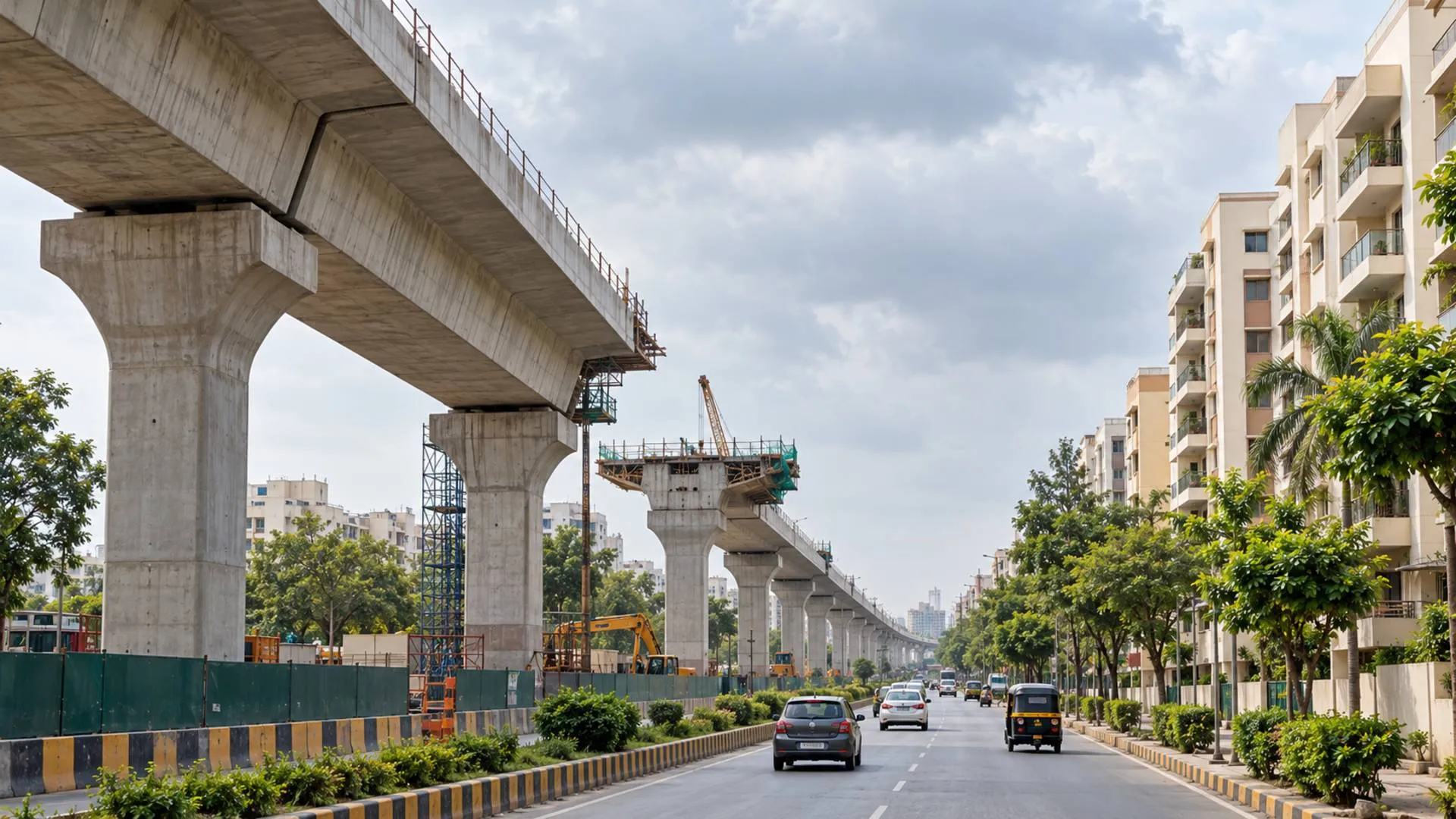
Akurdi’s property conversation is going beyond the familiar question of how much a flat costs. Buyers are coming to ask what happens when an established residential neighbourhood gets another public transport option on its belt.
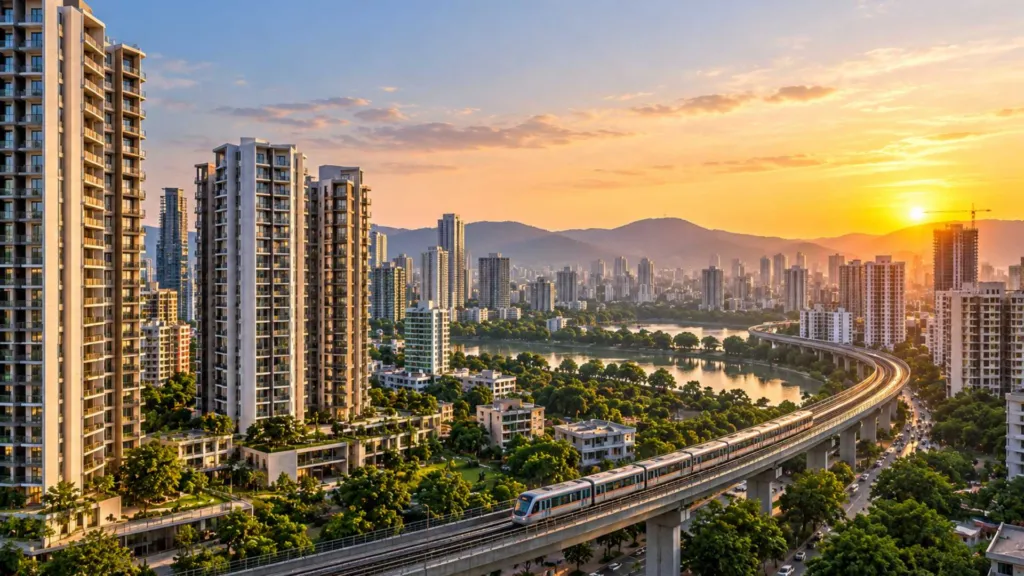
And there is a reason for that, along the PCMC-Nigdi corridor. The Times of India, quoting sources on August 30, 2026, reported that track-laying and electrical work had begun on the metro extension with approximately 75% of the viaduct completed.
So, for the families assessing Akurdi property rates in 2026, that progress represents a new factor at play in the purchase decision: whether the improved future connectivity justifies the price that’s being quoted today.
The metro is a reliable infrastructure development, but a guaranteed property-price jump is a different claim altogether, and the buyers should scrutinize it too.
Should I buy property in Akurdi before the metro extension arrives?
Buying before the extension opens can make sense if the apartment already meets your budget, commute, space, and possession needs. The PCMC–Nigdi extension remains under construction, so assess metro access as a future benefit. Compare current quotations, check the actual route to the planned station, and avoid relying on a promised appreciation percentage.
The official Pune Metro website publishes construction progress for the extension. Its August 31, 2026 update records 137 completed foundations or pile caps out of 153, 128 piers out of 153, and 1,090 cast segments out of 1,329. These figures establish progress, not readiness for passenger services.
What is the current property rate in Akurdi?
A single average cannot describe Akurdi’s older resale apartments, compact homes, larger family residences, and premium developments equally well.
Housing.com’s Akurdi price-trend dashboard displayed an average of approximately ₹9,442 per square foot when reviewed. City One’s buyer guide describes approximately ₹8,500 per square foot across premium projects, while Aurum PropTech Pulse reports ₹6,166 per square foot specifically for Sector No. 31.
These are different reference points, covering different market segments and geographic scopes. They should not be averaged together to produce a supposedly definitive Akurdi property rate.
| Reference website | Published indicator | What the figure describes |
| Housing.com | Approximately ₹9,442 per sq ft | Akurdi locality price-trend dashboard |
| City One | Approximately ₹8,500 per sq ft | Its guide’s premium-project reference |
| Aurum PropTech Pulse | Approximately ₹6,166 per sq ft | Sector No. 31, Akurdi |
Sources: Housing.com, City One, and Aurum PropTech Pulse. Figures are market references, not unit-specific quotations or interchangeable transaction benchmarks.
For anyone searching for a flat in Akurdi, Pune, the next step is to obtain comparable apartment quotations.
Ask for the documented carpet area, agreement value, included charges, floor, parking arrangement, building age, and possession status. A lower per-square-foot number may use a different area measurement or describe an apartment needing renovation.
For a 2 BHK flat in Akurdi under ₹80 lakh, use the budget as a search filter rather than assume it covers every new project. Check individual resale and compact-layout options, then calculate whether taxes, fees, interiors, and repairs keep the complete purchase within budget.
The same applies to 3BHK homes. City One’s guide places its broad standard 3BHK mid-market range around ₹75 lakh–₹1.5 crore. That is an indicative guide, not proof that every apartment in the band offers equivalent space or specifications.
The useful Akurdi flat price is the one attached to a specific apartment with a complete cost breakdown.
PCMC–Nigdi metro extension: what is actually changing?
The extension continues the existing PCMC–Swargate corridor northwards.
Pune Metro’s official project release identifies four stations: Chinchwad, Akurdi, Nigdi, and Bhakti-Shakti. It describes the Akurdi station as serving residential, educational, and industrial areas, while the northern stations would connect with the city bus network.
This matters because the benefit is broader than a station appearing beside a housing project. It could make public transport more useful for households whose journeys extend beyond their immediate neighbourhood.
The Times of India report says groundwork began in August 2024 and that officials aimed to complete the bulk of construction in 2027. It also records commuters seeking completion by March 2027. A commuter request or construction target should not be presented as a confirmed opening date.
For buyers asking, “When will the Nigdi–Akurdi metro extension open?”, the sound approach is to follow an official passenger-service announcement.
Until then, a household moving into Akurdi must plan around transport available today. Construction progress strengthens the future-connectivity case, but it does not remove the need for a workable current commute.
Why railway and metro access are complementary
Akurdi already has a railway station, highlighted in City One’s locality guide. The future metro station introduces another potential travel option rather than replacing the existing one.
However, “dual connectivity” should not imply that the railway and metro stations form a seamless interchange. Buyers need to check the actual location and journey between each station and the apartment.
Pune Metro’s official release explicitly discusses integration with Chinchwad railway station and proposes feeder arrangements for the extension. Those network plans should be distinguished from an individual property’s doorstep access.
For a railway-station flat in Akurdi, test the walk to the platform and check services relevant to your schedule. For a property near the planned Akurdi metro station, identify the expected entrance location and assess crossings, footpaths, and the final approach.
A listing claiming “within 500 metres” deserves a practical check. A straight-line radius may conceal a longer walking route.
Transport access becomes valuable when residents can use it comfortably and consistently.
How much could Akurdi property prices increase after the metro opens?
The reviewed references do not establish a reliable percentage increase attributable specifically to the extension.
Runal Group’s metro-impact article explains the general attraction of station proximity, access to employment, and long-term connectivity. It supports the reasoning behind buyer interest, but it does not provide an Akurdi-specific valuation model.
A plausible sequence is straightforward: easier journeys may encourage more households to consider a location; stronger interest may support rents or resale demand. The eventual outcome still depends on purchase prices, competing supply, apartment quality, affordability, and service convenience.
Some of the expected benefits may already be reflected in asking prices before operations begin. That makes the entry price important.
Consider two hypothetical apartments. One costs ₹80 lakh and is reasonably accessible to the planned station. Another costs ₹88 lakh, with the seller attributing the entire difference to metro proximity.
The buyer is effectively paying an ₹8 lakh premium. Before accepting it, investigate comparable transactions, room sizes, building condition, maintenance, and walking access. The metro explanation should not distract from other differences between the homes.
For investors, test the purchase without assuming a resale windfall. Would the likely rent, occupancy, and holding costs still make the property acceptable if appreciation were slower than expected?
Akurdi versus Ravet, Wakad, Nigdi, and Chinchwad
Akurdi’s metro development makes it worth comparing with neighbouring PCMC locations. It does not automatically make it the best investment for every household.
Mahindra Lifespaces’ March 2026 PCMC guide highlights the wider region’s industrial employment base, IT connections, established neighbourhoods, and transport infrastructure. These are regional demand considerations; they do not establish a uniform return for individual suburbs.
| Comparison | What should decide the shortlist? |
| Akurdi versus Ravet | Actual workplace journey, layout, project cost, and possession timing |
| Akurdi versus Wakad | Door-to-door commute and comparable apartment specifications |
| Akurdi versus Nigdi | Station access, neighbourhood amenities, and exact building position |
| Akurdi versus Chinchwad | Railway or metro usefulness for the household’s regular journeys |
| Akurdi versus Hinjewadi | Employment location, travel frequency, and total ownership cost |
A family working across PCMC may assess Akurdi differently from someone travelling daily to a particular Hinjewadi campus. Map distance alone does not capture peak-hour travel.
Similarly, avoid reducing an Akurdi-versus-Wakad comparison to “pre-metro” and “post-metro.” Identify the actual corridor and service status relevant to each property.
For an affordable flat in PCMC, compare equivalent carpet areas and building standards. A lower-budget resale apartment and a premium new launch serve different requirements.
Akurdi’s strongest comparison point is whether its existing neighbourhood and future transport option suit the buyer better at the price available.
Shubh Veda and Mantra Meraki: projects need their own assessment
The metro story is drawing attention to residential projects, but the development name should begin the enquiry rather than conclude it.
Shubh Developers’ official website presents Shubh Veda as a premium Akurdi project with larger residential configurations, including 3BHK, 4BHK, and 4.5BHK homes. It is therefore relevant to families researching an upgrade rather than a compact entry-level apartment.
For a current pricing reference, Magicbricks displayed Shubh Veda 3BHK asking quotations around ₹1.61 crore and ₹1.75 crore, with December 2030 possession indicated in those listings. Confirm the exact tower, layout, phase registration, agreement terms, and schedule directly before relying on them.
These examples show why a single Akurdi 3BHK price band cannot cover all specifications.
Mantra Properties’ official page describes Mantra Meraki as offering 2BHK, 3BHK, larger homes, and sky villas, with highway, BRTS, and upcoming metro connectivity. The page marks the project as sold out, so buyers should establish whether any quotation concerns resale, another transaction channel, or availability that has changed.
The developer also lists multiple phase registrations. A possession date or construction update for one phase should not automatically be applied to another.
For Shubh Developers, Mantra Properties, City One, or any other builder on the shortlist, useful differentiators include efficient layouts, transparent charges, clear documents, and credible delivery information.
A well-planned apartment with verifiable details gives the connectivity story something concrete to stand on.
Before buying, separate the metro premium from the household budget
A property purchase should remain manageable even if the metro opening takes longer than expected.
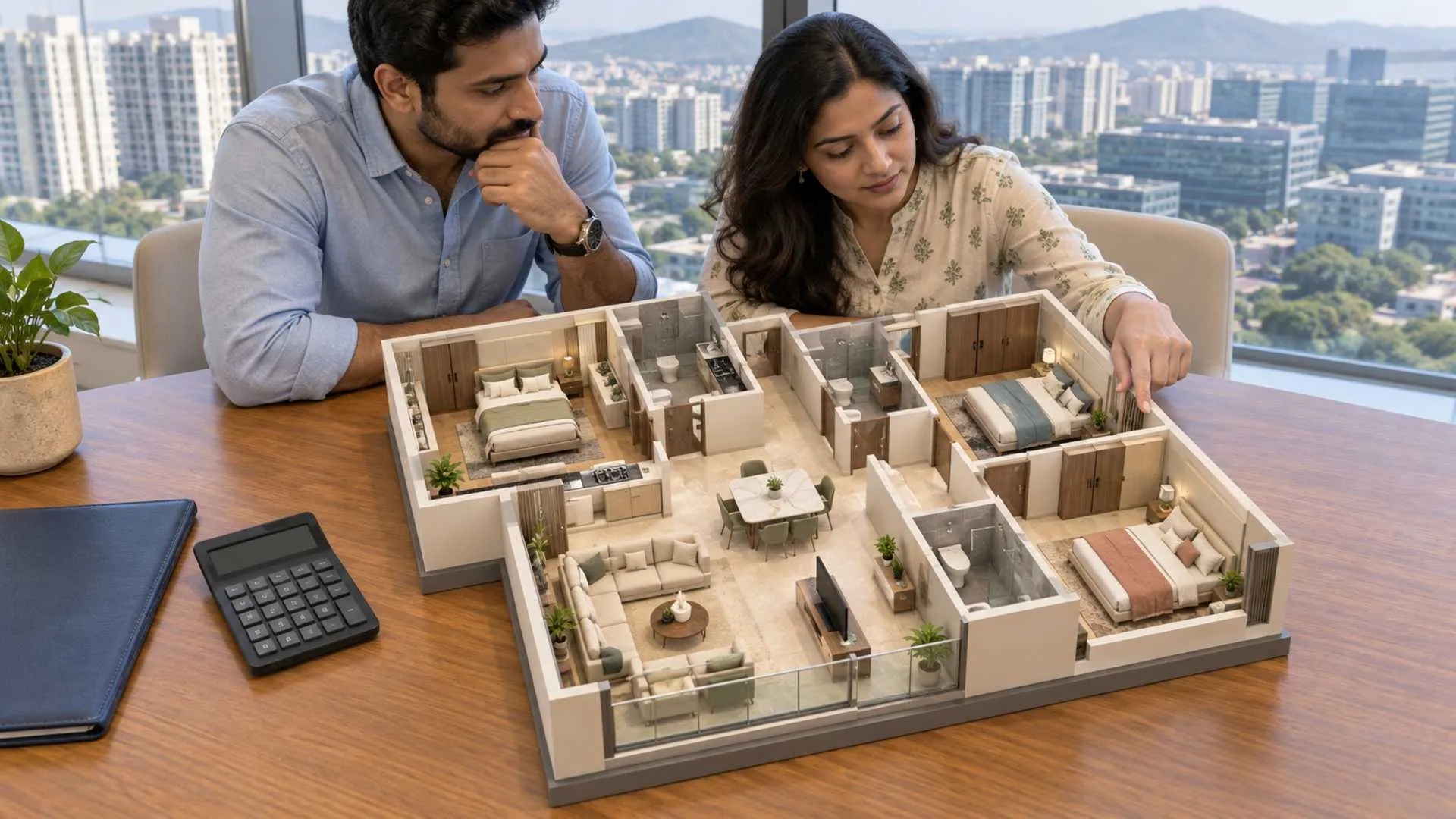
Start with the complete acquisition cost. Add applicable taxes and registration, legal review, brokerage where relevant, loan charges, deposits, interiors, and renovation requirements.
The Ready Reckoner value is a separate consideration from a portal’s asking-price average. Verify the appropriate valuation zone, property category, and current assessment instead of applying one quoted Akurdi figure to every building.
For a ready-to-move apartment, inspect the actual home and applicable completion or occupancy documentation. For an under-construction project, review the exact phase, approved plans, progress, and contractual possession obligations.
A focused site visit should answer four questions:
- Can the household commute conveniently before the extension opens?
- Is the route to the planned station practical?
- Does the apartment offer the space and condition expected for its price?
- Is the full purchase cost affordable without depending on future appreciation?
Visit during working-hour traffic and after dark. Examine noise, crossings, parking, access for older family members, and the condition of the approach road.
For rental investment, ask about achieved rents in comparable apartments and the time taken to find tenants. Planned metro access may help attract interest, but it should not replace evidence of present demand.
Akurdi property rates in 2026 deserve attention because the neighbourhood is gaining a tangible transport upgrade. The stronger purchase decision combines that future benefit with a suitable apartment, verified documentation, and a sensible price today.
Following the PCMC–Nigdi corridor? Explore RealtyConnect for locality guides, project updates, and real estate insights before planning your next move.