3 BHK vs 4 BHK Pune: Is the Upgrade Worth It?
3 BHK vs 4 BHK Pune 2026: Price, Space & Value Guide
SHARE:
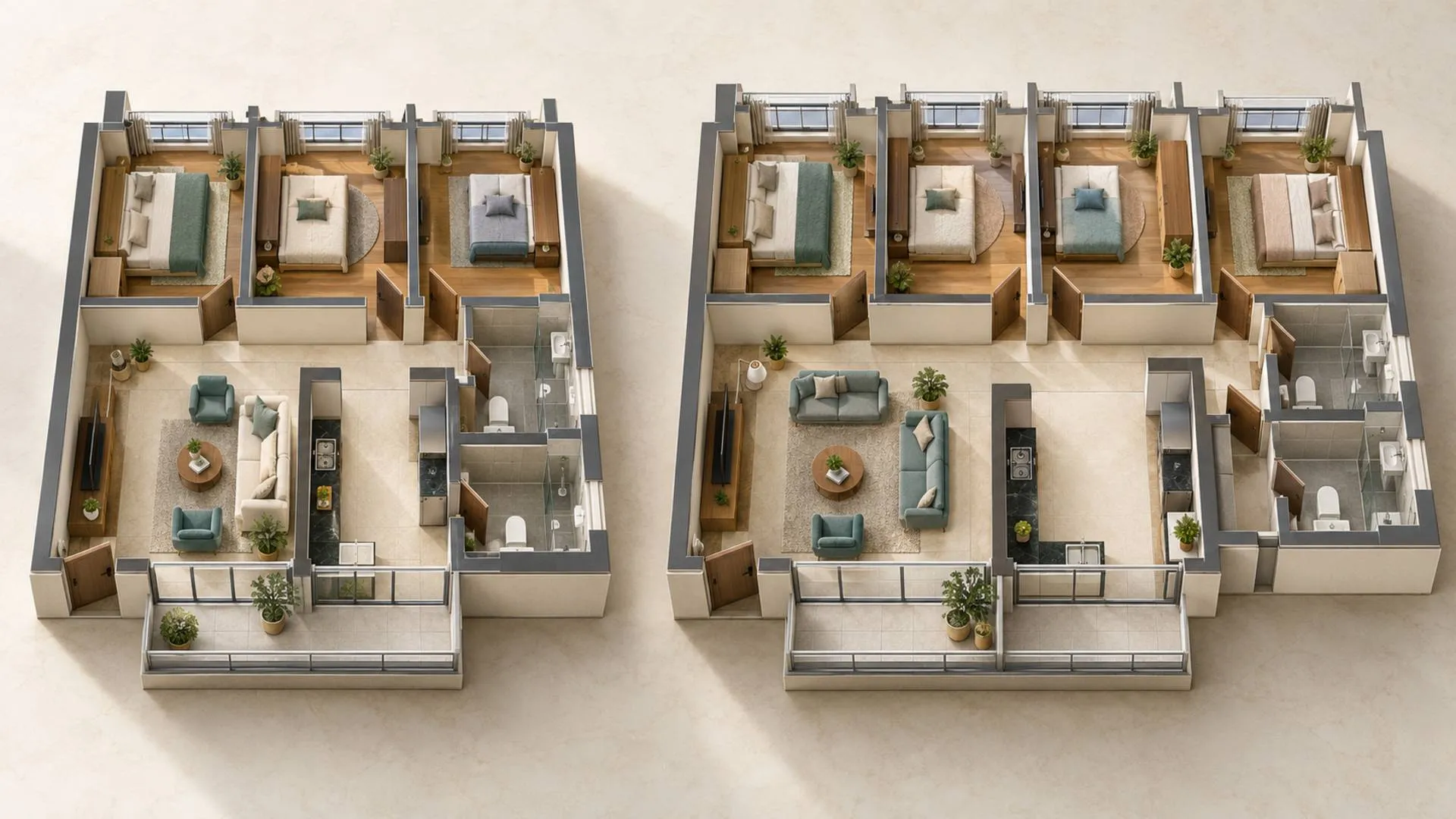
The fourth bedroom, then, has a tempting sales pitch. It offers up a quiet office, a comfortable room for parents and somewhere for guests to stay without evicting the children. Then there’s the matter of the price difference and suddenly, an extra room becomes a huge financial decision.
The dilemma for buyers comparing a 3 BHK flat in Pune with a 4 BHK is how to separate the useful additional space from a wider luxury upgrade. A higher quotation may include larger bedrooms, more bathrooms, a sprawling deck, additional parking or a different building entirely.
That makes the 3 BHK vs 4 BHK Pune comparison more complex than simply counting up the number of bedrooms. How much better would the larger apartment be for one’s household and does that improvement justify the sheer total ownership costs?
The supplied developer guides offer useful examples, but their price and return estimates vary. They do, however, offer a practical conclusion: that the fourth bedroom earns its value by its use, layout and affordability. Bedroom count alone can’t make it a better investment.
Is a 4BHK worth buying over a 3BHK in Pune, what is the actual price difference?
A 4 BHK can justify its premium when a family needs another permanent bedroom, a separate home office, or regular guest accommodation. Pune has no single price gap: location, carpet area, project positioning and specifications change the comparison. Request quotations for comparable units within the same project to identify the actual upgrade cost.
The price difference: are you buying another room or another category?
A published Baner comparison shows why buyers need to look beyond the numbers.
NOW Realty’s 2026 investment guide gives the following indicative figures:
| Published comparison | 3 BHK apartment | 4 BHK luxury flat |
| Baner ticket size | ₹1.85–₹2.65 crore | ₹3.80–₹5.75 crore |
| Monthly rent | ₹60,000–₹85,000 | ₹1.05–₹1.85 lakh |
| Annual rental yield | 3.5%–4.5% | 3.0%–3.8% |
These are developer-published estimates, not independently verified citywide averages or guaranteed returns. The table explicitly describes the four-bedroom category as a luxury flat. It therefore does not isolate the price of adding one bedroom to an otherwise identical apartment.
A separate NOW Realty configuration guide describes a typical premium Baner upgrade of 25%–40%. The difference between these presentations reinforces the need for a defined comparison rather than one headline percentage.
Ask the sales team to quote both configurations on the same basis: comparable floor, possession stage, specifications and payment terms. Request a written breakdown of inclusions and additional charges.
Then ask what changes beyond the fourth room. Does the living area expand? Is the kitchen more practical? Are there extra bathrooms or parking spaces? Is the price partly paying for a view or a lower-density building?
This exercise can reveal a worthwhile premium apartment in Pune. It can also reveal that the upgrade costs far more than the additional space your family needs.
Carpet area decides whether the fourth bedroom delivers
A bedroom label does not tell you whether a room can comfortably accommodate a bed, wardrobe and desk. Nor does it reveal whether the apartment’s passages consume much of the extra area.
Austin Realty’s guide to premium 4 BHK flats in Wakad emphasises room proportions, usable carpet area, privacy and floor-plan efficiency. It identifies Aurus by Austin as a project offering both 3 and 4 BHK residences, making configuration comparison within one development possible.
Project-specific measurements are more useful than assuming every 3 BHK or 4 BHK follows a standard size. NOW Realty’s configuration guide, for example, describes premium Baner 3 BHK homes of approximately 1,100–1,250 sq ft carpet area, compared with around 1,500 sq ft for its four-bedroom Presidential Suite. Those figures describe that developer’s comparison, not all Pune homes.
Consider an illustrative comparison. A 1,250 sq ft 3 BHK priced at ₹2 crore works out to ₹16,000 per carpet sq ft. A 1,600 sq ft 4 BHK priced at ₹2.50 crore works out to ₹15,625 per carpet sq ft.
The larger home is slightly cheaper per square foot, yet requires ₹50 lakh more upfront. Its additional 350 sq ft must still be examined for practical value. These are hypothetical figures, not current property quotations.
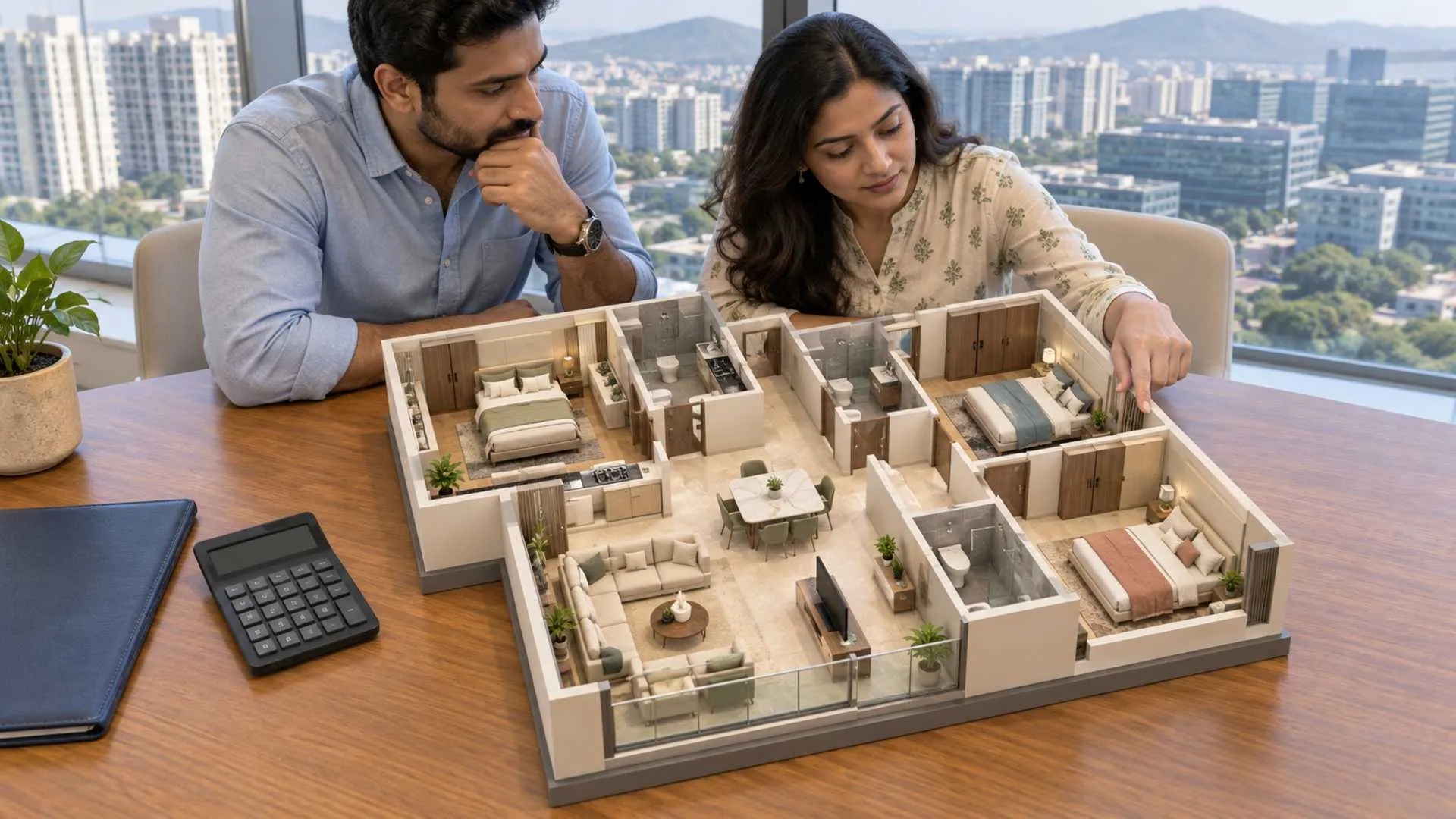
During a visit, place furniture on the plan rather than imagining empty rooms. Check door swings, wardrobe depth, desk placement and bathroom access. Look for a dining area that works when the family is together.
A spacious flat in Pune should support comfortable movement after furnishing. If four bedrooms leave the shared living area cramped, the upgrade may fail the very household it was meant to help.
When family life makes a 4 BHK worth paying for
The strongest case for another bedroom begins with a recurring problem.
Imagine a couple with two children who each need their own room. All three bedrooms are already assigned. If grandparents move in, or one parent needs a permanent office, the household must rearrange existing space.
For this family, another room can resolve a daily conflict. For a couple whose guests visit twice a year, its value may be much smaller.
SOBHA’s apartment comparison highlights family routines, remote work, visiting parents and future adaptability as reasons to consider larger homes. Its guidance also stresses that an efficiently planned 3 BHK can satisfy smaller households without paying for unused space.
A dedicated office is especially useful when work calls regularly interrupt domestic life. But the room needs more than a desk: assess sound separation, ventilation, power sockets and whether it remains available when relatives visit.
For multigenerational living, examine bathroom convenience and the separation between bedrooms and entertaining areas. Another bedroom offers limited privacy if its door opens directly into a busy living room.
Before upgrading, identify the fourth room’s primary purpose:
- A permanent bedroom for parents or another family member.
- A home office used regularly.
- Guest accommodation needed frequently.
- A clear household requirement expected within the next few years.
A room with a defined role is easier to justify than one bought for an uncertain future. Equally, a family likely to outgrow three bedrooms should include the inconvenience of another move in its decision.
The extra bedroom also comes with an extra financial commitment
The advertised price gap is only the starting point. Buyers must also account for acquisition expenses, interiors, financing and recurring outgoings.
Here is an illustrative loan calculation. Suppose a 4 BHK costs ₹50 lakh more than the comparable 3 BHK. If the buyer contributes ₹10 lakh towards that difference and borrows the remaining ₹40 lakh over 20 years at an assumed 9% annual interest rate, the additional EMI is approximately ₹35,989.
That represents roughly ₹4.32 lakh in annual repayments. If the assumed rate remains unchanged for the entire term, repayment on the additional loan totals approximately ₹86.37 lakh, including ₹46.37 lakh in interest.
This is a financing illustration, not a current bank quotation or a promise of loan eligibility. It shows why the decision deserves more attention than the sales price alone.
A buyer might comfortably afford that commitment because the larger home solves a long-term need. Another household may find that it restricts education savings, retirement contributions or flexibility during a career change.
Lodha’s apartment-selection guide recommends weighing budget, space requirements, future needs and location together. That approach is particularly useful when comparing a first premium purchase with a more substantial upgrade.
Request the maintenance schedule instead of assuming every charge rises directly with carpet area. Add furnishing, cooling and cleaning costs separately. A fourth room intended as an office may need different spending from one fitted as a guest suite.
The appropriate budget is the amount that remains comfortable after these commitments, not simply the maximum loan available.
Investment returns and location can change the verdict
A 4 BHK may command more rent in rupees while producing a lower percentage yield. This distinction matters when choosing an investment flat in Pune.
For illustration, a ₹2 crore apartment renting for ₹65,000 monthly produces a 3.9% gross annual yield. A ₹3 crore apartment renting for ₹90,000 monthly produces 3.6%. The larger apartment earns more monthly income, but less rent relative to its purchase price.
Both examples exclude vacancy, acquisition expenses and ownership costs. They are calculations, not market forecasts.
For resale, distinguish a higher selling price from a better return or faster exit. SOBHA’s guide describes 3 BHK homes as appealing to a broader market and 4 BHK homes as serving a more specialised premium audience. Actual outcomes still depend on location, condition and pricing.
Claims that four-bedroom homes will appreciate at a fixed annual rate should therefore receive close scrutiny. Ask for comparable completed transactions, their dates and the basis of comparison. A premium paid today can absorb much of an expected future gain.
Location introduces another trade-off. A 3 BHK near daily destinations may offer better practical value than a larger apartment requiring difficult journeys.
A 3 BHK vs 4 BHK Baner comparison should remain focused on comparable buildings and routes. Buyers considering a 4 BHK in Wakad, a 3 BHK in Kharadi, or homes in Hinjewadi, Hadapsar, Viman Nagar and Bavdhan should apply the same method: test the actual journey from each project entrance to work, school and essential services.
A larger home and a better location are both valuable. Your household must decide which improvement it will experience more often.
Could a 3.5 BHK be the smarter middle ground?
For families seeking an office or study rather than another full bedroom, a 3.5 BHK deserves consideration. The “half” room varies by project, so check its dimensions and intended use.
Goel Ganga Developments’ configuration guide describes this flexible-space approach. At Ganga Avanta on Magarpatta Road, it lists 3.5 BHK carpet areas of approximately 1,438–1,490 sq ft and 4 BHK options of approximately 1,688–1,715 sq ft.
Those examples make the alternative tangible. Buyers can examine whether the smaller flexible room meets their requirements before paying for the larger configuration.
Check whether it accommodates the planned desk or bed, provides ventilation and has sufficient privacy. Labels such as 3.5 BHK and 4.5 BHK should prompt a floor-plan inspection rather than assumptions about functionality.
The verdict on 3 BHK vs 4 BHK in Pune is ultimately personal. Choose the larger home when its additional space solves a lasting need and its cost leaves financial breathing room. Choose the 3 BHK when it already fits the household and preserves a preferred location or budget.
Before booking, compare two actual homes, not two bedroom labels. Request complete quotations, furnished-layout plans and recurring charges, then visit with the people who will live there.
Ready to shortlist a family flat in Pune? Use RealtyConnect to begin your search, and compare the homes against your budget, commute and room requirements before scheduling site visits.