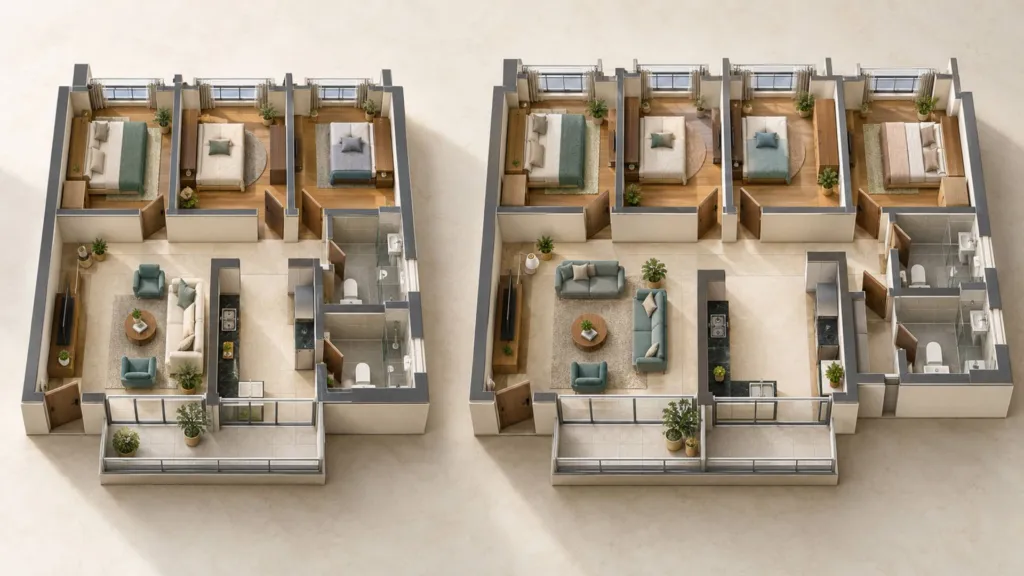
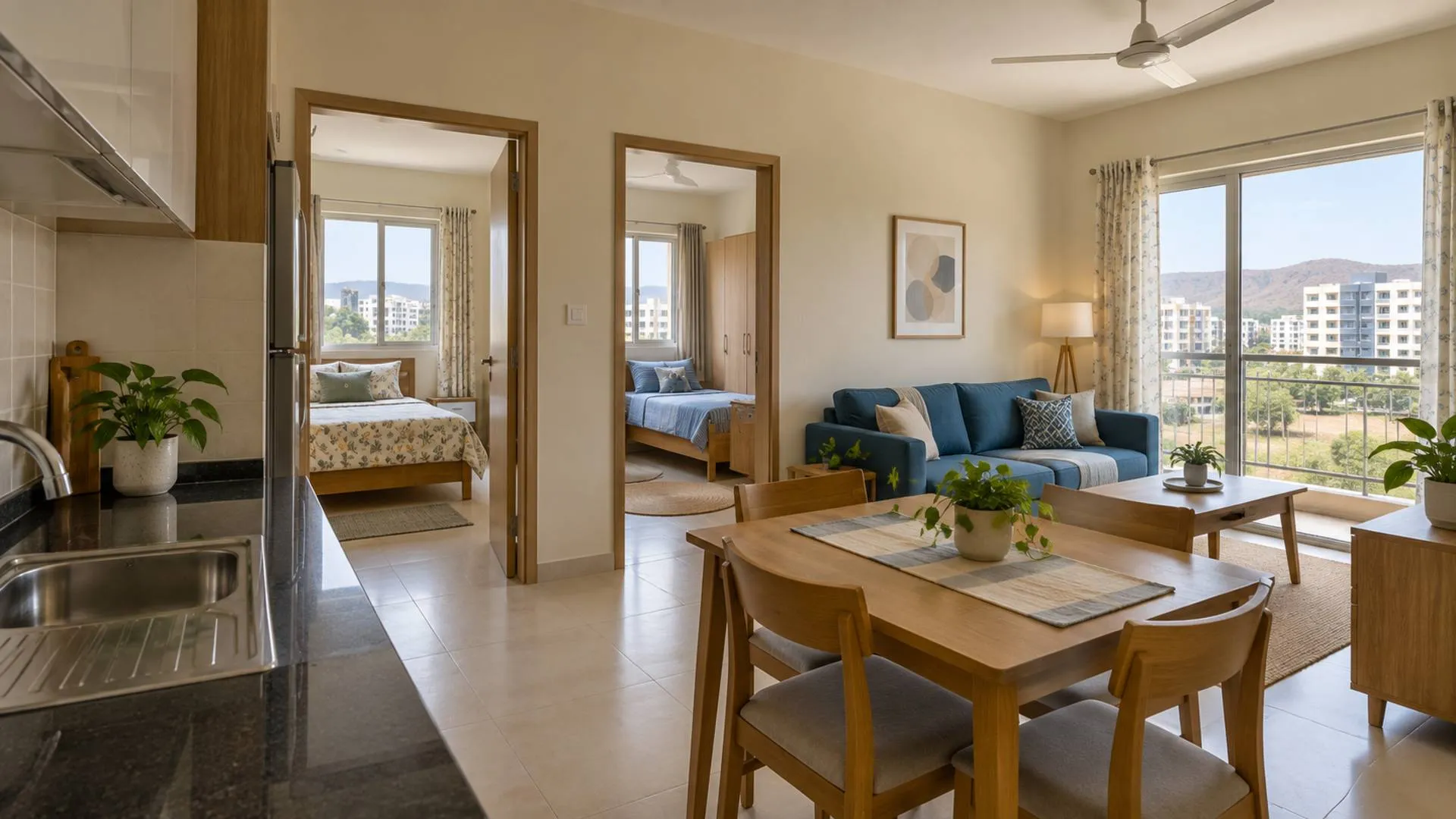
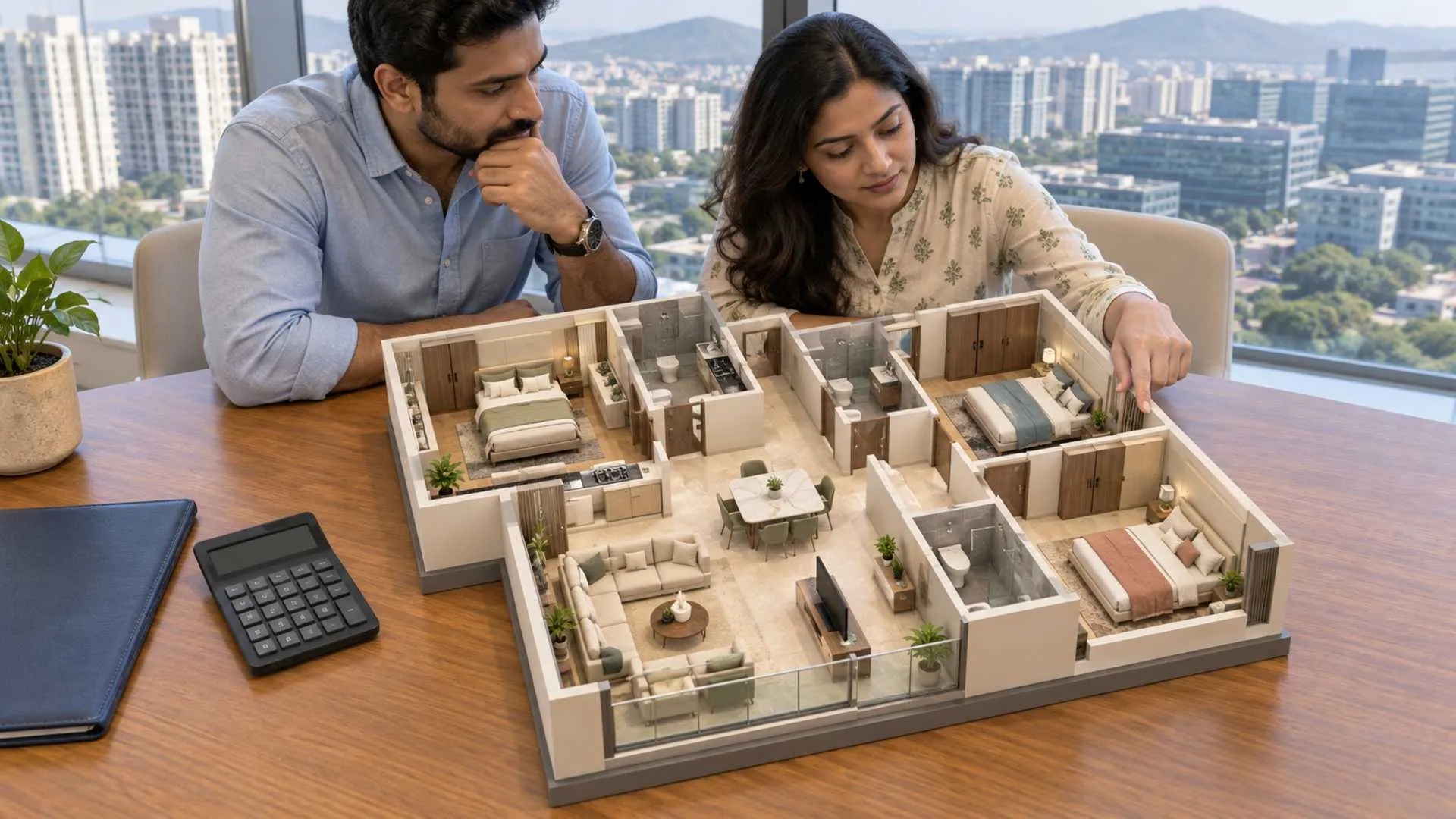
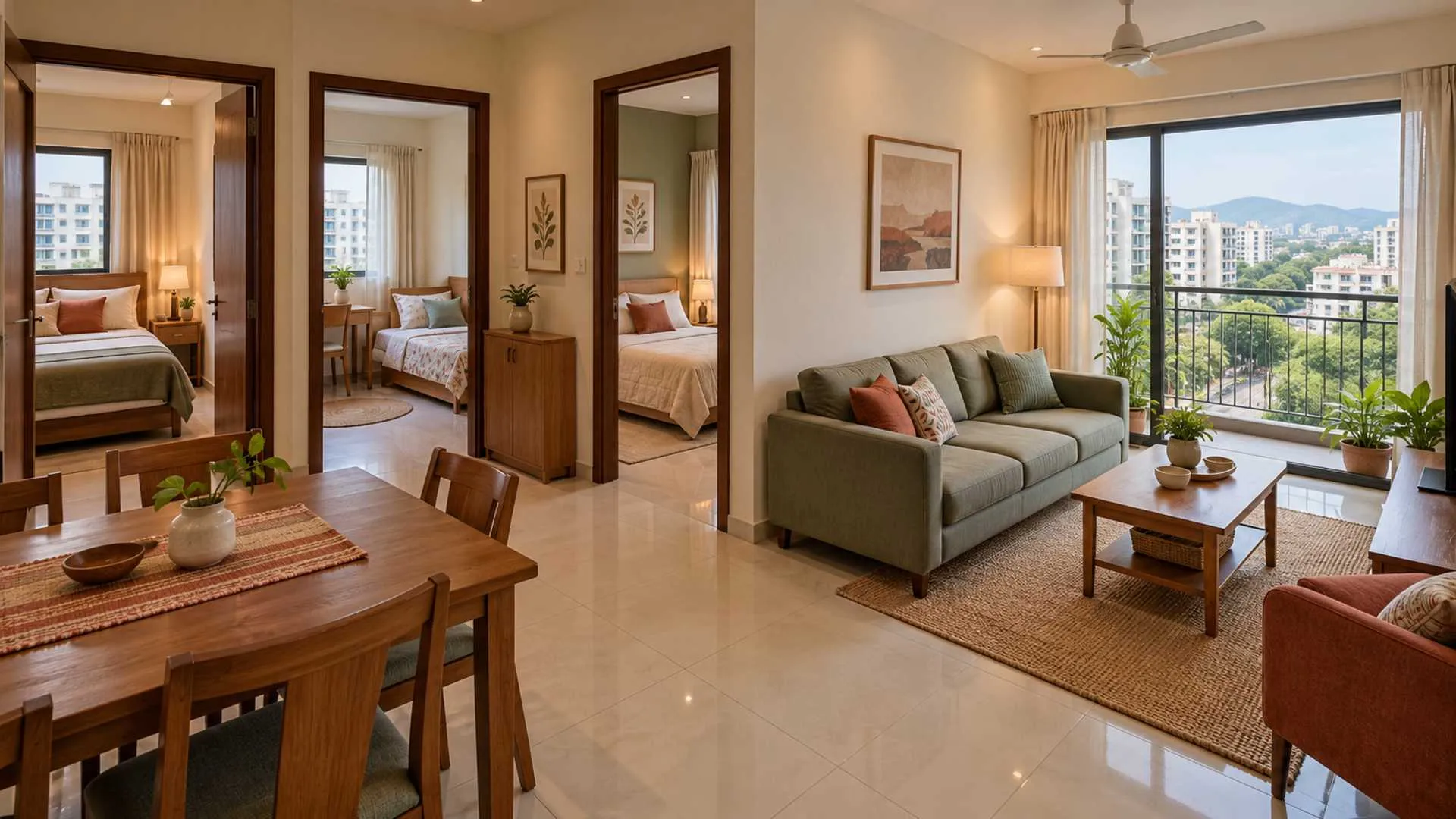
Pune Investment in 2026: Should You Choose 1 or 2 BHK?
1 BHK vs 2 BHK Pune Investment 2026: Which Is Better?
SHARE:

The smaller flat can provide a higher percentage yield. The larger flat can garner higher rent. Neither condition alone advises the buyer on which property to choose in the Pune property market.
That is the fundamental conflict between 1 BHK and 2 BHK Pune investment options for 2026. A novice buyer can opt for the lower initial outlay and reduced maintenance costs. Another purchaser can select the higher planned expenditure for an additional bedroom that suits nuclear families, remote work and leaves room for personal use in the future.
The given comparisons from developers and property sites continuously remark upon this dilemma. Yet, their appraisal remains centered around the buying advisability rather than the yield performance as an overall Pune market statistic. Their analysis informs the buyer’s decision, yet the investment choice demands more focused evidence.
The best investment flat in Pune is the one that promises the most plausible percentage yield at the given buying price, not the most persuasive selling plan.
Is a 1 BHK or 2 BHK flat a better investment in Pune in 2026?
A well-priced 1 BHK can suit investors prioritising a lower entry cost and rental yield. A 2 BHK can suit buyers seeking greater household flexibility and a broader potential tenant and resale audience. Neither configuration automatically wins: compare total acquisition cost, achievable rent, vacancy, expenses and local resale evidence before deciding.
The entry-price advantage: where a 1 BHK makes its case
A smaller purchase can leave an investor with more money for furnishing, repairs and periods without rent. That financial breathing room deserves as much attention as the apartment itself.
In its March 2026 comparison, Kumar World gives indicative Pune price ranges of ₹30–60 lakh for 1 BHKs and ₹50–90 lakh for 2 BHKs. These are broad developer-published ranges, not verified transaction averages or quotations for every locality. Their overlap nevertheless illustrates why a ₹50–70 lakh investor may encounter both configurations.
Namrata Group’s July 2026 Talegaon comparison presents a different budget picture: approximately ₹18–30 lakh for 1 BHKs and ₹33–48 lakh for 2 BHKs, depending on the project and location. These figures apply to its Talegaon discussion and should not be extended to Hinjewadi, Wakad or Kharadi.
The decision therefore involves both configuration and location. A buyer might compare a smaller flat near a particular workplace with a larger apartment in another market. The second property’s additional room only improves the investment if tenants value its location and can afford the required rent.
A lower price helps when it reduces financial strain without weakening the rental proposition. Inspect the layout, building condition and actual journey to likely employment destinations before treating a cheap flat as good value.
Rental yield versus rental income: two different winners
A 2 BHK can generate more monthly rent while earning a lower percentage return on the purchase.
Magicbricks’ configuration explainer describes the logic behind a compact home’s potential yield advantage: a smaller initial investment can make annual rent a larger proportion of the money spent. This is a useful principle, though the article does not set Pune-specific yield bands for either configuration.
Consider the following illustrative comparison. All prices, rents and expenses are assumptions, not live listings or Pune market averages.
| Measure | Illustrative 1 BHK | Illustrative 2 BHK |
| Property price | ₹45 lakh | ₹75 lakh |
| Total acquisition and setup cost | ₹48 lakh | ₹80 lakh |
| Monthly rent | ₹20,625 | ₹28,125 |
| Annual rent at full occupancy | ₹2,47,500 | ₹3,37,500 |
| Gross yield on total cost | 5.16% | 4.22% |
| Rent collected with one vacant month | ₹2,26,875 | ₹3,09,375 |
| Assumed annual owner-paid expenses | ₹30,000 | ₹42,000 |
| Net rental income before financing and income tax | ₹1,96,875 | ₹2,67,375 |
| Net yield before financing and income tax | 4.10% | 3.34% |
In this example, the 2 BHK earns ₹7,500 more each occupied month, but the 1 BHK produces the higher yield on total cost.
Using only the assumed property prices gives gross yields of 5.5% and 4.5%. Including acquisition and setup spending reduces both figures. That change explains why comparing advertised yield percentages without checking their denominators can distort an investment decision.
The formulas are straightforward:
Gross rental yield = annual rent ÷ total acquisition cost × 100.
Net rental yield = rent collected minus owner-paid operating expenses, divided by total acquisition cost, multiplied by 100.
For a financed purchase, assess cash flow separately by allowing for debt payments. Rental yield alone does not show whether the property can support its EMI.
Why the second bedroom can matter at resale
A 2 BHK offers uses beyond sleeping space. The additional room can accommodate children, a guest, a study or a home office.
Namrata Group’s May 2026 configuration guide argues that this flexibility broadens the potential tenant and buyer audience to include couples and small families. Kumar Builders’ 2026 outlook similarly positions two-bedroom homes around functionality and family requirements. These are developer assessments, rather than proof that every 2 BHK resells faster.
The sources also reveal why investors should be cautious about blanket liquidity claims. Namrata’s Talegaon article describes a narrower resale audience for 1 BHKs, while Nirman Developers argues that their lower price can attract buyers seeking an affordable entry. The differing emphasis reinforces the need to investigate the local market.
Ask how many comparable homes are competing for buyers in the same society. Examine condition, documented area, recurring charges and the difference between asking prices and completed deals where reliable evidence is available.
Resale liquidity means being able to sell at an acceptable price within your required timeframe. A larger potential audience helps only if the apartment is priced appropriately and meets that audience’s needs.
A well-located 1 BHK can therefore deserve consideration alongside a 2 BHK. Conversely, an extra bedroom cannot compensate for an awkward layout or an unrealistic exit price.
Hinjewadi, Kharadi or a budget locality: choose the tenant first
Before selecting a property in Pune, identify who is likely to rent it.
Nirman Developers’ investment-versus-end-use article distinguishes compact homes near employment and educational destinations from larger homes that accommodate family requirements. Its useful message is to connect configuration with the intended occupant rather than treating all Pune tenants as one group.
For a 1 BHK vs 2 BHK Hinjewadi investment comparison, examine the office phase, access route and competing rental stock. A tenant’s actual workplace may make one society more convenient than another within the same broad locality.
For Kharadi, apply the same test to the exact office destination. Compare realistic rents for similar homes with the full acquisition price. Employment proximity can support the proposition, but a high purchase price can still weaken the yield.
Wakad and Punawale require property-specific comparisons as well. Check transport options, everyday services and the costs a tenant will face after adding maintenance to rent. Do not assume that a “near Hinjewadi” description establishes an equivalent journey.
For Wagholi, Moshi, Mundhwa, Undri and Talegaon, begin with actual local rental evidence. The important question is whether your chosen configuration serves a tenant group willing to pay the rent needed for the investment to work.
Namrata’s Talegaon article connects its rental discussion to nearby industrial employment. That provides a different investment context from a premium IT-corridor apartment; investors should investigate the relevant workplaces and demand independently.
When evaluating Saheel Properties in PCMC or ARV New Town in the southern corridor, obtain current configuration-specific information. The supplied references do not verify project-level yields for these brands.
Furnishing, vacancy and the cost of upgrading later
Furnishing can change the rental calculation, but the extra rent must justify the expense.
Suppose furnishing costs ₹3 lakh and increases achievable rent by ₹4,000 a month. The simple recovery period is 75 occupied months, before repairs, replacements, vacancy and financing costs. These are assumed figures, not a forecast or a standard Pune furnishing premium.
Obtain comparable furnished and unfurnished rents within the same project or nearby equivalent buildings. A percentage uplift drawn from another locality may not apply to your apartment.
Vacancy also deserves a realistic allowance. Ask how long comparable properties remain available and whether the target tenant group moves frequently. A higher advertised rent is less valuable if the property sits empty waiting for someone to pay it.
The upgrade question introduces another set of costs. Buying a 1 BHK now and moving to a 2 BHK later can be sensible when it matches current finances. However, the plan involves more than the eventual price difference.
Allow for acquisition expenses on the first purchase, costs of selling, relocation, possible tax consequences and a second purchase’s transaction expenses. If you keep the 1 BHK as a rental, reassess whether you can carry both properties during vacancy.
Namrata Group’s earlier comparison emphasises future household needs when choosing a configuration. For an investor who may eventually occupy the flat, that consideration belongs alongside the yield calculation.
The ₹50–70 lakh investor’s decision
For a first-time investor, the purchase should leave room for surprises.
Treat ₹50–70 lakh as a total investment budget before deciding how much can go towards the flat itself. Obtain a written cost sheet, estimate essential setup spending and retain funds for vacancy or repairs.
Then compare a shortlist using the same assumptions:
- Entry cost: purchase price plus acquisition and setup expenses.
- Income: comparable achievable rent, with a vacancy allowance.
- Ownership: maintenance, repairs and other owner-paid expenses.
- Exit: competing supply, resale evidence and likely buyer needs.
Compare possession status separately. For an under-construction property, rental income cannot begin before the home is legally available and ready to let. A ready-to-move resale flat allows physical inspection, but its documents and condition still need scrutiny.
Request the relevant registration details, approved plans, documented carpet area and possession records. The development’s name or a configuration label cannot establish legal status, quality, or returns.
In the 1 BHK vs 2 BHK Pune investment comparison for 2026, choose a 1 BHK when its verified economics and lower commitment fit your goals. Choose a 2 BHK when the additional cost is supported by rental evidence, household flexibility and a credible exit plan.
Before booking, build a one-page investment comparison for three actual flats. Follow RealtyConnect for more property explainers, and ask every seller to support the return story with a written price, realistic rental comparables and complete documents.