43% of US Builders Cut Prices: What October’s Survey Reveals
43% of US Builders Cut Prices in October 2026
SHARE:
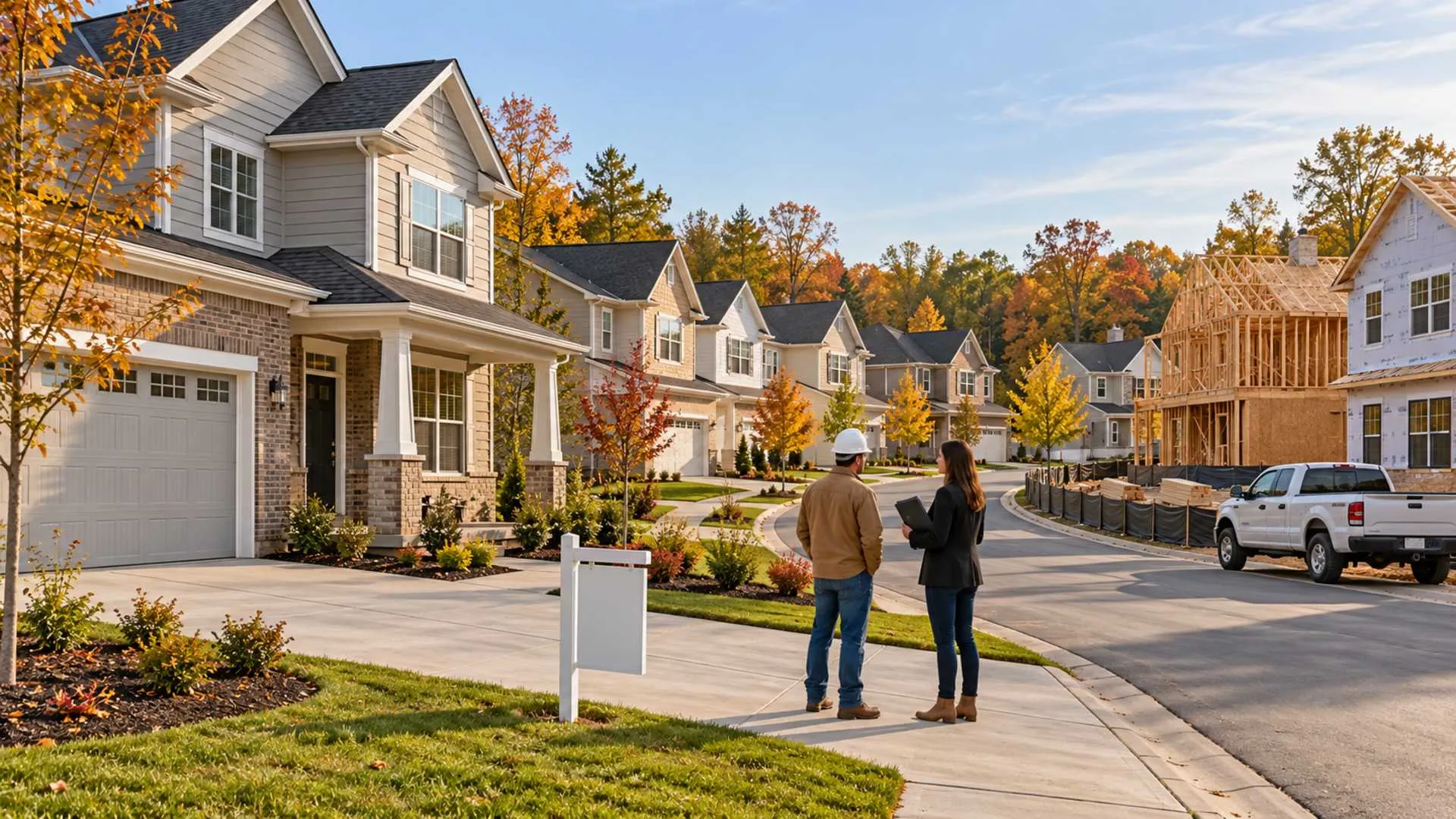
A lower asking price usually sounds like good news for homebuyers. In the US housing market, October’s discounts arrive with a complication: borrowing remains expensive enough to keep prospective purchasers on the sidelines.
Some 43% of surveyed US builders reported cutting prices in October 2026, according to the National Association of Home Builders. That was the highest proportion recorded during the 2020–2026 period. Meanwhile, builder confidence fell to its weakest level since June 2012.
The combination captures the pressure facing new-home developers. They are trying to make purchases more attractive while managing their own financing, construction and workforce costs.
For buyers, October’s NAHB survey points towards opportunities to negotiate. For builders, it raises a harder question: how much can pricing and incentives achieve when the monthly mortgage payment remains the main obstacle?
Why have 43% of US builders cut prices?
Builders are responding to affordability pressures and weaker buyer traffic. October’s NAHB survey recorded confidence at 29, with 43% reporting price reductions and 65% using sales incentives. The average reported reduction was 6%. These figures describe surveyed builders’ actions, not a 6% decline in all US home prices.
The distinction is essential. A greater share of builders offering discounts tells us that selling conditions have become more difficult. It does not mean every development offers the same discount, or that national property values have fallen by the same amount.
October’s NAHB survey: The numbers behind the headline
The NAHB/Wells Fargo Housing Market Index measures sentiment among builders of newly constructed single-family homes.
As Fordaq explains in its October report, the index combines assessments of current sales, expected sales over the next six months and prospective-buyer traffic. A reading above 50 means more builders consider conditions good than poor.
October’s results showed deterioration across all three components.
| Survey measure | October 2026 reading | Monthly change |
| Overall Housing Market Index | 29 | Down 3 points |
| Current sales conditions | 33 | Down 2 points |
| Sales expectations for the next six months | 32 | Down 5 points |
| Prospective-buyer traffic | 18 | Down 5 points |
Source: Fordaq’s account of the NAHB/Wells Fargo survey. These are sentiment readings, rather than percentages of homes sold or measures of construction output.
The Wall Street Journal also reported the overall reading of 29 as the lowest since June 2012. Its coverage linked the decline to high mortgage rates, elevated costs and worsening labour conditions.
An index reading of 29 does not mean that home sales fell 29%. It indicates that surveyed builders’ assessment of market conditions remains well below the survey’s positive threshold.
More builders are discounting, but the average cut is holding steady
The recent direction is clear. NAHB’s September release reported that 35% of builders cut prices in August, rising to 38% in September. October’s figure increased further to 43%.
That is an eight-percentage-point increase over two months.
However, the average reported price reduction remained at 6% for the seventh consecutive month. October therefore showed a widening use of discounts without an increase in the average reported reduction.
Sales incentives tell a related story. The Times of India’s October 20 coverage reported that 65% of builders used incentives. October was the nineteenth consecutive month in which the share stood at least at 60%. That does not mean the figure was exactly 65% throughout those nineteen months.
Together, the figures suggest that concessions have become a persistent part of selling new homes.
For buyers, the advertised price is consequently only the beginning of the comparison. The financing terms, conditions attached to an offer and complete cost of ownership can determine whether a concession provides meaningful value.
Why mortgage rates above 7% can outweigh a discount
The affordability problem becomes clearer when translated into a monthly payment.
Freddie Mac’s October 15 release put the average 30-year fixed mortgage rate at 7.40%. This is a dated market benchmark, rather than a rate available to every borrower.
Consider an illustrative $500,000 home purchased with a 20% deposit. The mortgage would be $400,000.
Over 30 years, principal-and-interest payments would be approximately:
- $2,398 a month at 6%.
- $2,770 a month at 7.4%.
- $2,603 a month at 7.4% if the home price fell 6% and the buyer still borrowed 80% of the purchase price.
These calculations exclude taxes, insurance, association fees and other costs. They illustrate financing mechanics, rather than a prediction for a particular property.
Even after the hypothetical price reduction, the payment remains around $205 above the original 6% borrowing scenario.
A discounted home can still feel less affordable when the interest rate rises. That helps explain why price cuts and weak buyer traffic can appear together.
Additional evidence points in the same direction. In its October 21 newsletter, Calculated Risk cited Mortgage Bankers Association figures showing unadjusted purchase applications 18% below a year earlier for the week ending October 16. Mortgage applications and builder sentiment measure different things, but both indicated pressure on demand.
What incentives should buyers examine?
Mortgage-rate buydowns are one documented response. NAHB’s August new-home sales release identified them among the incentives builders use to support sales.
When comparing offers, buyers should establish whether a proposed rate benefit is temporary or lasts for the loan term. They should also ask whether the offer requires a particular lender, deposit, property, or completion date.
A useful comparison requests written alternatives: the purchase price with the incentive, the price without it, and the full financing terms under each option.
Where closing-cost assistance or upgrades are offered, ask what those benefits replace and how they have been valued. An upgrade matters most when it is something the buyer would otherwise choose to purchase.
Judge the complete transaction, including the payment after any temporary benefit ends.
This also gives builders a practical way to strengthen their offer. Clear pricing and understandable finance illustrations can help purchasers assess affordability more effectively than an oversized discount headline.
Builders face pressure on both demand and construction costs
Weak demand does not automatically make homes cheaper to produce.
The Times of India reported rising construction-loan, material and diesel costs alongside labour shortages. It also relayed NAHB’s account of immigration-enforcement activity disrupting work in some markets. These are reported industry pressures; the survey does not quantify how much each factor contributed to every builder’s decision.
This creates a difficult balance. Reducing prices may help move inventory, while higher production costs restrict the room available for further concessions.
The outlook consequently extends beyond this month’s sales campaign. In its October 1 assessment, NAHB warned of a second consecutive annual decline in single-family homebuilding during 2026, with signs of further weakness in 2027.
A subsequent Scotsman Guide report, covering chief economist Robert Dietz’s outlook, put the projected production decline at 4–5% in 2026 and about 3% in 2027. These are forecasts, rather than completed-year results.
What does this mean for global and Indian real estate?
October’s survey describes US new-home builders. It does not establish that Indian developers will follow the same pricing path.
The useful international lesson concerns affordability. Buyers respond to the combined burden of the deposit, monthly payment and ownership expenses. A reduction in the advertised property price may solve only part of that problem.
Indian buyers can apply that principle when comparing festive offers, payment plans or finance-linked promotions. Request the complete cost sheet and examine what the concession changes over the full transaction.
For investors considering US property, the survey provides market context. A purchase still requires local evidence on comparable prices, achievable rents, recurring expenses and resale demand.
The finding that 43% of US builders cut prices reveals a market working harder to convert interest into sales. October’s survey makes negotiation worth exploring, while leaving the affordability calculation firmly in the buyer’s hands.

FAQs:
 More US Homes, Fewer Contracts: Why Buyers Hesitate in 2026