

Can Empty Office Towers Become Homes? The Global Conversion Experiment
Can Empty Office Towers Become Homes? The Global Conversion Experiment
SHARE:
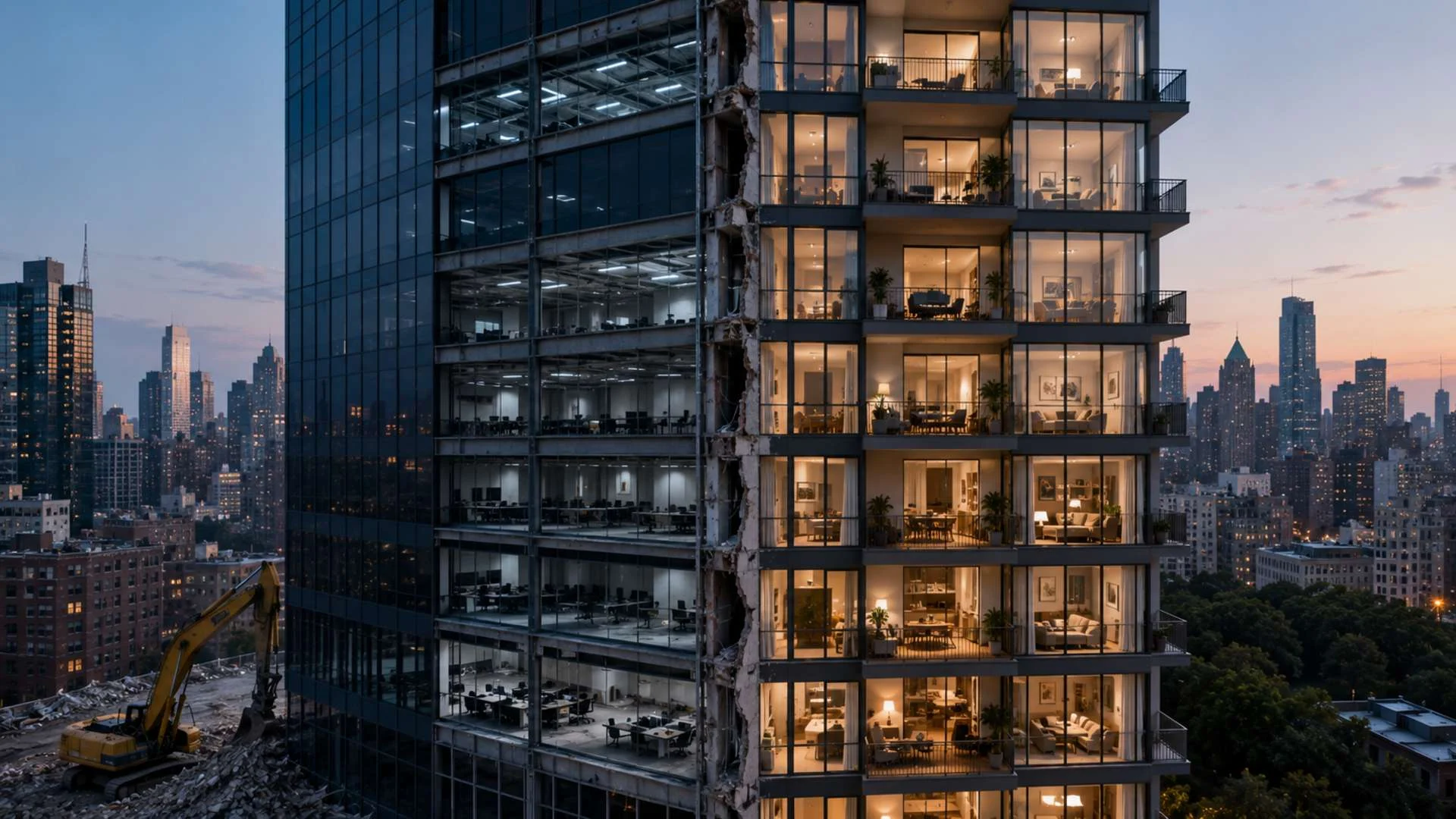
What happens when a city has too many office and not enough homes?
Developers from New York to Dallas are turning to a more radical solution: instead of demolishing a vacant office tower, make apartments out of it by gutting the cubicles.
The office tower residential conversion global experiment 2026 sits at the intersection of two post-pandemic problems: underused offices and expensive housing. But turning a boardroom into a bedroom is a lot harder than just changing the furniture. Brookings latest 2026 research finds that office-to-residential conversion works in some markets, but in most places the economics still do not add up without the right building, purchase price and policy environment.
Can an office building really be converted into apartments?
Yes. Office buildings can become apartments through adaptive reuse, but only certain towers are good candidates. Floor-plate depth, windows, plumbing, elevators, zoning, structural condition and conversion costs determine whether the transformation is financially and physically viable.
Wall Street Has Already Turned Boardrooms Into Bedrooms
The experiment is no longer theoretical.
New York’s One Wall Street, the Art Deco former office and banking tower, completed a major adaptive-reuse transformation into 566 residences. It has been described as the largest office-to-condominium conversion in New York City at the time of completion.
Dallas offers another striking example. The former First National Bank Tower reopened as The National, a mixed-use development incorporating 324 luxury apartments alongside offices, retail and a hotel.
These projects demonstrate why office buildings converted into apartments through adaptive reuse have captured developers’ attention. Instead of destroying an existing structure and starting again, they can preserve the building’s frame, elevators and architectural identity.
Urban Land Institute reporting has cited conversions as potentially 15–20% less expensive than comparable new apartment construction in some cases, while also offering faster completion and lower embodied-carbon impacts.
So why isn’t every empty tower becoming housing?
The 35-Foot Problem
The biggest enemy of an office conversion may be the distance between a window and the building’s core.
Modern offices often have huge floor plates because employees can work under artificial lighting far from windows. Apartments are different. Bedrooms and living spaces generally need practical access to daylight and ventilation.
ULI says a window-to-core depth of around 35 feet (11 metres) is particularly favourable. Gensler’s Steven Paynter has said only about 25–30% of buildings his team evaluates are viable for office-to-residential conversion.
Then comes plumbing.
An office floor might have two central restroom blocks. Convert that same floor into 15 apartments and suddenly every unit needs bathrooms, a kitchen, drainage and water connections.
Developers may therefore face:
- New plumbing and mechanical systems
- Windows or light wells
- Fire and residential code upgrades
- Structural alterations
- Zoning or land-use changes
The Center for American Progress notes that large floor plates, fixed windows and insufficient plumbing can make adaptive reuse office residential conversion costs and challenges particularly severe.
In other words, an empty office is not automatically cheap housing waiting to happen.
Why Cities Are Still Obsessed With the Idea
The appeal becomes obvious when viewed from the street.
A half-empty business district can become quiet after 6 p.m. Restaurants lose customers, shops struggle and valuable buildings remain underused. Housing introduces people who need supermarkets, cafés, gyms, schools and services seven days a week.
There is also a sustainability argument. Adaptive reuse preserves much of the carbon already embodied in an existing structure, avoiding some of the emissions associated with demolition and rebuilding. ULI cites a Gensler estimate that reusing a 12-storey building could avoid around 3.3 million pounds of CO₂ emissions compared with replacement.
But office conversions are not a magic solution to housing shortages.
Brookings warns that they are generally a niche housing-supply strategy. Its 2026 study found that in most of six U.S. case-study cities, conversions could not produce housing at anything close to the scale needed to solve the wider shortage.
The experiment is therefore less “convert every office” and more find the buildings where conversion makes extraordinary sense.
Could Mumbai, Bengaluru or Gurugram Be Next?
For India, this is where the story becomes fascinating and speculative.
The office-to-residential conversion global trend in India in 2026 has not yet developed at the scale seen in parts of the United States. Nor should vacant Grade B offices in Mumbai, Bengaluru, Hyderabad, Gurugram or Noida automatically be assumed convertible.
Indian projects would have to navigate local zoning, FSI/FAR rules, building codes, ownership structures, fire regulations and residential approvals. A conversion in BKC or Lower Parel, Mumbai, for example, would depend on the property’s specific planning permissions and economics, not simply office vacancy.
Yet ageing Grade B and Grade C buildings could eventually make adaptive reuse more relevant, particularly where the land is valuable but the existing office product is losing tenants to newer Grade A developments.
The question for India may therefore become: Is an obsolete office building worth more as an office, or as something completely different?
The Skyscraper May No Longer Have One Life
For much of modern real estate, buildings were designed around a single identity: office, hotel, mall or apartment.
That assumption is starting to weaken.
The global conversion experiment suggests the next generation of real-estate value may come from adaptability, how easily yesterday’s workplace can become tomorrow’s home.
Not every empty tower will survive the test. Deep floor plates, expensive plumbing and zoning restrictions will eliminate many candidates.
But One Wall Street and The National have already proved something important: a skyscraper’s original purpose does not have to be its final one.
For Indian developers, investors and city planners watching ageing commercial districts, that may be the bigger opportunity. Before demolishing an obsolete office tower, it may be worth asking what else the building could become.