

Dubai Office Rents Surge 31.5% as Commercial Property Takes Lead
Dubai Office Rents Surge 31.5% as Commercial Demand Rises
SHARE:
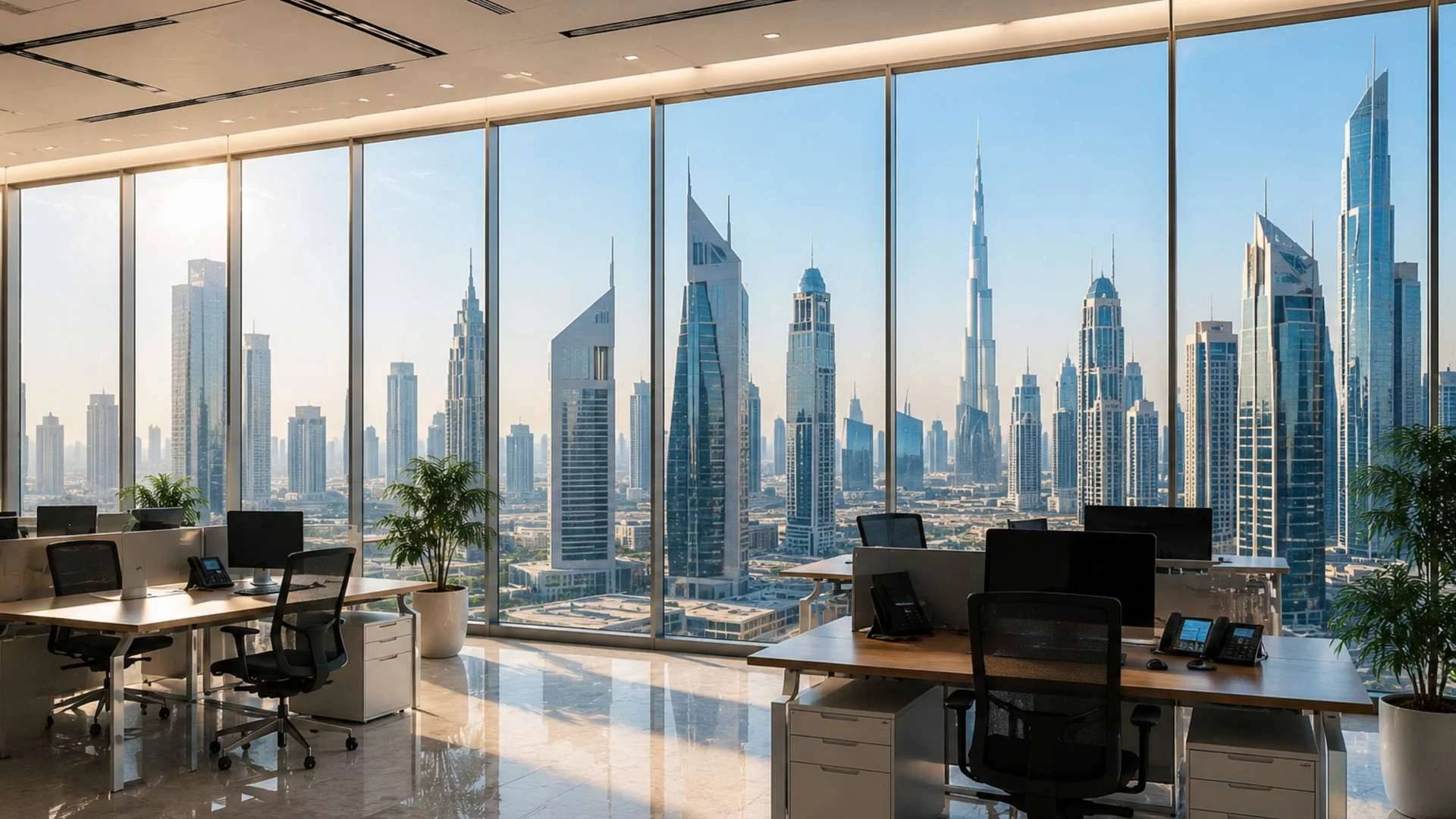
Dubai’s office market is showing a striking divergence from residential real estate in 2026, with limited quality supply and resilient business demand pushing commercial rents sharply higher.
Why did Dubai office rents jump 31.5% in Q2 2026?
Dubai Grade B office rents reportedly surged 31.5% in Q2 2026, while Grade A rents rose 26.2%, highlighting how quickly occupiers are being pushed across the quality spectrum as well-located office space remains scarce. The trend reflects a market where demand is increasingly colliding with limited availability.
The CBRE UAE Q2 2026 market review paints a broader picture of commercial strength. Dubai office rents increased 13% year-on-year, with prime rents rising 16% and occupancy holding at approximately 94%. Abu Dhabi was similarly strong, recording nearly 16% rental growth and around 96% occupancy. (CBRE)
The headline Grade B increase is particularly interesting because older stock is no longer simply competing on affordability. As premium offices become harder to secure, businesses are increasingly considering secondary buildings, allowing landlords of usable Grade B properties to push rents higher.
Supply shortage is driving the Dubai office market
Dubai’s biggest commercial property story is increasingly about availability rather than demand alone. Business districts such as DIFC, TECOM, DMCC, Business Bay and Downtown Dubai continue to attract companies, but the supply of immediately available, high-quality offices remains constrained.
This is not a new phenomenon. CBRE’s Q1 2026 report had already highlighted tight office conditions, with Dubai occupancy at about 95% and average rents up 14% annually. (CBRE)
That momentum has carried into Q2, even as the wider UAE economy faces geopolitical uncertainty. The office market is proving more resilient than the residential segment because companies still need strategically located workplaces, while new supply cannot be added overnight.
Commercial property pulls ahead of residential
The contrast with Dubai residential real estate is becoming harder to ignore. According to CBRE, residential rental growth moderated during Q2, while office and industrial markets continued to benefit from constrained supply and resilient occupier demand. (CBRE)
This creates an increasingly interesting investment equation for Dubai property investors. Residential real estate remains a major part of the market, but commercial property is gaining attention as rental growth, occupancy and business expansion support office fundamentals.
The market is also seeing premium transactions. A reported $33.8 million Vision Tower office transaction illustrates the appetite for strategically located commercial assets.
What happens next?
The big question for H2 2026 is whether Dubai is able to add enough office inventory to cool rental growth without dampening demand.
For the occupiers, this could mean higher costs and earlier leasing decisions. But for investors, offices in good locations with decent occupancy and quality specs could continue to be among Dubai’s most-watched commercial assets.
Anyone following Dubai’s commercial property market will see from the latest numbers that the office sector is not just bouncing back. It is one of the strongest growth stories in the UAE property market.
Looking for the latest property developments, investment opportunities and market movements in Dubai? RealtyConnect AI: Unlock deeper real estate insights with RealtyConnect AI.