Is ₹1 Crore Becoming the New Normal for Urban Homes?
Is ₹1 Crore the New Normal for Urban Homes in India?
SHARE:
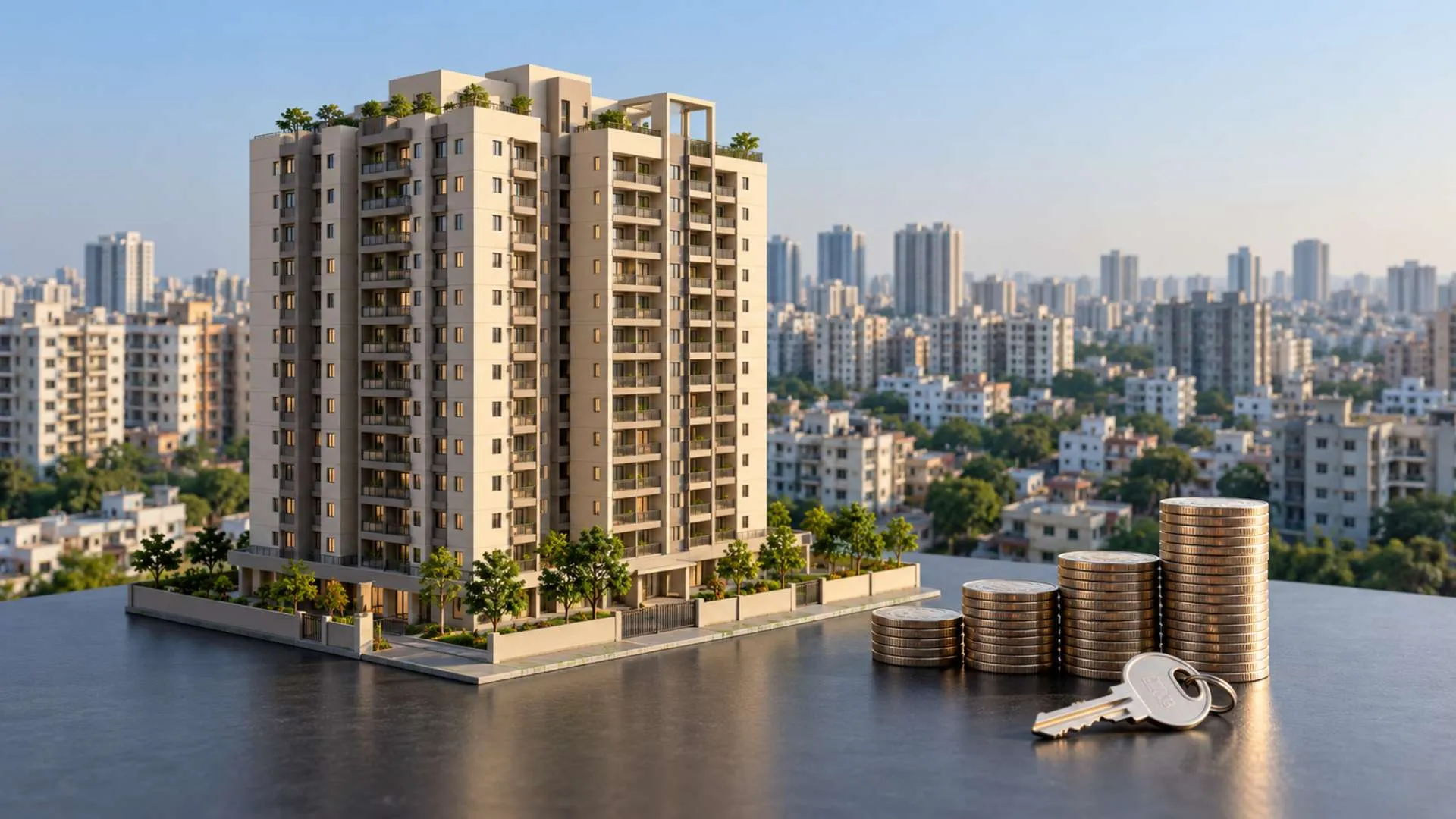


While the word crore used to mean an upgrade, now for many city-based homebuyers, it simply means a baseline. Sometimes it’s not even enough.
The question of whether 2026 is shaping up to be the year when a crore becomes the new normal for urban homes in India can be attributed to a shift in the market. Prices have gone up, and developers are offering high-end homes as well. However, for those looking to buy smaller homes, there are fewer options available in various job hubs.
It should be noted that while a crore is becoming increasingly common in big housing markets, it is not the new minimum price for homes throughout the country. Instead, we need to look at what you get for your money, and how comfortable a family will be funding it.
Is ₹1 crore the new normal for homes in India?
Increasingly, yes, in major metropolitan markets, but not everywhere. Knight Frank reports that homes above ₹1 crore accounted for 54% of sales across eight leading cities in H1 2026. Lower-priced homes remain available, although buyers may need to compromise on location, size, specifications or possession timelines.
Homes Above ₹1 Crore Have Crossed Half of Sales
The housing market premiumisation trend in India is visible in actual transactions.
According to Knight Frank’s H1 2026 India Real Estate report, homes above ₹1 crore represented 54% of sales, compared with 49% in H1 2025, across its eight tracked markets. The shift reflects both higher-income demand and existing housing moving into more expensive brackets after price appreciation.
That distinction matters. A home crossing ₹1 crore does not automatically acquire luxury specifications. Sometimes, the price changes faster than the product.
Separately, JLL’s residential market analysis puts the share of apartments above ₹1 crore at 63% in 2025, up from 53% in 2024 and 46% in 2023. Its tracked markets and methodology differ from Knight Frank’s; the percentages should not be combined into one continuous series.
Both datasets nevertheless point towards premiumisation in Indian residential real estate: a shift in the balance between luxury, premium and mid-segment homes.
For buyers asking whether home prices crossing ₹1 crore in Indian cities are squeezing the middle class, the concern is therefore grounded in a measurable change in the sales mix.
Why Affordable Housing Under ₹1 Crore Is Shrinking
The widely circulated claim that affordable housing supply collapsed 36% between 2022 and 2024 needs a precise definition.
The Economic Times, citing PropEquity, reported that new supply priced at ₹1 crore and below across nine cities fell from 3,10,216 units in 2022 to 1,98,926 in 2024, approximately 36%.
This describes new supply in the affordable and mid-income categories, not a disappearance of 36% of India’s existing lower-priced homes. Nor does ₹1 crore represent a uniform official definition of affordable housing.
The squeeze also involves apartment sizes. Moneycontrol’s August 2026 report, citing NoBroker data, reported that 3 BHK and larger homes accounted for as much as 68% of new supply across Bengaluru, Hyderabad and Chennai.
Developer preference for larger homes can raise ticket sizes even when the price per square foot appears competitive. Buyers seeking two bedrooms may find themselves choosing between a larger loan and a more distant address.
This helps explain why it feels harder to buy a flat under ₹1 crore in Mumbai, Bengaluru or Delhi in 2026. The mismatch concerns the homes available at the right price, in the right location and configuration.
India’s Housing Affordability Crisis: Prices Versus Incomes
Can the middle class buy a home in India in 2026? The answer depends on income, savings and location, not the sales category alone.
The household income growth versus property price inflation gap is important. The Economic Times’ coverage of Magicbricks’ 2024 research reported property-price growth of 9.3% annually between 2020 and 2024 across ten markets, against household-income growth of 5.4%.
The same research put the average price-to-income ratio at 7.5 times in 2024, rather than the frequently repeated 11-times figure. Its comparison benchmark was five times annual household income.
The Magicbricks Housing Affordability Report also reported an EMI-to-income ratio of 61% in 2024, compared with 46% in 2020. These are historical, methodology-specific measures, not a statement that every Indian borrower currently spends 61% of income on housing.
India-versus-global housing comparisons require matching definitions. Comparing an Indian average home price with a foreign median household income would create a misleading affordability ranking.
Which Cities Are Most and Least Affordable in 2026?
Business Standard’s coverage of Knight Frank’s H1 2026 Affordability Index provides this comparison:
| Market | Modelled home-loan EMI as a share of household income |
|---|---|
| Ahmedabad | 23% |
| Kolkata | 25% |
| Pune | 28% |
| Chennai | 29% |
| Bengaluru | 35% |
| Hyderabad | 41% |
| NCR | 67% |
| Mumbai Metropolitan Region | 69% |
Source: Knight Frank, H1 2026, as reported by Business Standard. The series uses revised residential-price methodology.
Ahmedabad was the most affordable among these eight markets, while MMR was the least affordable. These ratios measure modelled home-loan EMI affordability in Indian cities, not guaranteed loan eligibility or the affordability of every neighbourhood.
They also explain why an average flat price in India, presented city-wise for 2026, cannot answer a particular household’s buying question.
Where Can You Still Buy a Flat Under ₹1 Crore?
Is ₹1 crore enough to buy a flat in Indian cities? Yes, but the shortlist changes sharply by locality.
For a flat under ₹1 crore around Mumbai, examine selected Navi Mumbai and Vasai–Virar options rather than assuming central Mumbai specifications. Current Panvel listings on Square Yards and Virar listings on Mumbai Property Exchange show advertised options within this bracket. Availability and final costs require confirmation.
A 2 BHK under ₹1 crore in Bengaluru remains a realistic search in selected Electronic City and Devanahalli projects. Property Point’s 2026 guide identifies these among several lower-entry corridors.
For Noida and Greater Noida, Moneycontrol’s June 2026 NCR guide reports that sub-₹1 crore options persist, including resale opportunities in the wider region.
Pune suburban searches, Kolkata and Ahmedabad also deserve investigation. Chennai buyers should compare individual corridors, while Hyderabad’s rising ticket sizes make configuration and location particularly important.
A 2 BHK flat price comparison across India’s top cities must match carpet area, age, possession and total consideration. Buying in the city centre versus a suburb is also a comparison of travel costs and daily time.
Pune Projects Show Why “Value” Needs a Budget Check
For an affordable 2 BHK search around Undri–Pisoli, ARV New Town offers that configuration; obtain a current quotation to establish whether the chosen unit falls below ₹1 crore.
Shubh Veda in Akurdi markets larger luxury residences. Saheel Luxton in Wakad offers 2, 3 and 4 BHK homes near Pune’s employment corridors, while Mantra Properties lists Mantra Melange at Kharadi Riverside. These are different propositions, not interchangeable sub-₹1 crore recommendations.
Rent Versus EMI: What Income Does a ₹1 Crore Home Need?
Consider a hypothetical ₹1 crore purchase, financed with a ₹75 lakh loan over 20 years at 8% annual interest.
The EMI works out to approximately ₹62,733 a month. Keeping that payment at an illustrative 35% of take-home household income would require about ₹1.79 lakh monthly. This is a budgeting example, not a lender’s eligibility rule.
The buyer also needs ₹25 lakh towards the price, plus transaction expenses, furnishing and reserves.
For comparison, a ₹1 crore loan, rather than a ₹1 crore home, produces an EMI of approximately ₹83,644 under the same assumptions.
The rent versus EMI calculation in urban India should compare equivalent homes. Against a hypothetical rent of ₹30,000, the ₹62,733 EMI creates an immediate monthly difference of about ₹32,733. However, part of the EMI builds ownership; owners also bear maintenance, taxes, repairs and the opportunity cost of upfront capital.
For middle-class first-time buyers, the practical choices are:
- Set an all-inclusive ceiling before choosing the project.
- Compare smaller homes and completed resale properties.
- Price the commute before moving to the fringe.
- Stress-test repayments and preserve an emergency reserve.
Should buyers purchase now or wait for prices to correct? Affordability pressure alone cannot establish that Indian home prices are in a bubble—or predict a correction date. Decide around a suitable home and sustainable finances.
The New Normal Still Needs a Personal Limit
₹1 crore is becoming a mainstream urban housing ticket, but it should not become every household’s compulsory budget. The affordable housing challenge in India in 2026 concerns access to suitable homes as much as headline prices.
For a first-time homebuyer priced towards the fringe, the peripheral-city trade-off must include transport, services and family time. A market’s new normal is useful information; your repayment capacity remains the buying limit.
Explore RealtyConnect Chat to begin your property search with a clear city, configuration and budget brief. Compare the complete cost before deciding what ₹1 crore should buy for you.