

Mumbai Development Plan 2034: Will New Supply Reshape Property Prices?
Explore how Mumbai Development Plan 2034 and DCPR 2034
SHARE:
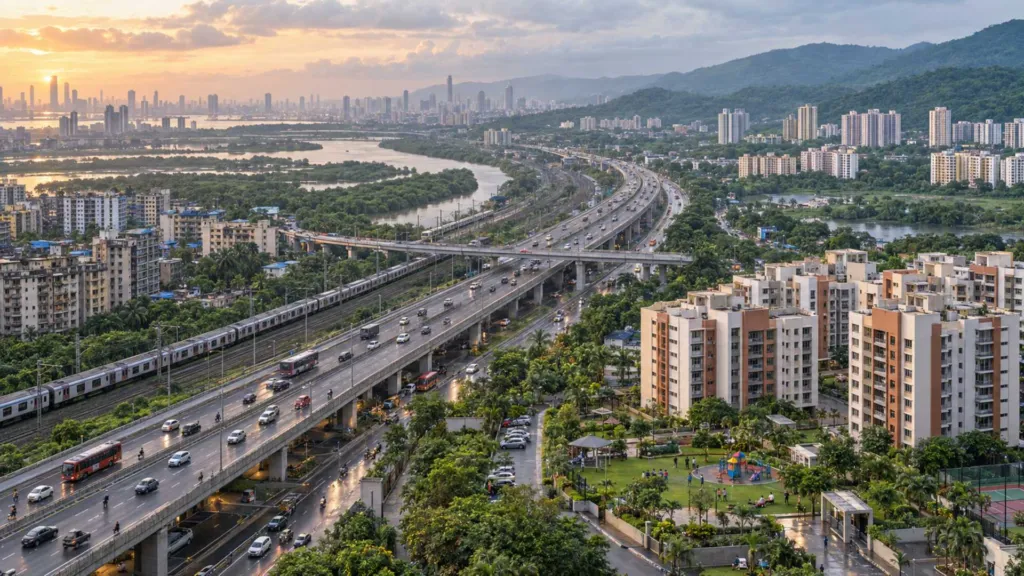
Mumbai’s Development Plan 2034 promised something the land‑starved city urgently needed: buildable land, higher development potential and a fresh attempt to expand affordable housing.
That promise immediately raised a question. If builders can construct homes on the same land and previously restricted areas become developable, will Mumbai property prices finally come down?
The answer in 2026 is more complicated than the original headline suggested.
Mumbai Development Plan 2034 is not an announced plan. Mumbai Development Plan 2034 was sanctioned in 2018, while its accompanying Development Control and Promotion Regulations, known as DCPR 2034, have subsequently governed how land and buildings can be developed within Greater Mumbai. The framework continues to evolve through government amendments.
DP 2034 determines the city’s land‑use vision, including residential zones, commercial areas, roads, amenities and reservations. DCPR 2034 translates the vision into development rules governing Floor Space Index, redevelopment, Transferable Development Rights and construction permissions.
The plan can expand Mumbai’s housing capacity, but development potential, on paper, does not automatically become affordable homes on the ground.
Will Mumbai Property Prices Come Down Because of Development Plan 2034?
Mumbai Development Plan 2034 can moderate property prices by unlocking land, raising permissible FSI and encouraging redevelopment. However, a citywide price fall is unlikely unless this additional development potential produces completed homes at competitive costs. Land prices, FSI premiums, construction expenses, infrastructure capacity and continued buyer demand will determine the actual impact. Some micro-markets may see greater supply and slower price growth, while well-connected locations could appreciate.
When DP 2034 was announced, industry experts cited by Moneycontrol discussed the possibility of a 10–15% price correction. That forecast was explicitly conditional: additional FSI needed to be available at rational prices, and newly opened land had to translate into affordable housing supply.
It was not a prediction that every flat in Mumbai would become 15% cheaper.
Years later, that distinction matters. Mumbai has not experienced a uniform price correction solely because of DP 2034. Strong demand, high construction costs, limited land availability in established neighbourhoods and the premium buyers place on connectivity continue to support values.
The more realistic impact is likely to be price rationalisation rather than a dramatic price crash. In locations receiving substantial redevelopment inventory, buyers may gain more choice, better amenities and stronger negotiating power. In locations where infrastructure and redevelopment improve neighbourhood quality, prices could rise despite additional supply.
What DP 2034 Changed for Mumbai’s Housing Market
One of the plan’s biggest proposals involved opening approximately 3,700 hectares of land previously classified as a No-Development Zone or Special Development Zone.
The 2018 Moneycontrol report said more than 3,000 hectares were expected to support affordable housing, alongside around 300 hectares of salt-pan land. The broader policy ambition was to facilitate approximately 10 lakh affordable homes by 2034, including compact units measuring roughly 30–60 square metres.
These were planning targets, not completed-housing figures or guaranteed delivery commitments.
Developability depends on ownership, environmental restrictions, physical access, litigation, reservations, infrastructure and project viability. Salt-pan and ecologically sensitive areas can also involve environmental and flooding concerns that cannot be resolved simply through a zoning change.
The plan simultaneously raised development potential through revised FSI provisions. Moneycontrol’s original coverage reported residential FSI of up to 3 in the island city and up to 2.5 in the suburbs under relevant conditions. Commercial FSI could rise to as much as 5 in specified locations.
However, buyers should not treat these figures as universally applicable Mumbai FSI rules in 2026. Permissible FSI varies by plot, road width, land use, planning authority, redevelopment category, premiums, TDR and subsequent amendments. A project’s sanctioned plan is more important than a general city-level FSI headline.
The plan primarily covers Greater Mumbai under the Brihanmumbai Municipal Corporation. Locations controlled by other planning authorities may have different rules. For example, BKC is substantially governed by MMRDA, so citywide DCPR provisions should not automatically be applied to every BKC property.
How FSI Changes Affect Flat Size and Property Value
Floor Space Index is the ratio between the total permissible built-up area and the plot area.
If a 1,000-square-metre plot has an effective FSI of 2, it can broadly support 2,000 square metres of FSI-counted construction, subject to other rules. An effective FSI of 3 increases that potential to 3,000 square metres.
Higher FSI does not necessarily mean every buyer receives a larger flat. A developer may instead construct more apartments, additional floors, larger rehabilitation units or a combination of residential and sale components.
DCPR 2034 also permits fungible compensatory area of up to 35% over admissible FSI or built-up area for residential, industrial and commercial development, subject to applicable premiums and scheme-specific conditions. This provision accommodates areas such as internal walls and certain building components that would otherwise affect usable planning.
For a homebuyer comparing a 2BHK flat in Mumbai or a 3BHK flat in Mumbai, the key measurement remains RERA carpet area. Buyers should not assume that higher plot FSI automatically creates a 35% larger apartment.
The financial effect is equally complex. Higher FSI can spread land cost across more saleable inventory, potentially improving project viability. But if the developer must pay a substantial premium to obtain additional FSI, the saving may not reach buyers.
As real estate research firm Liases Foras explained in Moneycontrol’s 2018 report, expensive FSI can result in limited consumption of the available development potential. In that situation, the policy may increase the underlying value of land without materially reducing the price of an apartment for sale in Mumbai.
Redevelopment Could Be DP 2034’s Biggest Property-Price Influence
The most visible effect of DCPR 2034 may come not from untouched land but from Mumbai redevelopment.
Much of the island city and established suburbs consist of ageing cessed buildings, cooperative housing societies, slum settlements and fragmented plots. Replacing these properties can create safer buildings, rehabilitate existing occupants and add free-sale apartments to the wider market.
Different redevelopment routes are covered by different regulations:
- Regulation 33(7) addresses qualifying cessed-building redevelopment in the island city.
- Regulation 33(9) covers cluster redevelopment and urban renewal arrangements.
- Regulation 33(9)(A) contains provisions for the Dharavi Notified Area.
- Regulation 33(10) governs eligible slum rehabilitation schemes.
- Regulation 33(7)(B) provides additional built-up-area incentives for certain authorised residential societies that are at least 30 years old.
These routes should not be treated as interchangeable. Rehabilitation entitlement, incentive FSI, consent requirements, premiums and approval authorities depend on the applicable scheme.
Current redevelopment momentum shows how significant this channel could become. A Knight Frank analysis reported in 2025 estimated that society redevelopment projects underway across Greater Mumbai could add more than 44,000 apartments by 2030. The western suburbs between Bandra and Borivali were expected to account for the majority of that supply.
This can produce different price effects within the same neighbourhood. New supply may limit aggressive increases in older resale-flat prices. At the same time, a completed tower with parking, lifts, security and modern amenities may command a premium over the building it replaces.
Redevelopment creates additional inventory, but it can also upgrade the entire price profile of a micro-market.
Which Mumbai Areas Could Benefit Most?
South Mumbai and the island city have a large concentration of old and cessed buildings. Areas such as Dadar, Mahim, Matunga, Byculla and parts of South Mumbai could benefit from redevelopment where projects are legally, financially and physically feasible.
The advantage is not limited to more apartments. Redevelopment can replace structurally ageing buildings, reorganise plots and improve internal services. Yet small plots, narrow roads, tenant negotiations and heritage restrictions can make execution difficult.
Worli and Lower Parel may benefit more from mixed-use redevelopment and continued commercial demand than from affordable supply. Additional development capacity in these locations does not automatically create affordable housing because land and entry prices are already high.
The western suburbs, including Andheri, Goregaon, Malad, Kandivali and Borivali, have greater society-redevelopment potential. New construction in these areas can offer buyers more choices across premium, mid-segment and compact configurations.
Eastern suburbs such as Vikhroli, Bhandup, Nahur and Mulund may benefit where redevelopment combines with better connectivity and employment access. Any development proposed on former NDZ, salt-pan or environmentally sensitive land should undergo particularly careful legal and environmental verification.
Dharavi represents a specialised redevelopment programme rather than a normal private residential project. Its property-value impact will depend on rehabilitation delivery, infrastructure, commercial integration and the timeline over which sale inventory enters surrounding markets.
The broader lesson is simple: DP 2034 does not create one Mumbai property market. It creates different redevelopment and supply opportunities across individual plots and corridors.
New Homes, Better Amenities and Infrastructure Pressure
DCPR 2034 is not only about maximising buildable area. It also regulates roads, open spaces, parking, public amenities and infrastructure contributions.
A 2026 amendment increased the area permitted free of FSI for specified residential recreation facilities, such as fitness, yoga, meditation and covered swimming facilities, from 2% to 4% of total built-up area, subject to the notified conditions. Ownership of these facilities is intended to remain with the housing society or apartment owners’ association.
For buyers considering a new flat in Mumbai in 2026, this could support larger recreation spaces in future developments. It should not be confused with a general doubling of a project’s recreational FSI or assumed to apply without conditions.
Higher development intensity also creates a challenge. More homes on the same land mean more pressure on roads, water supply, drainage, public transport and social infrastructure. FSI-led redevelopment delivers its full value only when civic capacity expands alongside population density.
This is why a project close to reliable transport, schools, hospitals and employment may appreciate even as citywide housing supply increases. Buyers pay not only for the apartment but also for the neighbourhood’s ability to absorb growth.
Should Buyers Purchase Now or Wait for DP 2034 Supply?
Waiting solely for DP 2034 to reduce Mumbai property prices may not be a dependable strategy. The plan’s impact will unfold unevenly until 2034 and potentially beyond, while individual redevelopment projects can take years to secure approvals, relocate occupants, obtain finance and complete construction.
A ready-to-move flat in Mumbai offers greater certainty over the actual apartment, surrounding infrastructure and possession. An under-construction redevelopment project may offer a newer building or different entry price but carries approval, construction and delivery risks.
Before deciding to buy property in Mumbai, buyers should verify:
- The project’s MahaRERA registration and latest quarterly updates
- The sanctioned building plans and applicable DCPR regulations
- The plot’s ownership, title history and encumbrances
- Whether the project uses base FSI, premium FSI, TDR or fungible area
- Rehabilitation and free-sale components in a redevelopment project
- Access roads, water, drainage and transport capacity
- RERA carpet area rather than promotional built-up-area figures
- The developer’s delivery record and the project’s financing status
Buyers should also compare a new launch with a ready-to-move flat Mumbai option in the same locality. A lower launch price can lose its advantage if possession is distant, rent must be paid during construction, or the surrounding infrastructure remains uncertain.
Is Mumbai Real Estate Overpriced in 2026?
Mumbai is expensive by Indian standards, but “overpriced” cannot be answered with one citywide number. A luxury flat Mumbai buyer in Worli is participating in a different market from a first-time buyer evaluating an older apartment in the suburbs.
A property may be overpriced if its quoted rate is far above comparable registered transactions, its rental yield is exceptionally weak, or its premium depends entirely on infrastructure that has not been completed. Conversely, a costly home may still represent fair market value if it offers scarce location advantages, clear title, strong connectivity and sustained end-user demand.
DP 2034 adds another layer to this assessment. Higher FSI may increase future competition around one project while making another plot more valuable for redevelopment. Buyers must evaluate the precise property rather than expecting the development plan to move every Mumbai price in the same direction.
DP 2034 Will Reshape Mumbai, But Not Through a Simple Price Cut
The Mumbai Development Plan 2034 creates the capacity for additional homes, commercial space and urban renewal. It can support redevelopment in ageing neighbourhoods, increase affordable-housing opportunities and bring previously restricted land into the city’s long-term development framework.
What it cannot do by itself is guarantee inexpensive housing.
Mumbai property prices will come under meaningful pressure only where added FSI becomes viable construction, construction becomes completed inventory and that inventory meaningfully exceeds demand at the relevant price point.
In other locations, redevelopment, new amenities and better infrastructure could raise property values instead. The likely outcome is not one citywide correction but a widening difference between well-executed, well-connected projects and developments where density grows faster than infrastructure.
Disclaimer: DCPR provisions can change through notifications and vary by plot, scheme and planning authority. Buyers should obtain current planning information and independent legal advice before making a property decision.