NRI Guide to Buying a Pune Township Home in 2026
NRI Guide to Buying Property in Pune Townships 2026
SHARE:


How can an NRI buy a home in a Pune township?
An eligible NRI or OCI can generally purchase a residential township home without prior RBI approval, using permitted banking channels. Shortlist the exact apartment, verify title and applicable MahaRERA records, arrange financing, complete tax requirements and register the purchase. A properly executed Power of Attorney can enable representation without visiting India.
Buying a property in Pune from abroad is often done because you want to create a future family home but also generate some rental income before returning to India.
A fully integrated township will be a big selling point. You have security, communal upkeep, facilities and amenities, which can make owning a property straightforward. However, you may struggle to know who to contact if your property is empty, needs repairs, or has tenants leaving, especially as you will be thousands of miles away.
The best option for investing in property as an NRI in Pune townships would be purchasing a property that is well suited to your needs. It should be clearly owned, with verifiable finances and reliable on-site management.
Life Republic, Amanora, Magarpatta and Blue Ridge are all properties worth comparing.
FEMA rules: what an NRI can buy in India
The first distinction is between buying an ordinary residential apartment and acquiring restricted categories of land.
The Reserve Bank of India’s property FAQs explain the framework under the Foreign Exchange Management Act and the Non-Debt Instruments Rules. Eligible NRIs and OCIs can generally buy residential and commercial property; agricultural land, plantation property and farmhouses fall outside the general purchase permission.
A township label does not change these rules. Check the legal classification and approvals of the particular property, especially when considering plots, villas or land-linked products.
Also distinguish FEMA residential status from income-tax residential status. Neither should be determined from a passport or an overseas address alone; obtain advice where citizenship, employment or residence has recently changed.
AB Housing Realty’s NRI guide usefully identifies banking, representation and exit planning as issues surrounding the purchase. However, transaction-specific rules should be checked against official guidance rather than applied from a generic checklist.
Which Pune township suits an NRI buyer?
Begin with the likely occupant. A future family home, an immediately rentable apartment and a long-horizon investment require different shortlists.
| Township | Location and investment context | What an overseas buyer should investigate |
|---|---|---|
| Magarpatta City | Established Hadapsar township | Resale condition, society finances and access to the intended workplace |
| Amanora Park Town | Hadapsar | Tower-specific costs, service arrangements and rental support |
| Life Republic | Marunji, near Hinjewadi | Exact precinct, possession stage and external commute |
| Blue Ridge | Hinjewadi Phase 1 | Entry price, building condition and Phase 1 tenant demand |
| Megapolis | Hinjewadi Phase 3 | Relevance to Phase 3 employers and internal access |
| Ivy Estate | Wagholi | Apartment condition, local services and the actual east-Pune commute |
The west-Pune locations are supported by the respective township disclosures. Kolte-Patil identifies Ivy Estate as a Wagholi development, while Amanora identifies its Hadapsar township and provides a rental-desk channel.
For an NRI comparing Magarpatta, Amanora and Life Republic, geography should precede amenities. Hadapsar and Hinjewadi serve different employment corridors. Kharadi also needs its own commute assessment rather than being treated as interchangeable with Hadapsar.
Metro Line 3 adds a connectivity consideration for Hinjewadi, including Megapolis. Passenger services began in November 2026, with stations opening in phases. Measure the apartment-to-station journey rather than assuming uniform benefits across western townships.
There is no verified universal winner for rental yield or appreciation. Compare apartments with similar carpet areas, possession status and furnishing requirements.
For an NRI seeking a Pune township flat under ₹1 crore, request current resale and new-sale quotations separately. The advertised price must leave room for transaction costs, repairs and furnishing.
NRE versus NRO: establish the funding trail before booking
NRIs can pay through normal inward banking remittances or eligible NRE, NRO and FCNR(B) funds. RBI guidance excludes payments through foreign-currency notes or travellers’ cheques.
An NRE account commonly holds eligible overseas earnings remitted to India. An NRO account accommodates eligible Indian-source receipts. Both can be relevant to a Pune township purchase, but payment eligibility and later repatriation treatment are separate questions.
Ask the authorised dealer bank to confirm the route before transferring the booking amount. Preserve account statements, remittance references, payment acknowledgements and the funding contribution of each joint owner.
Avoid routing purchase money informally through a relative’s account. The aim is a clear record connecting the buyer, payment and registered ownership.
NRI home-loan eligibility also depends on the lender. Expect requests for passport and immigration documents, overseas address proof, employment or business records, income evidence and bank statements. NOW Realty’s NRI buying guide highlights the importance of coordinating the legal and financial process rather than treating the property search as a standalone exercise.
Obtain a written sanction and repayment schedule. Test affordability against exchange-rate movements, overseas living costs and periods without rental income.
The purchase process: verify, authorise and register
1. Define the purpose and complete budget
Decide whether the home is for parents, eventual occupation or rental income. Include applicable stamp duty, registration, GST where relevant, brokerage, deposits, interiors and management expenses.
For a new launch, model rent-free holding periods and possible construction delays. For resale, budget for repairs and replacement of ageing fittings.
2. Verify the exact MahaRERA project or phase
Search the registration number on the official MahaRERA portal. Match the promoter, location, building and phase with the agreement. Examine disclosed completion dates, updates and available regulatory information.
Foresight Realvision’s checklist identifies direct project verification as a central NRI buying step. A registration number for one township phase does not verify every building carrying the same brand.
3. Commission independent legal and physical inspections
Have your lawyer examine title, registered ownership documents, mortgages, approvals, litigation and applicable occupation or completion documentation.
For resale, inspect the ownership chain, society records, unpaid dues and loan-release arrangements. Legal Assure’s Pune resale guide highlights these risks, including undisclosed charges, inherited-property issues and unauthorised alterations.
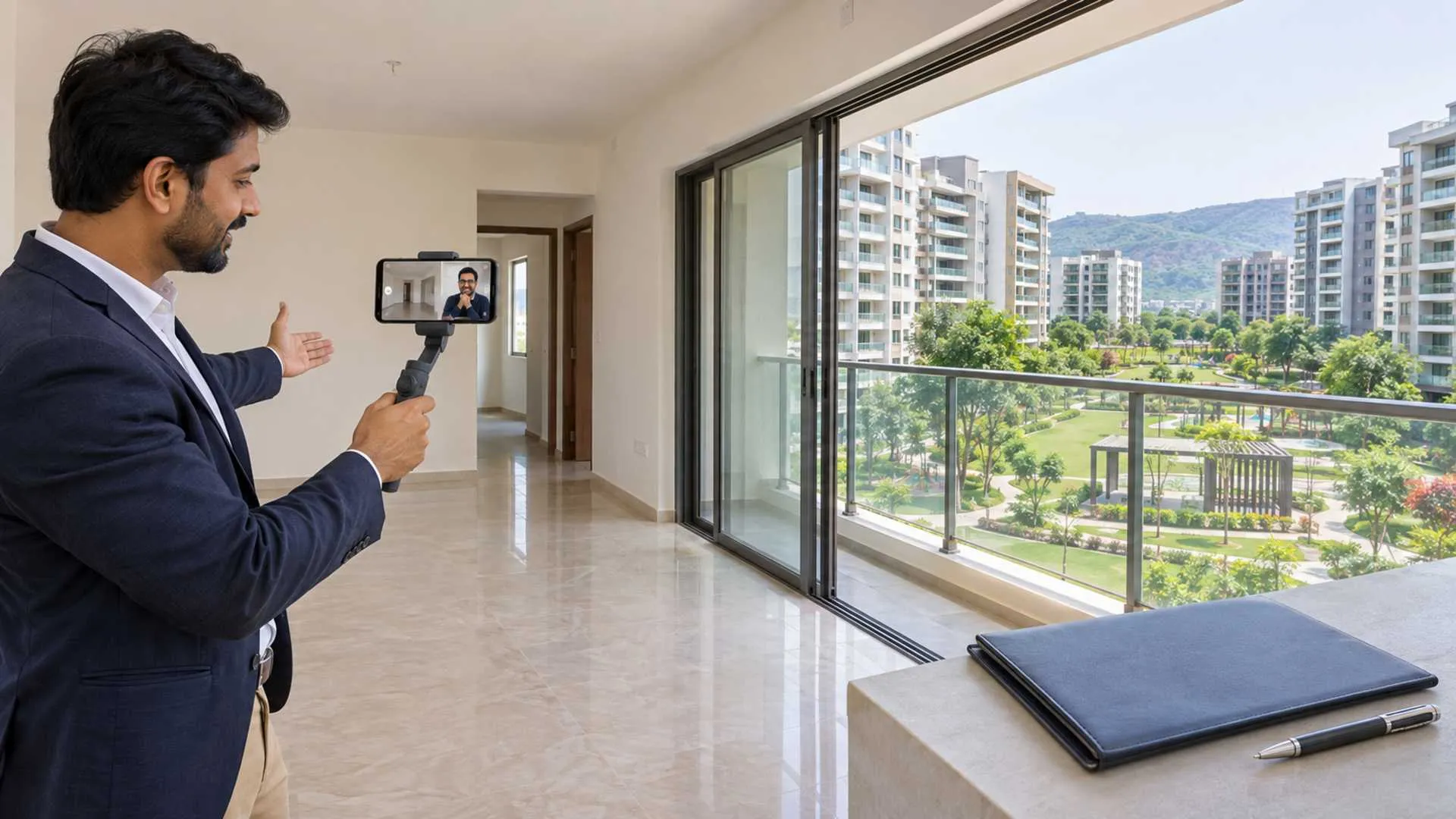
Arrange an independent inspection of the actual apartment. A video tour cannot fully establish seepage, lift reliability, water arrangements or maintenance quality.
4. Finalise terms before paying substantial sums
Record carpet area, parking rights, specifications, payment stages, possession terms and cancellation conditions. Confirm what township amenities are included and what requires separate membership.
MahaRERA’s official FAQs explain that a promoter cannot accept more than 10% of the apartment cost before entering into a written, registered agreement for sale.
5. Register and complete the handover
Coordinate signing, applicable taxes and registration with your lawyer and lender. Obtain the registered document, payment records, possession papers and relevant society-transfer documentation.
A Power of Attorney authorises representation; it does not itself transfer ownership.
Buying remotely: get the Power of Attorney right
An NRI can often complete a Pune property purchase without visiting India by appointing an authorised representative. That does not mean the entire transaction is universally available through a paperless online process.
Use a property-specific Power of Attorney defining the permitted actions: signing agreed documents, appearing for registration and collecting the registered instrument. Include borrowing powers only where necessary and acceptable to the lender.
AB Housing recommends limiting the authority to the transaction rather than granting unnecessarily broad financial or sale powers.
Execution requirements depend on the country and consular jurisdiction. Check whether notarisation, apostille, consular attestation or a combination applies, followed by Maharashtra stamping, adjudication or registration requirements as applicable.
For example, the Indian Consulate in Seattle publishes requirements involving supporting identity documents, notarisation, witnesses and submission through VFS. Other missions can prescribe different procedures.
Have the Pune lawyer and lender approve the draft before execution overseas. This reduces the risk of discovering missing powers after the original document reaches India.
Tax and repatriation: plan the exit at entry
Tax treatment depends partly on the seller’s residential status, not just the buyer’s NRI status.
For a resident seller, official Income Tax Department guidance provides for 1% TDS on the higher of consideration or stamp-duty value where either reaches ₹50 lakh, subject to applicable conditions. Buying from a non-resident seller follows different withholding provisions; do not automatically apply 1%.
The department’s current Form 141 guidance also distinguishes resident-seller purchases from qualifying transactions involving non-resident sellers. Have a chartered accountant confirm the correct form, deduction and payment deadline before disbursement.
Indian rental income and gains can be taxable in India, with applicable treaty relief depending on circumstances. TDS is not necessarily the final tax liability.
Official guidance generally treats property held for more than 24 months as long-term; the current long-term capital-gains framework uses a 12.5% base rate without indexation, subject to applicable provisions, surcharge, cess and available relief. Confirm the position when selling.
Repatriation is not governed by one blanket limit. RBI directions provide a conditional route for qualifying foreign-exchange-funded property purchases, including a restriction involving two residential properties. Other eligible remittances may use the USD 1 million-per-financial-year assets route, subject to conditions and tax documentation. Confirm the appropriate route with the bank.
Rental management determines the experience after purchase
A township can simplify shared maintenance. It does not automatically manage your apartment, find tenants or collect rent.
Appoint a manager under a written agreement covering tenant checks, compliant documentation, collections, inspections, repair limits, deposit handling and vacancy reporting. Keep approval rights over major expenditure.
Amanora’s official website provides a rental-desk channel, but buyers should establish the actual scope, fees and availability of any assistance.
For rental-yield comparison, use the complete investment. A hypothetical ₹90 lakh acquisition earning ₹30,000 monthly produces 4% gross yield at full occupancy. Vacancy, maintenance, repairs, management and tax reduce the retained return. This is an illustration, not a township forecast.
If considering alternatives, compare Saheel Luxton in Wakad, Mantra Properties in Kharadi, Shubh Developers in Mundhwa and ARV New Town in Undri–Pisoli against the intended occupant’s location needs. Developer branding alone cannot establish affordability or investment performance.