Singapore Investors’ Guide to Pune Real Estate: What Matters in 2026
Singapore Investors’ Guide to Pune Real Estate 2026
SHARE:
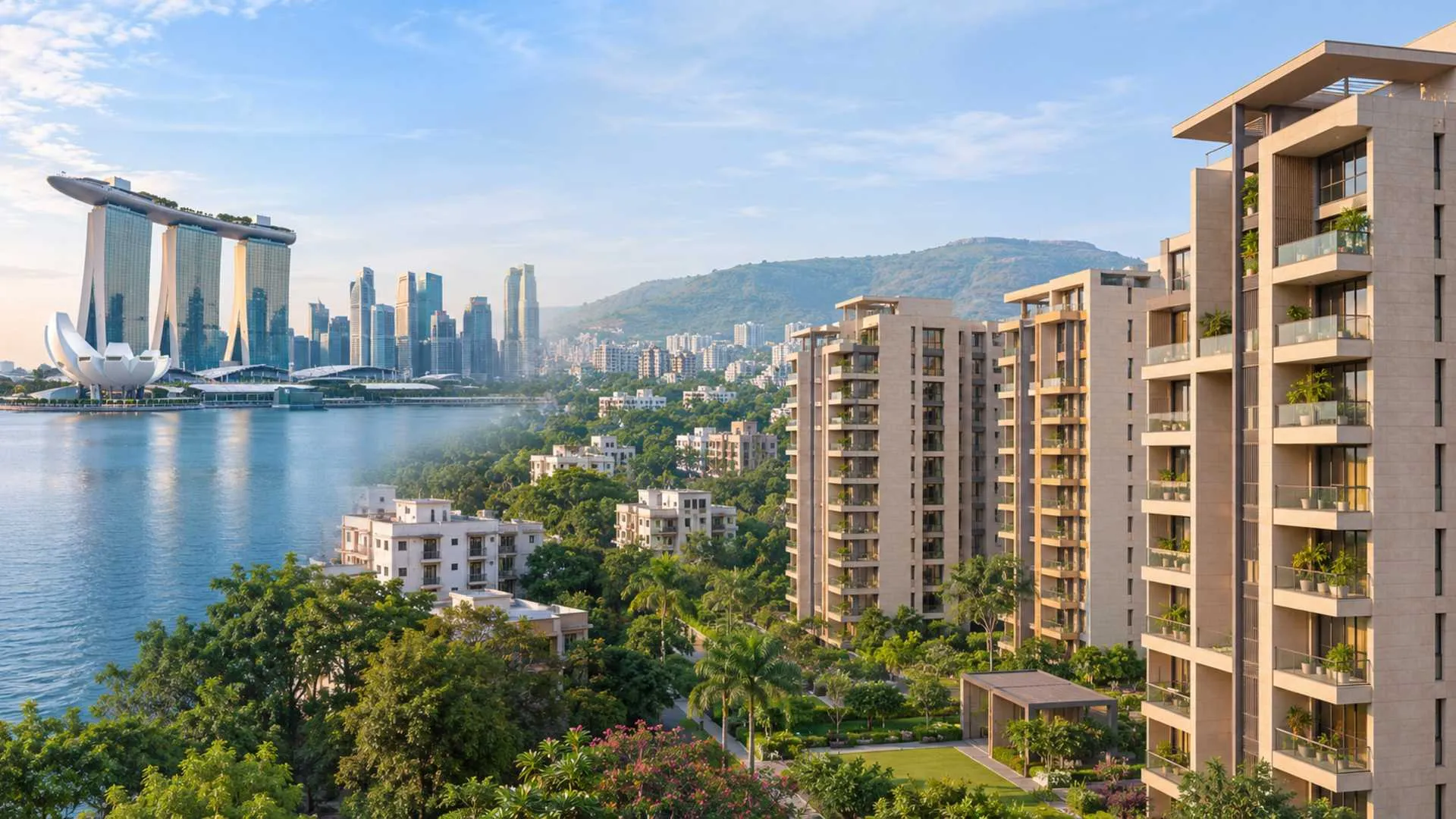


Purchasing residential property in Pune can be a great way to build up an asset that can generate income as well as a place to come back to for an Indian professional living in Singapore. As with any investment, it is important to ensure this is possible.
The following guide will help you make informed decisions about purchasing property in Pune in 2026 as a Singapore investor. We’ll look at:
Will I qualify to buy? How much stamp duty will I pay in Singapore? What taxes are incurred in India? Choosing the right location. Managing your property from abroad.
Pune has great employment hubs; however, a low entry price does not always mean you will get a better investment. It will depend on the property itself, funding, currency exchange and what you plan on doing with the property in the long run.
Should a Singapore NRI invest in Pune real estate?
Pune can suit Singapore-based NRIs seeking an Indian rental asset or future family home. Compare employment access, net rental income, developer delivery and resale demand. Confirm FEMA eligibility, Indian taxes and repatriation arrangements before buying; Singapore’s ABSD rules alone should not determine the decision.
Singapore Property Versus Pune Property: Start With Your Status
The Singapore ABSD 60% versus India property-tax comparison attracts attention, but the buyer’s classification changes the calculation.
According to IRAS, foreigners buying Singapore residential property generally face 60% Additional Buyer’s Stamp Duty, calculated on the higher of the purchase price or market value. Singapore permanent residents buying their first residential property face 5%, while Singapore citizens buying their first face no ABSD. Different rates apply to subsequent purchases, with reliefs available in qualifying circumstances.
Therefore, an Indian citizen working in Singapore should first establish whether they are treated as a foreigner or permanent resident for the proposed Singapore purchase.
Buying in Pune does not attract Singapore ABSD on that Indian transaction. However, Maharashtra stamp duty, registration charges, applicable GST and other acquisition expenses still need budgeting.
“NRI Singapore buy property Pune, DTAA tax ABSD escape” is a search proposition, not a complete investment strategy. Singapore cooling measures may encourage consideration of Indian property, but the comparison must include financing, liquidity, management and currency exposure.
An Indian-origin Singapore citizen should also establish OCI eligibility rather than assuming that NRI purchase permissions automatically apply.
Can an NRI in Singapore Buy Property in India?
Under the Reserve Bank of India’s property-purchase guidance, NRIs and OCIs can purchase eligible residential and commercial property in India. Agricultural land, plantation property and farmhouses fall outside the ordinary purchase permission.
This is the starting point for NRI buying property in India in 2026 rules. FEMA residential status, Indian income-tax residence and Singapore tax residence answer different questions; one label does not settle all three.
For FEMA rules governing NRI real estate in India, verify the legal classification of the property. A development marketed as a “weekend villa” or “farm retreat” requires particular attention to its underlying land use.
The same care applies to joint ownership. An overseas spouse who is neither an NRI nor OCI may be subject to different conditions. Confirm eligibility before paying a deposit or deciding whose names belong on the agreement.
Best Areas in Pune for Singapore NRI Investment
The strongest Singapore NRI Pune real estate investment locations in 2026 depend on whether the goal is rent, eventual occupation or both.
Kolte-Patil’s updated Pune market guide identifies Kharadi and Hinjewadi with employment-led rental demand, while discussing NIBM and Undri as family-oriented locations. These are developer perspectives to investigate, rather than guaranteed return rankings.
| Pune location | Why a Singapore-based buyer might shortlist it | What should decide the purchase |
|---|---|---|
| Kharadi | Eastern technology and GCC employment access | Occupied offices, achieved rents and competing supply |
| Hinjewadi | IT-corridor investment and return planning | Workplace phase, approach roads and daily travel |
| Baner–Balewadi | Premium family living and western employment access | Schools, usable space and total acquisition cost |
| Wakad | Housing choices serving the western employment belt | Actual Hinjewadi commute and building maintenance |
| Viman Nagar | Established eastern residential setting | Building age, parking, airport access and purchase premium |
| Undri–NIBM | Family-oriented housing and budget alternatives | School routes, water arrangements and workplace distance |
| Koregaon Park | Premium lifestyle and selected luxury-home searches | Title, upkeep, entry price and resale buyer pool |
| Wagholi | Budget-led apartment searches | Completed infrastructure, access and all-inclusive pricing |
Luxury Residences’ locality guide includes Balewadi among its investment locations, while Kotibhaskar’s Pune investment guide emphasises employment, education and established neighbourhood infrastructure. Neither substitutes for comparing individual properties.
For a Singapore NRI buying a flat in Kharadi near an IT or GCC office hub, tenant access deserves priority. For a Singapore NRI investing in Hinjewadi with return plans, the household’s likely workplace and school matter just as much.
A luxury villa in Koregaon Park serves a different budget and tenant market from an affordable first investment in Undri. Likewise, a Wagholi 2 BHK or 3 BHK under ₹1 crore should remain a search brief until current quotations confirm it.
Four Developer References to Compare
Saheel Luxton in Wakad offers 2, 3 and 4 BHK homes, giving Singapore NRI return planners a western-corridor option to examine. Mantra Melange at Kharadi Riverside belongs in an eastern shortlist.
For Singapore NRI buyers considering Viman Nagar, Shubh Developers lists Shubh Nirvana there. ARV New Town in Undri–Pisoli offers multiple configurations for a budget comparison. “NRI-friendly” and “affordable value” should be tested through documentation, service arrangements and the final quotation.
Returns: Calculate the Income You Keep
Which areas in Pune offer the best returns for Singapore NRI investors? A locality name cannot answer without an entry price and evidence of achievable rent.
Consider a hypothetical ₹1.2 crore apartment earning ₹45,000 monthly. Annual rent of ₹5.4 lakh produces 4.5% gross yield against the advertised price.
If acquisition and furnishing bring the investment to ₹1.3 crore, gross yield falls to approximately 4.15%. Deduct an illustrative ₹1 lakh annually for vacancy and owner-paid expenses, and the yield becomes approximately 3.38% before tax and financing.
That is why the NRI Nivesh Pune–Hyderabad comparison cautions that returns depend on the building and employment access. Its published yield ranges are directional marketing guidance, not verified results for a particular apartment.
For a Pune-versus-Bengaluru comparison, use equivalent homes, achieved rents and complete costs. The best city in India for NRI property investment in 2026 may ultimately be the city where the household has a credible long-term use.
GCC office expansion, Pune’s technology corridors and NRI return migration create a useful buying framework, not a promise of appreciation. Measure demand already present before paying for expected future growth.
How to Buy Property in Pune From Singapore: A Practical Guide
A Singapore NRI can buy a flat in Pune using an NRE account, but the banking trail must remain clear.
RBI guidance permits payment through inward remittances via banking channels or eligible NRE, FCNR(B) and NRO accounts. Foreign-currency notes and travellers’ cheques are not permitted payment methods.
The practical sequence is:
- Confirm eligibility and budget. Establish ownership status, PAN, funding sources and acquisition expenses.
- Shortlist and verify. Check the project, legal title, approvals and seller.
- Arrange funding. Confirm the remittance route, beneficiary and loan eligibility.
- Review the agreement and authority documents. Use a carefully limited power of attorney where necessary.
- Register and retain records. Preserve remittance evidence, receipts, agreements and loan documents.
For the NRE account versus NRO account decision, both may be usable for eligible purchases, but funding source and later repatriation requirements differ. Agree on the route with the authorised dealer bank before remitting.
SBI Singapore offers facilitation for NRI home loans provided by SBI India. The lender still assesses income, credit, repayment capacity and property documents.
The NRI home loan India process in 2026 should therefore begin before committing to a payment schedule. Singapore income does not establish automatic approval.
DTAA India–Singapore: Property Tax Rules Buyers Must Understand
The DTAA India–Singapore tax treaty for property allocates taxing rights; it does not make a Pune investment tax-free.
Under the official India–Singapore treaty text, Article 6 permits India to tax income from Indian immovable property. Article 13(1) permits India to tax gains from its sale. The treaty’s separate share-investment provisions should not be applied to a directly owned apartment.
For NRI property tax in India and capital gains in 2026, the broad framework is:
| Event | What the buyer should budget or verify |
|---|---|
| Purchase | Stamp duty, registration, applicable GST and seller-dependent withholding obligations |
| Rental income | Indian income tax, withholding and return-filing requirements |
| Sale after more than 24 months | Generally 12.5% long-term capital-gains tax without indexation, plus applicable surcharge and cess |
| Earlier sale | Generally short-term gains taxed at applicable rates |
The Income Tax Department’s capital-gains guidance confirms the 24-month property holding threshold and general 12.5% long-term rate. The alternative indexed-tax protection for qualifying older property is restricted to resident individuals and HUFs; an NRI should not assume eligibility. Exemptions and the actual liability require transaction-specific calculation.
IRAS generally exempts overseas income received by individuals in Singapore, with exceptions. Do not assume either automatic double taxation or an automatic foreign-tax credit.
Eligible NRE-account interest can be exempt in India. However, NRE deposit tax treatment does not transfer to rental income or property gains. Replacing liquid cash with real estate changes taxation, liquidity and risk; “compounding” is not guaranteed.
RERA Protection, Currency Risk and Getting Money Back
For RERA protection and NRI buyer Pune project verification in 2026, use the official MahaRERA website. Match the registration to the exact phase, inspect disclosures and examine relevant orders.
NRIs purchasing as allottees receive the applicable statutory rights concerning information, possession and qualifying remedies. Registration does not guarantee title, completion or returns.
Have an independent lawyer review ownership, encumbrances, plans and the agreement. Arrange local inspections and property management before handover.
Currency also affects performance. If a property rises in rupees while the rupee weakens against SGD, the Singapore-dollar gain can be smaller. Include conversion spreads and remittance charges.
Repatriation rules for NRI property sales under FEMA and RBI directions depend on funding and documentation. RBI’s master direction provides a qualifying foreign-funded route, with residential-sale repatriation restricted to not more than two properties. This is not a two-property ownership limit. Other eligible remittance routes require separate checks.
Finally, the “Singapore PE investment in Indian real estate tripled” claim is historical. IBEF’s report citing ANAROCK compared approximately US3.5 billion in 2017–2018. Institutional investment supports the significance of the India–Singapore corridor; it does not validate an individual flat’s returns.
Choose the Property That Fits Your Return Plan
A Singapore investors’ guide to Pune real estate should end with a household decision: where would you live, who would rent the home meanwhile, and how would you manage an eventual sale?
Residential property can combine family use with rental income. Commercial property requires a different assessment of tenants, leases, vacancy, fit-outs and taxes. Compare both after costs rather than choosing the larger advertised yield.