Delhi vs Gurugram vs Noida: Where Should NRIs Invest in 2026?
Delhi vs Gurugram vs Noida: Best for NRI Investment 2026
SHARE:
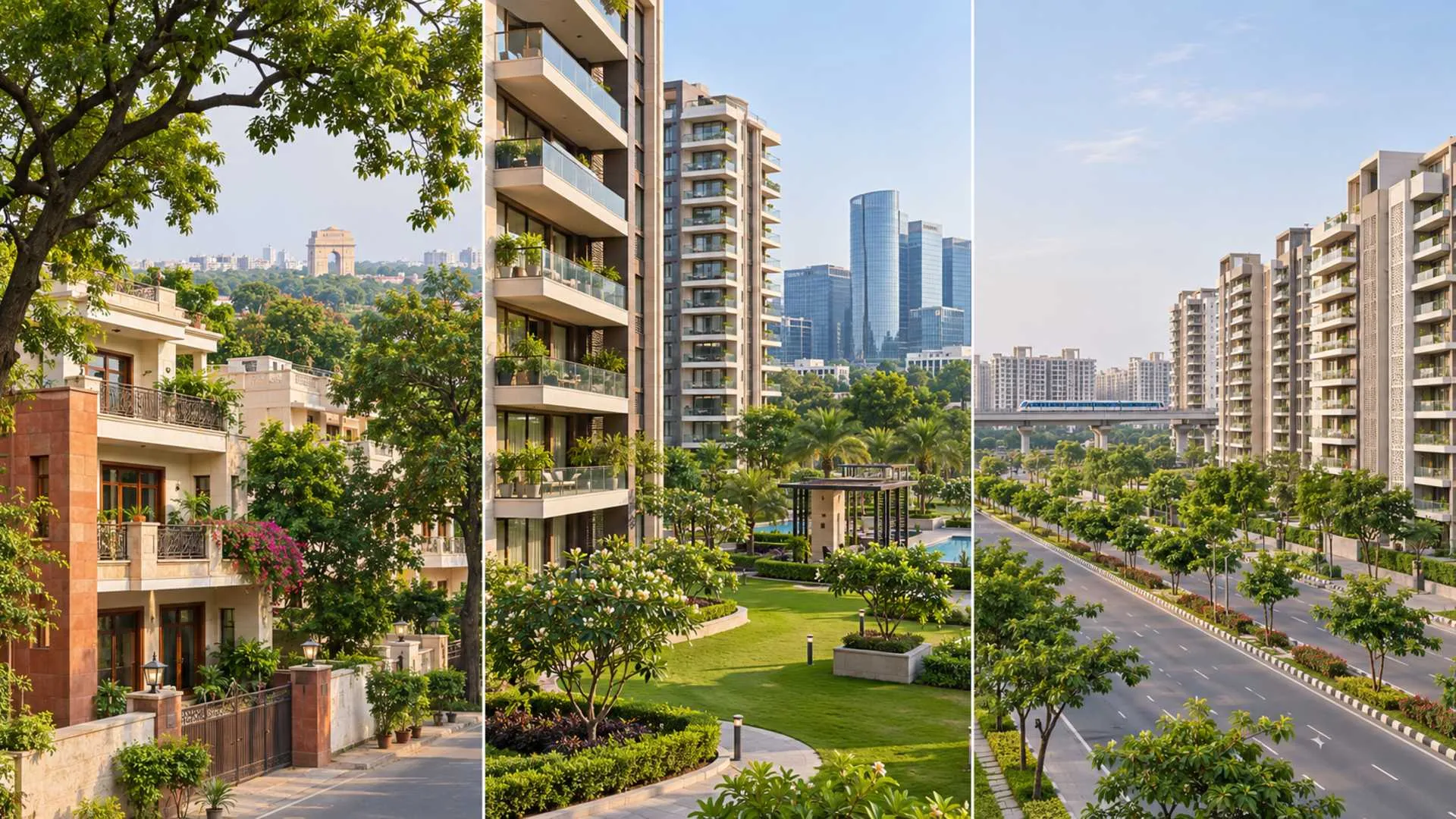


There are three options for the NRI looking to invest in real estate within Delhi NCR. They can invest in an established location within Delhi, have access to the corporate tenants of Gurugram, or pay less at the lower end of the market in Noida.
Historically, Noida has performed better than the other cities as far as price increases go. However, Gurugram is the top-performing city of the three with the highest gross yield. Delhi is much more expensive.
Investing from overseas means you also need to consider whether it will be easy to rent out and maintain.
Ultimately, which is the best city to invest in within NCR in 2026 depends on the amount of income you’re happy to get from your property, how you plan to use it in the future and how much management you’re willing to take on.
Should an NRI invest in Delhi, Gurugram or Noida in 2026?
Gurugram deserves consideration for corporate-linked rental demand; Noida offers a lower average acquisition price and strong recorded appreciation; Delhi suits buyers prioritising established neighbourhoods and future personal use. Compare individual properties on net rental income, legal clarity, maintenance and resale prospects before choosing. Historical city-level returns do not predict an individual home’s performance.
Delhi, Gurugram and Noida: prices, appreciation and rental yields
For a consistent Delhi vs Gurugram vs Noida NRI investment comparison, use figures from the same reporting period.
ANAROCK data reported by The Economic Times provides the following comparison:
| Market | Average residential price, Q2 2026 | Price growth, 2019–Q2 2026 | Gross rental yield, Q2 2026 |
|---|---|---|---|
| Delhi | ₹26,700 per sq ft | 47% | 3.2% |
| Gurugram | ₹13,350 per sq ft | 117% | 4.3% |
| Noida | ₹10,780 per sq ft | 125% | 3.9% |
These are reported market averages, not quotations for specific homes or guaranteed investment returns.
The table also challenges a familiar assumption: the market with the highest property price does not necessarily deliver the highest rental yield.
Delhi property prices in 2026 cannot be reduced to a single neighbourhood benchmark. Likewise, Gurugram’s average does not represent Golf Course Road’s trophy developments, and Noida’s average does not describe every ultra-luxury launch in Sector 128.
Prateek Group’s budget comparison makes a useful distinction between South Delhi builder floors and the apartment-led choices available in Gurugram and Noida. The same bedroom count can conceal substantial differences in usable space, land rights and shared facilities.
For NRIs, that means comparing three actual homes with similar carpet areas and possession status before comparing three city names.
Delhi: an established address with a different ownership experience
Delhi’s appeal is particularly relevant to buyers planning a family return, accommodating parents or purchasing near an existing social network. Greater Kailash, Defence Colony and other established South Delhi neighbourhoods belong on that shortlist.
However, an NRI investment in South Delhi luxury floors requires a different inspection from a purchase in a large gated society. Prateek Group notes that builder floors dominate much of the South Delhi three-bedroom market, with maintenance, parking and security arrangements differing from those of apartment complexes.
Check who maintains the lift, roof and water systems. Establish whether terrace rights are exclusive, how the land share is documented and how neighbours divide repair costs. An attractive interior cannot resolve an unclear ownership arrangement.
The luxury-floor market has also shown momentum. Business Standard, citing Golden Growth Fund, reported annual price increases of 6–21% across the tracked South Delhi luxury-floor categories in Q2 2026. This describes price growth, rather than a 21% increase in NRI demand.
For buyers considering Greater Kailash versus Vasant Kunj, compare the particular building and housing format rather than treating both as interchangeable luxury-floor markets. Similarly, Lutyens’ Delhi is a specialised ownership and planning proposition requiring its own legal examination.
Delhi can suit a wealth-preservation objective, but neither prestige nor scarce supply makes a property immune to overpricing or a slow resale.
Gurugram: the rental-income case starts with the tenant
For an NRI asking which NCR city offers higher rental income, Gurugram provides a compelling starting point. Its corporate ecosystem supports a pool of professionals seeking housing near employment centres.
Moneycontrol identifies multinational companies, global capability centres, technology businesses and financial-services firms as important sources of tenant demand. It also distinguishes established residential-employment ecosystems from newer corridors receiving substantial housing supply.
For NRI investment around Golf Course Road, DLF developments and Golf Course Extension Road, start with the likely tenant profile. Does the apartment suit an executive family, a relocating professional, or a household needing proximity to a particular school?
Luxury branded residences and corporate demand can support premium positioning, but a high purchase price can compress the yield. Concierge services and extensive amenities also bring recurring charges that must enter the calculation.
SOBHA’s Noida–Gurgaon comparison highlights Gurugram’s corporate base and premium residential ecosystem. Its quoted yields differ from the broader ANAROCK averages, reinforcing the need to establish the property segment and methodology behind each number.
Dwarka Expressway, Southern Peripheral Road and Sohna Road expand the shortlist. Yet a newly delivered home may compete with several similar units for tenants. Ask for recently executed leases in the same development, rather than relying entirely on advertised rents.
Gurugram’s income proposition becomes convincing when the tenant demand is demonstrable at the price being paid.
Noida: lower entry pricing, but growth needs careful interpretation
Noida’s appeal combines comparatively lower reported average prices with substantial historical appreciation. That supports its inclusion in an NRI buying property in Delhi NCR guide, particularly for buyers seeking a manageable entry budget.
The Noida property appreciation figure of 125% covers 2019 to Q2 2026. It is cumulative growth across that period, not a one-year return or a forecast for a purchase made today.
Optimal Realty’s comparison frames the choice around purchase purpose, contrasting Gurugram’s established luxury proposition with Noida’s lower entry pricing and infrastructure-linked opportunities. That is a useful starting framework, although individual projects still require independent assessment.
For Noida Expressway investment, separate Sector 137’s rental-oriented search from luxury-led comparisons involving Sectors 128 and 150. Inspect the actual office commute, occupied surroundings, building condition and competing rental stock.
Greater Noida West deserves a separate budget comparison. It should not be treated as the same location as Noida Expressway or the Yamuna Expressway airport belt.
For an NRI seeking a three-bedroom home under ₹1.5 crore, begin with current, verified inventory and the total acquisition cost. Do not assume that this budget secures a particular configuration in every shortlisted sector.
The Jewar Airport narrative also needs geographic discipline. A property marketed as benefiting from the airport may still be far from a tenant’s workplace. Regional infrastructure can strengthen an investment thesis, but everyday accessibility determines whether a home is practical to occupy.
Dwarka Expressway versus Noida Expressway: compare the daily journey
The Dwarka Expressway vs Noida Expressway NRI investment comparison is more useful when it begins with the intended occupier.
For a household working on Gurugram’s side of NCR, test routes to the actual office and Delhi airport. For a Noida-based household, examine access to local employment centres and the relevant metro station.
The Noida Metro Rail Corporation publishes its present network and journey-planning information. Use operational routes when assessing a purchase; keep proposed extensions separate from connections already available.
SOBHA identifies metro, expressway and airport connectivity as important differentiators between the markets. Nevertheless, assess the last kilometre yourself: access roads, crossings and station transfers can materially affect convenience.
Infrastructure-led appreciation is only one part of the calculation. Water reliability, drainage, power backup, air quality and building management should sit beside connectivity in the final inspection report.
Rental yield versus appreciation: calculate the money you retain
A rental yield comparison across Delhi NCR cities in 2026 should distinguish gross income from the amount an overseas owner actually retains.
Consider an illustration, rather than a market quotation:
A home costing ₹2 crore in total and renting for ₹60,000 monthly produces ₹7.2 lakh annually at full occupancy, a 3.6% gross yield. One vacant month reduces collected rent to ₹6.6 lakh. If owner-paid expenses total ₹1.2 lakh, the remaining ₹5.4 lakh represents 2.7% before income tax and financing costs.
That difference matters when comparing a prestigious Delhi floor, a premium Gurugram apartment and a lower-entry Noida home.
Ask each property manager for a written estimate covering leasing fees, maintenance, repairs, vacancy and inspection charges. Include furnishing replacement where relevant.
Capital appreciation versus rental yield is therefore not a simple either-or decision. A property can generate both, but neither should be assumed. Historical NCR property appreciation figures also describe different periods: a 2019–2026 comparison should not be relabelled as a five-year trend.
For NRIs, exchange-rate movements add another variable. Calculate returns in both rupees and the currency in which you measure your savings.
FEMA, tax and verification: the checks that travel across NCR
The core FEMA rules do not change when an NRI chooses Delhi over Gurugram or Noida. Eligible NRIs and OCIs can generally purchase residential and commercial property under the applicable framework; agricultural land, plantation property and farmhouses fall outside the general purchase permission.
Deutsche Bank India’s acquisition guidance explains that purchase payments can come through normal inward banking remittances or eligible NRE, NRO and FCNR accounts. NRI home loans remain subject to lender eligibility and documentation.
Keep remittance records and establish the repatriation route before buying. The treatment depends on the original funding source, applicable limits, tax compliance and bank documentation; the two-residential-property condition under the foreign-exchange-funded route is not a blanket prohibition on owning more homes.
The Income Tax Department confirms that Indian property income and gains can be taxable in India. DTAA relief depends on the applicable treaty and circumstances; living abroad does not automatically remove Indian tax obligations.
Before transferring a booking amount, commission independent checks of title, encumbrances, applicable RERA registration, sanctioned plans, possession documents and unpaid dues. Verify any leasehold or authority-transfer conditions. For remote purchases, define the power of attorney narrowly and arrange an independent physical inspection.
The final choice is personal: Delhi for a particular established address, Gurugram for a demonstrable corporate rental opportunity, or Noida for a suitable home at a comparatively lower entry cost. Each can work when the property matches the investor’s objective.