


Will AI Change What Companies Need From Offices by 2030?
AI & Office Space by 2030: What Could Really Change
SHARE:
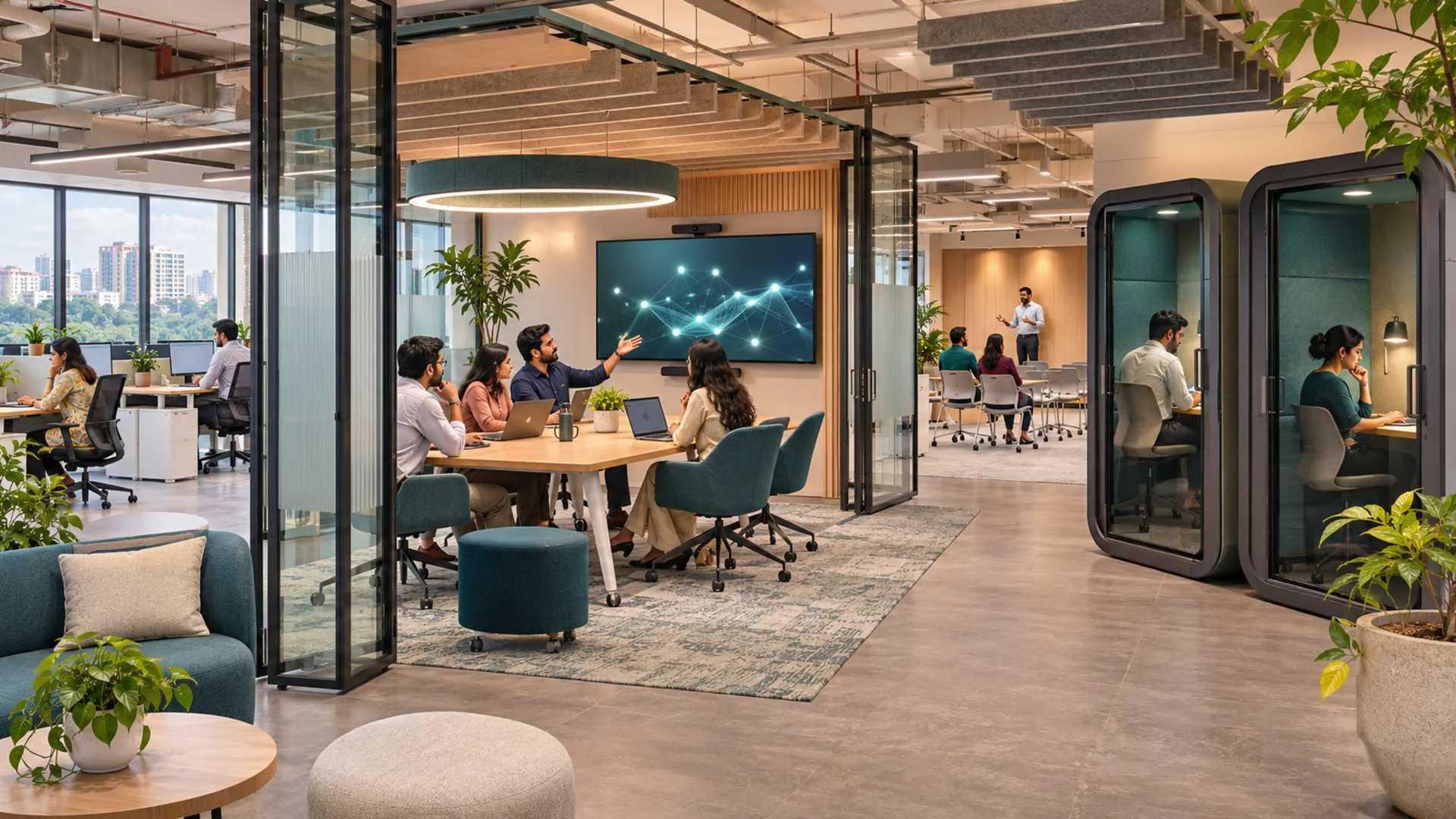


While the number of people working in offices in India is expected to rise to around 48 million in 2030, up from around 38 million in 2025 ETEnterpriseAI, Cushman & Wakefield, Nov 2026), a new narrative is emerging around the types of space. Adaptable space, dependable infrastructure and flexible environments are becoming increasingly important. Developers, landlords and users must consider how workplaces will evolve in the future. However, we should not assume that automation means fewer people or sq ft are required in the workplace.
How Will AI Change Office Requirements by 2030?
AI could shift office requirements towards adaptable layouts, dependable digital infrastructure and spaces supporting focused work, collaboration and learning. Its effect on total office demand will depend on hiring, business expansion, attendance policies and space utilisation. Companies should connect workplace decisions to changing workflows rather than assume a fixed reduction in office space.
India’s Office Demand Forecast Challenges the Empty-Office Narrative
The relationship between AI and commercial real estate is more complicated than “automate a job, remove a desk.”
A company might use productivity gains to reduce recruitment. Another might expand its services, enter new markets or create roles requiring different skills. The resulting property requirements can move in different directions.
Cushman & Wakefield’s “AI Impact Scenarios: India” models several possible outcomes rather than presenting one inevitable future. Its assessment expects India’s office-using workforce to grow across its scenarios, with Global Capability Centres, or GCCs, supporting expansion even as the pace of IT services hiring changes.
The November report coverage also highlights an important distinction between employment growth and building occupancy:
| Indicator | 2025 position | Reported outlook |
|---|---|---|
| Office-using workforce | Around 38 million | Around 48 million by 2030 |
| Office vacancy | 14.3% | Projected to peak at 16.2% in 2029 |
| Office vacancy in 2030 | — | Projected to ease to 15.5% |
Employment can expand while vacancy rises because developers are also adding supply. A growing workforce does not guarantee that every building will attract tenants.
That makes building quality, location and adaptability central to the office market outlook.
Different Work Could Require a Different Office Layout
The most immediate change may happen inside the floor plate.
Gartner’s June 2026 analysis describes a shift towards multidisciplinary teams working alongside AI agents. It also emphasises investment in data quality, governance, people and change management. This is organisational guidance, rather than a prescription for how many meeting rooms a company needs.
The practical real estate implication is that companies should examine activities before allocating space.
If a team spends less time preparing routine information and more time reviewing decisions, it may need places for discussion alongside quiet areas for checking work. Employees learning unfamiliar tools may need spaces for demonstrations and supervised practice.
These are planning possibilities, not universal outcomes:
| Changing activity | Office provision worth evaluating |
|---|---|
| Reviewing AI-assisted work | Quiet rooms and spaces for team review |
| Cross-functional problem-solving | Adaptable project rooms |
| Staff training | Rooms suitable for demonstrations and workshops |
| Hybrid teamwork | Meeting spaces with usable audio and video |
| Confidential work | Enclosed areas and appropriate access controls |
These are editorial planning implications. The appropriate mix depends on each organisation’s work.
The office of 2030 may need a better balance of settings, rather than simply more collaborative space. Replacing every desk with a lounge would overlook people who still need sustained concentration.
Reliable Infrastructure Could Matter More Than Visible Technology
An impressive screen in reception says little about whether a building supports everyday work.
NTT DATA’s March 2026 discussion of “Future of Work 2030,” based on Everest Group research involving more than 330 organisations globally, argues that fragmented workplace and network systems can undermine technology investment. Its emphasis is on connecting systems and supporting adoption, rather than adding isolated tools.
For an occupier inspecting an office, this suggests practical questions. Can employees use their tools reliably throughout the space? Do meeting rooms work consistently? Who resolves failures involving several service providers?
The answer requires coordination between real estate, facilities, IT and business teams. A property decision based only on rent and seating capacity may miss requirements that emerge during fit-out or occupation.
Companies should also distinguish their own infrastructure requirements from the landlord’s responsibilities. Record what the building provides, what the tenant must install and who maintains each part.
A workplace becomes useful through dependable performance, not the number of technologies listed in its brochure.
Flexible Offices Could Help Companies Manage Uncertain Space Needs
AI adoption creates uncertainty about team size, skills and working patterns. Committing to a rigid layout before understanding those changes can make later adjustment expensive.
In its August 2026 workplace commentary, Enzyme Offices argues that companies will increasingly seek spaces that can expand, contract or be customised as teams change. As a managed-office provider, it presents an industry perspective that occupiers should assess against actual contractual terms.
Cushman & Wakefield’s scenario research similarly encourages occupiers to map workflows to space and evaluate options such as flexible accommodation, expansion rights and lease breaks.
Flexibility can take several forms. An established company might retain a conventional headquarters while using managed space for a developing team. Another may prioritise a building whose layout can be altered without a wholesale refit.
A flexible-office agreement still needs scrutiny. Compare notice periods, expansion availability, fit-out restrictions, service charges and exit costs.
The relevant question is how the arrangement helps the company respond when its requirements change.
AI Could Widen the Gap Between Desirable and Outdated Offices
Occupiers already expect AI to influence property decisions.
JLL’s October 2026 “India office market 2030” analysis reports that 77% of Indian business leaders surveyed expect AI to reshape their portfolios within three to five years. Only 19% were actively optimising AI in real estate operations. The figures indicate an expectation of change alongside an implementation gap.
For landlords, that creates an opportunity to offer buildings that can accommodate different workplace configurations. It also creates a reason to investigate what tenants actually need before committing to upgrades.
Adding a technology label to an inflexible property will not resolve an inconvenient commute, poor maintenance or unsuitable internal space.
For developers, the stronger proposition is a building whose capabilities are clear and demonstrable. For occupiers, the task is to separate necessary features from expensive extras.
AI may make office selection more demanding, even where total demand continues to grow.
What Companies Should Check Before Their Next Lease
A 2030 workplace strategy can begin with the next renewal or expansion decision.
Start by understanding current use. Which rooms are difficult to book? Which areas remain empty? Where do employees struggle to concentrate or collaborate? Then assess how planned changes to work could affect those patterns.
Before signing, bring these questions into the decision:
- Workforce: What are the plausible hiring and role-change scenarios?
- Attendance: How many people need space on the busiest days?
- Layout: Can the office accommodate different activities over time?
- Infrastructure: Are technical requirements and responsibilities documented?
- Adaptability: What would a later reconfiguration involve?
- Commercial terms: What options exist to expand, reduce or leave?
- Performance: How will the company assess whether the workplace is helping?
Avoid using a single headcount forecast as the entire accommodation plan. Two teams of the same size may have very different requirements.
Equally, do not assume that AI productivity gains will arrive on the same timetable across every department. Phased decisions can leave room to learn from actual experience.
By 2030, the Office Will Need to Earn Its Place
AI is likely to change the work performed in offices, but the available research does not support one simple answer about how much space every company will need.
The stronger direction is towards workplaces that can accommodate changing activities, connect people with reliable systems and adjust as businesses learn. Some organisations may reduce space; others may expand or change their composition.
For India’s commercial real estate sector, the opportunity is to deliver offices that remain useful through those transitions. The most persuasive office address will combine a practical location with the ability to support the work happening inside.