NBCC’s ₹5,191 Crore Auction Shows How Home Sales Rebuild Delhi
NBCC’s ₹5,191 Crore Auction: How Delhi Redevelopment Works
SHARE:
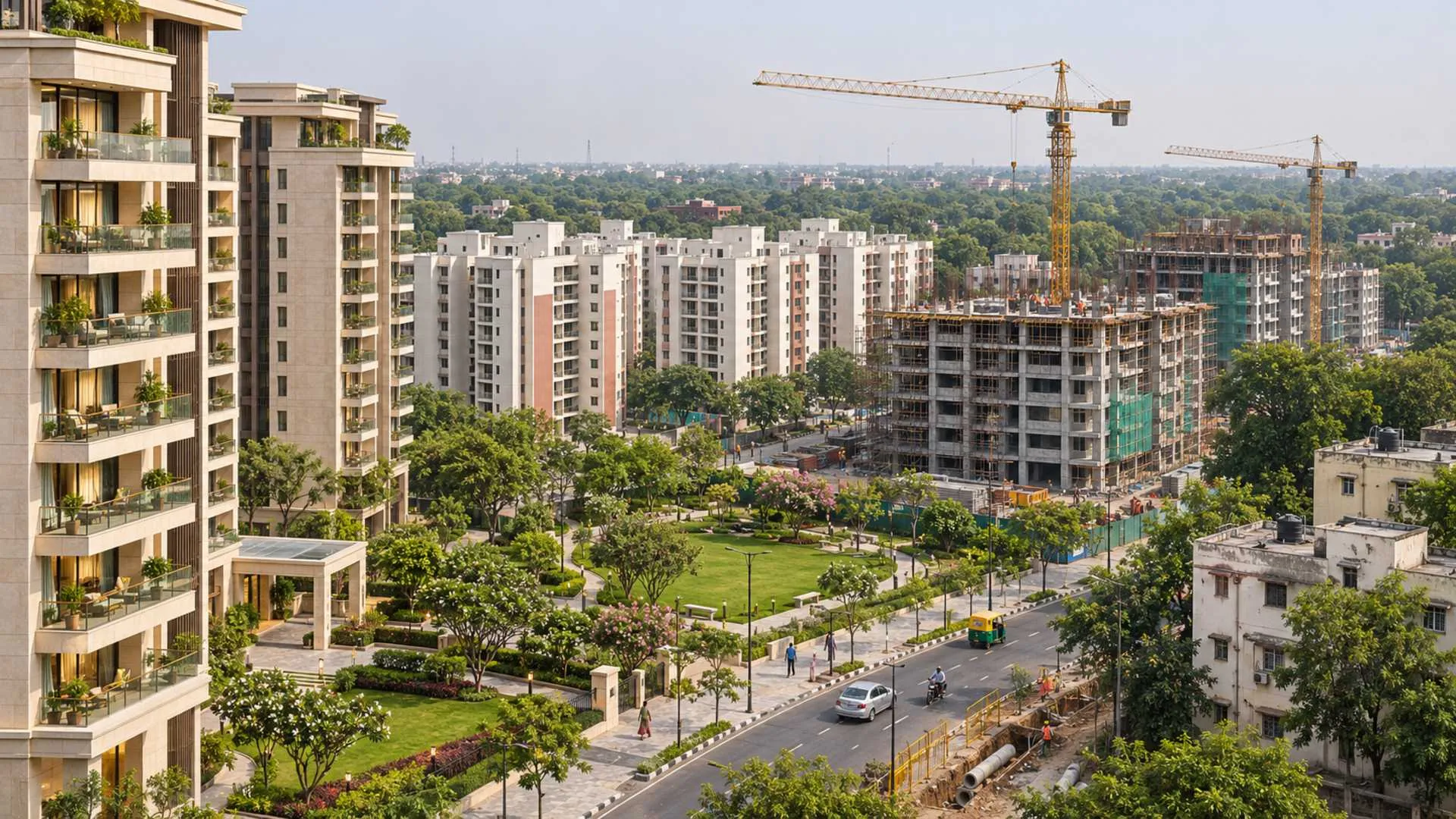


The sale of a luxury apartment in South Delhi has raised a larger question: how can premium housing be used to fund redevelopment of government areas?
In a recent e-auction of Avenue Towers by NBCC, the public sector firm said that it sold around 8.80 lakh sq ft of residential space for ₹5,191 crore at Africa Avenue Marg in Sarojini Nagar. This transaction, as Mint reported, will go towards the central government’s redevelopment scheme. Thus, the high demand for premium residential properties is being used as a funding source for public assets.
This headline highlights that there is high demand for such a premium residential property within NBCC e-auction 2026. However, it also highlights the potential for using existing government land values to fund their redevelopment.
How does NBCC fund Delhi colony redevelopment?
NBCC helps fund Delhi’s government colony redevelopment by selling designated commercial and premium residential space through e-auctions. Proceeds support replacement government housing, offices and associated infrastructure under the seven-colony GPRA programme. The model seeks to meet redevelopment costs through asset monetisation rather than additional government budget support.
The ₹5,191 crore headline and the number behind it
The Avenue Towers transaction makes the mechanics of government land monetisation in India unusually visible: valuable property is sold, and the proceeds support a wider rebuilding programme.
But one distinction matters immediately. ₹5,191 crore is the reported property sale value, not NBCC’s profit.
Sahi reported that NBCC is entitled to a 1% marketing fee, equivalent to approximately ₹51.91 crore on the announced value. That fee must itself be distinguished from net profit and cash already collected.
This is essential context for anyone encountering NBCC share price news alongside the auction announcement. A large transaction can support project funding and fee income, but its headline value does not automatically become company earnings.
Pricing also deserves attention. The Pioneer reported an average sale rate of ₹59,014 per sq ft, against a reserve rate of ₹37,161, with the highest bid reaching ₹89,061 per sq ft. The reported average was nearly 60% above reserve. These are auction-specific outcomes, not a ready-made valuation for every nearby apartment.
Seven colonies, one larger redevelopment programme
GPRA stands for General Pool Residential Accommodation: government housing intended for eligible employees.
The seven-colony programme combines different sites and implementing agencies. NBCC handles Sarojini Nagar, Netaji Nagar and Nauroji Nagar. CPWD handles Kasturba Nagar, Sriniwaspuri, Mohammadpur and Thyagraj Nagar.
According to NBCC’s official releases, the programme is expected to create more than 21,000 government residential units, at an estimated cost of around ₹32,000 crore. The March 2026 announcement also recorded the inauguration of more than 2,700 government flats and foundation-laying for over 6,600 additional flats and Bharat Business Park.
The scale explains why residential and commercial sales both matter. Government employee housing, office accommodation and supporting facilities require substantial funding; premium saleable space provides a way to generate it.
Nauroji Nagar already offers a completed example. Its World Trade Centre was inaugurated in January 2025, showing how a government colony redevelopment can produce a major commercial asset.
How home sales fund government colony redevelopment in Delhi
The self-financing model connects three decisions: what the government retains, what it rebuilds and what it sells.
A portion of a redevelopment site generates saleable residential or commercial space. Buyers pay for those assets. The resulting revenue supports the broader programme’s construction and infrastructure obligations.
The Press Information Bureau describes this approach as monetising a limited part of the project area to finance modern government housing, supporting infrastructure and public facilities.
That is the practical meaning of “sell premium to build public” in Sarojini Nagar and Netaji Nagar redevelopment.
However, “without burdening the public exchequer” should be read as a financing objective. Government land remains a valuable public contribution. The programme must also manage construction costs, sales timing and delivery obligations.
Self-financing does not mean cost-free; it means using project assets to meet project costs.
Nor should government employee accommodation be confused with housing available to every member of the public. The public benefit here includes renewal of government assets and associated infrastructure, while the programme’s residential beneficiaries have a defined eligibility framework.
Bharat Business Park shows why offices matter too
Residential sales are only part of the story.
NBCC’s initial Bharat Business Park commercial e-auction generated ₹5,779.44 crore, covering five of eight towers. A later September 2026 update reported that all eight towers, spanning approximately 23.44 lakh sq ft, had been sold for about ₹10,000 crore.
The earlier auction amount forms part of that later total. Adding both would double-count sales.
Taken together, the reported Bharat Business Park and Avenue Towers figures illustrate how self-financing government housing projects in India can draw on different property markets. Offices attract commercial buyers; premium apartments reach residential purchasers.
The distinction also matters when asking how much NBCC has “earned” from auctions. Sale commitments, collections, project funding and company fees answer different questions. A reliable cumulative total requires disclosures that separate them.
What Delhi homebuyers should check before bidding
For buyers asking how to buy an NBCC auctioned flat in Delhi, the starting point is the current official notice, not an old advertisement or a social-media price.
The earlier 262-flat Avenue Towers offering near Chanakyapuri, advertised above ₹15 crore, was cancelled in August.
Buyers should therefore distinguish historical launch descriptions from the inventory, pricing and conditions of a subsequent auction. Avenue Towers’ official address is in Sarojini Nagar on Africa Avenue Marg; proximity to the Diplomatic Enclave should not turn it into an assumed separate Chanakyapuri project.
NBCC’s published bidder manual outlines enrolment on the designated auction platform, document submission, account activation, unit selection and the required transaction-fee and earnest-money payments.
Before participating, buyers should:
- Read the latest brochure and every applicable corrigendum.
- Confirm the area definition, ownership terms, approvals and possession conditions.
- Calculate taxes, registration, maintenance and other charges beyond the bid.
- Review payment deadlines, cancellation provisions and deposit-forfeiture clauses.
A reserve price is an auction starting point, not a guaranteed purchase price. Set a maximum total budget before bidding begins.
Comparisons with DDA housing or private-builder flats should use the actual property, location, specifications and contractual terms. Public-sector involvement alone cannot settle which purchase offers better value.
Can Mumbai and Pune replicate the model?
The Avenue Towers result gives other cities a case study, but replication requires more than valuable land.
A workable urban redevelopment model for Indian cities needs clear ownership, permissible development capacity, credible demand and a realistic construction budget. Existing occupants must also have enforceable arrangements for relocation and return where applicable.
In Mumbai, a redevelopment involving long-standing occupants may face different obligations from Delhi’s GPRA programme. In Pune, achievable selling prices and local construction costs would determine whether enough surplus could fund replacement assets.
The useful question is: after meeting all redevelopment obligations, does saleable space generate enough revenue to complete the public component?
The NBCC approach can also overlap with a public-private partnership. Self-financing describes the funding mechanism; PPP describes how responsibilities and risks are shared between public and private participants. Neither label, by itself, proves that a project will succeed.
NBCC’s Amrapali work in Noida and Greater Noida should likewise be assessed separately. Those court-supervised stalled-project arrangements have their own obligations; their auction figures should not be casually added to Delhi’s GPRA funding totals.
South Delhi’s next test is delivery
What does the ₹5,191 crore Avenue Towers auction mean for surrounding property prices?
The result indicates willingness to pay substantial amounts for the auctioned homes. It does not establish a guaranteed rise across South Delhi. Nearby valuations will depend on each property’s condition, access, ownership terms, competing supply and the quality of completed infrastructure.
The wider test of government colony redevelopment’s impact on property prices will come as rebuilt neighbourhoods function in practice. Better facilities may strengthen an area’s appeal; construction disruption and infrastructure pressure can complicate that picture.
NBCC’s auction has made the financing proposition tangible. Premium homes can help fund urban renewal, but the lasting achievement is completed housing and infrastructure.