MahaRERA Registers 435 Projects: Eight Checks Before Booking Your Home
MahaRERA 435 Projects: 8 Checks Before Booking a Flat
SHARE:
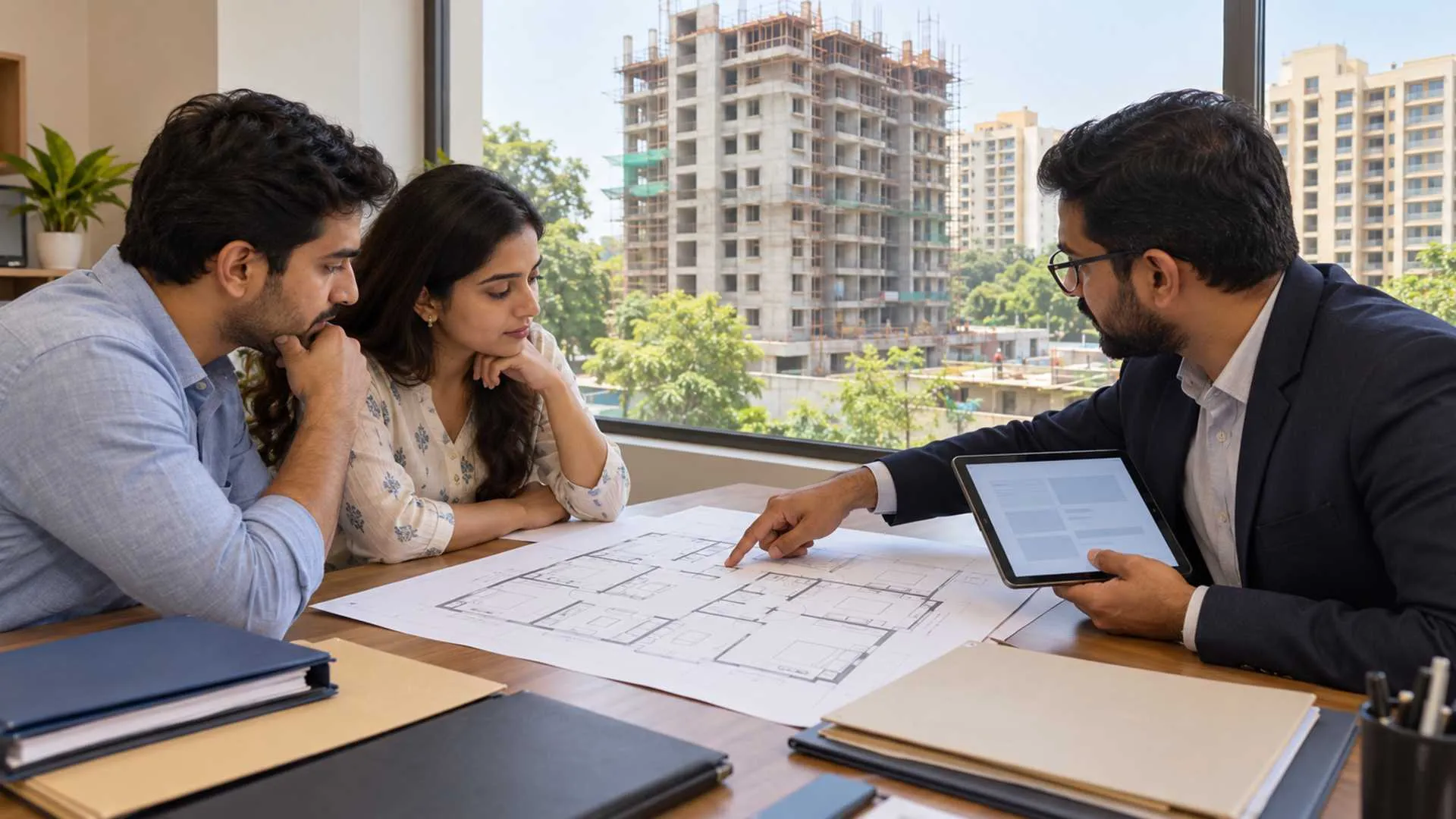


While the festive offer may end today, your home loan might last decades. But between those two points, there are documents you should consider looking at. Specifically, the MahaRERA registration for the project.
While the announcement of 435 new projects being registered under MahaRERA around Dussehra 2026 increases the availability of housing stock in the regulated sector, it is not necessarily an easy booking decision.
These 32,981 proposed flats are expected to have an investment of ₹23,719 crore (Free Press Journal, 23 October).
Now, if you are looking to buy a property registered under MahaRERA in Maharashtra in 2026, you need to dig further into the specifics of the development. Ensure that the project has a coherent story, from registration, permissions, construction status and contractual promises.
What should buyers check after MahaRERA registers new housing projects?
Verify the exact project and phase, current registration status, completion date, sanctioned plans, commencement certificate, title and encumbrance disclosures, construction updates, complaints and agreement terms. Registration provides a framework for disclosure and accountability; buyers must still examine the property, promoter and documents before booking.
What the 435 registrations actually mean
The festive announcement contains three different regulatory actions. Treating them as one category can obscure what has happened to a project.
| Regulatory action | Reported number | What buyers should examine |
|---|---|---|
| New project registrations | 435 | The registered phase, permissions and declared commitments |
| Extensions | 210 | Revised validity, reasons and contractual possession obligations |
| Corrections | 609 | What changed in the project’s disclosed information |
The supplied PropNewz explainer distinguishes registrations, extensions and corrections. Its central implication is useful: an extension or correction is a reason to read the relevant documents closely. It is not, by itself, proof of misconduct.
Pune recorded 140 new registrations in the reported festive batch, while a broader Mumbai–Konkan grouping accounted for 201. Published coverage calls the latter MMR, but its breakdown includes Ratnagiri and Sindhudurg alongside Mumbai, Thane, Raigad and Palghar.
The wider Pune-area breakdown also lists 13 projects in Satara, eight in Kolhapur, and three each in Sangli and Solapur. Three registrations in the overall batch were reported in Dadra and Nagar Haveli and Daman, so the total should not be described as exclusively Maharashtra projects.
These are festive-batch figures, rather than full-year Pune or Mumbai totals. Mid-day separately reported 2,491 new registrations from April 2026 through 19 October, alongside extension and correction applications. Application clearances should not be confused with new housing projects.
How to check MahaRERA project registration before buying
Buyers searching “maharera.mahaonline.gov.in project search verification” should begin with the regulator’s current official project-search page.
Select registered projects, enter the project name or MahaRERA registration number, and narrow the results by district or other available filters. Open the certificate and project details; check any extension certificate as well. The official website also provides revoked-project and abeyance lists.
Match the number to your building or phase, not merely the development’s marketing name. Save dated copies of the records you rely on.
The supplied Nirman Developers checklist reinforces the need to compare registration details, carpet area and completion timelines with the sales presentation. Rising Spaces similarly recommends checking progress disclosures and litigation before purchasing.
The eight checks before booking a flat
1. Confirm the legal project identity.
Compare the certificate’s project name, promoter entity, location and phase with the booking form. A group brand may differ from the legal entity selling the apartment.
2. Read the current status and timeline.
Check registration validity, extension documents and the agreement’s possession date together. Ask for a written explanation if the salesperson promises handover substantially earlier than the contractual commitment.
3. Examine the commencement certificate and sanctioned plans.
Establish whether the permissions cover the building and floor being offered. A commencement certificate and an occupancy certificate serve different purposes; neither should be substituted for the other in a sales explanation.
4. Review title, mortgages and litigation.
Read the land-title report, encumbrance disclosures and ongoing litigation. Have an independent property lawyer examine material issues rather than treating a document upload as a title guarantee.
The Indian Express, reporting MahaRERA’s buyer guidance, specifically identifies commencement certificates, title clearance, litigation and encumbrances among the documents purchasers should examine.
5. Compare progress reports with the site.
Read the latest available quarterly updates and their reporting dates. Then visit the project. A recently uploaded document may describe an earlier reporting period, so distinguish the upload date from the work it records.
6. Check builder complaints and track record.
Use project-wise and promoter-wise complaint searches, then read the orders and outcomes. A complaint is an allegation, not an established finding; equally, an absence of listed complaints does not establish delivery quality. MahaRERA provides both complaint-search routes and a judgments section.
7. Reconcile the apartment and promised amenities.
Compare carpet area, layout, parking arrangements, facilities and amenity-delivery commitments with the draft agreement. Ask what is included in your phase and what depends on a later one.
8. Read the agreement and payment schedule.
Review possession, cancellation, refund, maintenance and additional-charge provisions. Under Section 13 of the RERA Act, a promoter cannot accept more than 10% of the apartment’s cost as an advance or application fee without first entering into and registering the agreement for sale.
Pune project examples: Why the exact registration matters
The checklist applies equally to RERA-registered flats for sale in Pune, new housing projects in Mumbai, and developments in Thane or Navi Mumbai.
The following published references illustrate how buyers can begin verification. They are not a list of projects included in the 435-registration batch, and their current status must be checked independently.
| Project being researched | Published reference and buyer action |
|---|---|
| Saheel Luxton, Wakad | Published registration reference: PM1260002502043. Match the certificate, promoter and building offered. |
| Shubh Tristar, KP Annexe–Mundhwa | Published references include P52100052695 for Wing A and P52100055763 for Wing B. Confirm your wing. |
| Mantra Melange, Kharadi | The developer’s brochure identifies P52100079582, registered as Mantra Kharadi Phase 1. Match the marketing and registered names. |
| ARV New Town, Undri–Pisoli | Listings identify multiple phase registrations. Obtain the number applicable to your apartment. |
| Manisha Constructions’ 64 Hills, Bavdhan | Published registration reference: P52100055915. Review the current certificate and disclosures. |
| Excellaa projects, Bavdhan and Pimple Nilakh | The developer publishes separate project numbers, including P52100047444 and P52100054268. Search the particular development. |
Sources: Square Yards, Mantra Properties’ brochure, Housing.com and Excellaa’s project website. These are published search references, rather than a certification of present compliance.
The Mantra example demonstrates a practical point: a marketing name can differ from the registered name. Searching only the brochure headline may therefore miss the relevant record.
The 70% rule, delays and advertisements without registration
The RERA 70% escrow account rule is better understood as a separate-project-account requirement. Section 4 requires 70% of amounts realised from allottees to be deposited in a separate scheduled-bank account for land and construction costs, with withdrawals linked to completion and professional certification.
It supports financial discipline; it is not a government guarantee that buyers’ money cannot be lost or that delivery cannot be delayed.
MahaRERA’s three-tier scrutiny process examines legal, financial and technical matters. The Indian Express reported its introduction in January 2024. That scrutiny makes registration meaningful, but buyers still need to monitor what happens after registration.
If possession is delayed, examine the agreement and applicable orders before deciding on a claim. As PropNewz explains, an extension of registration must be considered alongside the buyer’s contractual rights; the revised portal date does not, by itself, answer every delay-compensation question.
If a builder advertises without a registration number, first establish whether registration is legally required or an exemption applies. Where registration appears mandatory, preserve the advertisement and use MahaRERA’s Inform Non-Registration route. For a complaint, organise the agreement, receipts, correspondence and requested relief before following the regulator’s online filing guidance.
More choice should mean better comparison
Maharashtra’s festive-season housing launches give purchasers more options and developers an opportunity to demonstrate transparency through accessible documents and clear commitments.
The most useful response to MahaRERA’s 435 registrations around Dussehra 2026 is to compare projects on evidence. Check the same eight points across every shortlist, regardless of launch discounts or developer familiarity.