AI Turns Property Panoramas Into 3D Homes: What Research Shows
AI Turns Property Panoramas Into 3D Homes: Research
SHARE:
A property photograph can portray a beautiful living room. It is less capable of providing information on how that room relates to the kitchen, corridor, or other bedrooms.
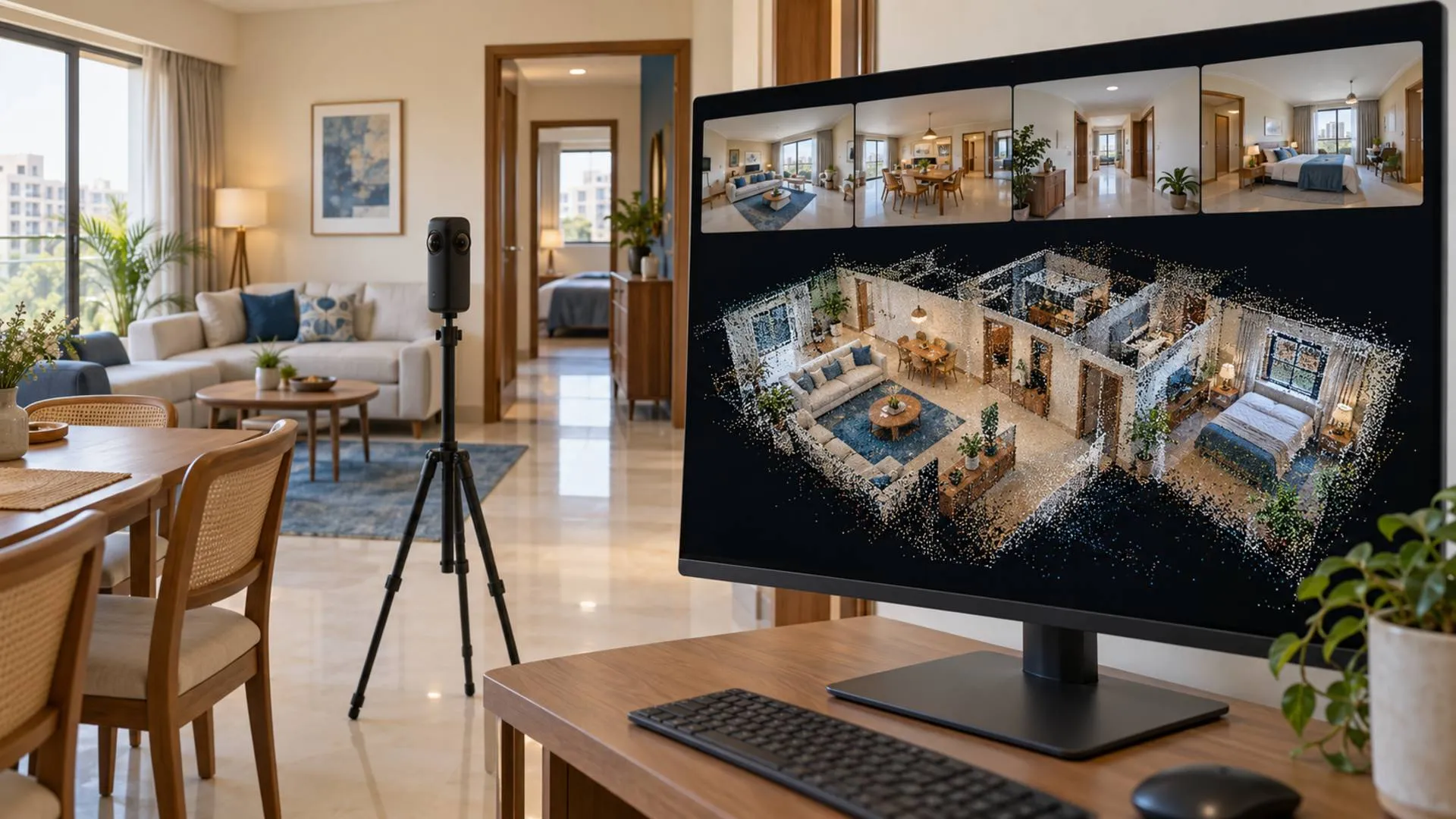
AI research is beginning to bridge that gap. CasaMaestro, a 2026 research project, is an example. The project is able to form house-scale 3D reconstructions from 20-50 indoor panoramas. It can provide a potential foundation for more spatially informative property experiences.
The transition of interest for the technology of real estate would be from showcasing single perspectives to portraying how an interior fits together. That could allow buyers to ask more informed questions prior to visiting a property.
The research does not establish that any collection of listing photographs can form a perfectly accurate digital home, however. It is essential to understand the inputs, outputs and limitations in order to identify the opportunity.
What does new AI research show about turning property panoramas into 3D homes?
CasaMaestro demonstrates that 20–50 indoor panoramas can support house-scale 3D reconstruction by predicting depth and camera positions. The result is a spatial point-cloud representation, rather than merely linked photographs. It suggests possibilities for property visualisation, but does not establish survey-grade accuracy or remove the need to inspect and verify a home.
CasaMaestro: connecting panoramic views across a home
Developed by Yuzhou Ji, Xiaotian Yang and Zhipeng Zhang at Shanghai Jiao Tong University’s AutoLab, CasaMaestro addresses a problem familiar to anyone browsing property listings: fragmented views provide an incomplete understanding of space.
The research paper describes a model that predicts metric depth, the estimated distance to surfaces and camera poses, meaning the positions and orientations from which images were captured. Together, these enable house-scale point-cloud reconstruction. The authors report experiments on real-world and synthetic scenes.
A point cloud represents surfaces through collections of points in three-dimensional space. It is not automatically a finished architectural model or a polished sales walkthrough.
The CasaMaestro project page describes a DINOv2-based visual backbone that processes information within and across panoramic views. For property professionals, the practical significance is the attempt to relate multiple viewpoints within one spatial reconstruction.
The demonstrated input is 20–50 panoramas, not one photograph of an entire house.
That distinction matters when assessing claims that AI can turn ordinary property images into complete, dependable models.
Several research advances, rather than one universal tool
The supplied references describe different problems and should not be combined into a single breakthrough.
DongA Science’s July 2025 article covers HUSH, not CasaMaestro. The underlying CVPR 2025 paper presents panoramic scene understanding using spherical harmonics, including depth, surface-normal and room-layout estimation. This concerns interpreting a panoramic scene, rather than demonstrating CasaMaestro’s multi-view house-scale pipeline.
The supplied ACM reference is another separate study. Hamad Bin Khalifa University’s publication record identifies it as a 2025 case study involving the Bluu Casa showroom in Doha Design District. It demonstrates a workflow from consumer-grade 360-degree capture to immersive WebXR viewing.
Related research explores other stages of the experience:
| Research | What it investigates |
| HouseTour | Generating spatially informed camera trajectories and property summaries |
| Top2Pano | Synthesising indoor panoramas from top-down views, including schematic floor-plan inputs |
The HouseTour research and Top2Pano project illustrate that reconstruction, presentation and image generation are distinct tasks. Their outputs should be evaluated accordingly.
For a newswire audience, the accurate story is continuing progress across 2025–2026 research, rather than one newly launched commercial product that performs every task.
What could change for property buyers in India?
The strongest potential application is better preparation before a physical viewing.
An NRI comparing homes in Pune or Mumbai could use an interactive representation to investigate room connections and identify areas requiring closer inspection. A local buyer could revisit the layout after a site visit or share it with family members involved in the decision.
These are potential applications, not measured Indian-market outcomes demonstrated by the papers.
For developers, a coherent 3D property model could make explanations more concrete. Instead of discussing a room in isolation, a sales representative could discuss its relationship to adjoining spaces.
The distinction between existing and proposed homes remains crucial. A reconstruction based on captured interiors serves a different purpose from an AI-generated visualisation of an unbuilt apartment.
Buyers should be told whether they are viewing captured conditions, inferred geometry, virtual staging, or a proposed design.
That disclosure makes the technology more useful. It allows viewers to understand which questions the experience can answer and which still require plans, measurements or an inspection.
Commercial virtual tours already use different approaches
The supplied product websites show why “AI virtual property tour” is a broad label.
PropertyPixel advertises browser-based scenes generated from photographs or a short video. Its own description explicitly says the result depends on source material and is not a measured property survey.
Kukan describes an on-site capture workflow, 3D Gaussian Splatting and a conversational guide informed by listing details. Aginera, meanwhile, advertises converting uploaded floor plans into interactive 3D models. These are vendor-described capabilities, not independent evidence that the tools perform identically or use CasaMaestro.
A developer evaluating proptech in India should therefore start with the required output: an attractive visualisation, a navigable tour, a spatial reconstruction or reliable measurements.
Those objectives demand different checks. A compelling demonstration alone cannot establish suitability for every listing.
Accuracy, capture quality and the role of professionals
CasaMaestro’s own project page identifies a revealing failure case: a lack of connecting viewpoints between adjacent rooms can produce poor predictions.
The implication for property capture is straightforward. Good coverage and connections between spaces remain important even when AI performs more processing.
Professional photographers and capture specialists can contribute through planning, lighting, coverage and review. The research does not demonstrate that those responsibilities disappear.
Before publishing an AI-generated home experience, check:
- Geometry: Do doors, walls and room connections match the property?
- Presentation: Are generated furnishings and altered finishes clearly disclosed?
- Measurements: Which dimensions were measured, and which were inferred?
- Coverage: Are any rooms or areas missing?
For remote buyers, the tour should support targeted follow-up questions. Request a live walkthrough, relevant documents and independent checks before committing to a purchase.
The future of AI property technology may involve fewer disconnected images and more useful spatial experiences. From property panoramas to 3D homes, the demonstrated progress is promising; trustworthy presentation will determine its practical value.
Explore property questions through RealtyConnect, and ask how any digital tour was created before relying on it. For developers, the next step is to test a representative property, review the output against reality and publish it with clear disclosures.

FAQs:
 DDA Offers 2,516 Flats Near ₹15 Lakh: What Buyers Should Know