One Buyer, One Mumbai Tower: What the ₹711 Crore Deal Reveals
₹711 Crore Juhu Tower Deal: What It Means for Mumbai Luxury
SHARE:
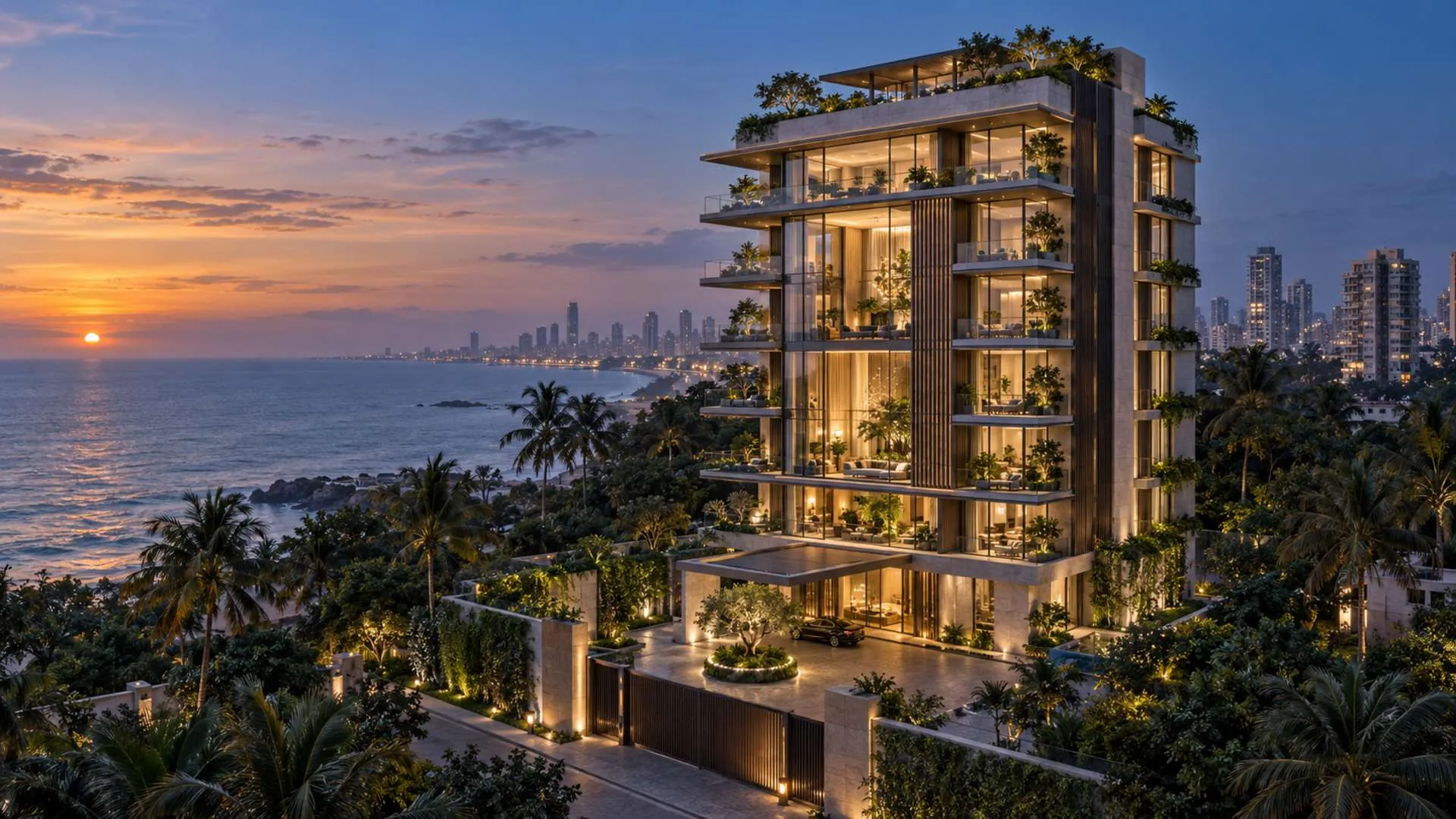
The most recent headline concerning luxury housing in Mumbai does not refer to a penthouse; rather, it concerns an entire tower being designed as a single-family home.
On 22nd September 2026, Embassy Developments Limited announced that it had entered into a memorandum of understanding with Dinesh Thakkar, who is the founder, chairman and managing director of Angel One, regarding the proposed sale of the entire residential tower at Embassy Terazza on Juhu Tara Road; the stated value of the transaction is about ₹711 crore.
The size of the property is exceptional since it is a tower of G+7 storeys offering a carpet area of about 63,000 sq ft, and Embassy has referred to it as the largest single residential unit transaction in India. If you divide the amount announced by the carpet area mentioned, you get an implied benchmark of approximately ₹1.13 lakh per sq ft, before taking into account the exact way in which taxes, registration fees, fit-outs or other transaction costs are handled.
The more important point, however, is that it is not enough for a wealthy buyer simply to acquire one of the towers. The transaction illustrates the way in which the top end of Mumbai’s real estate market is shifting from buying the most desirable apartment in a building to taking control of the building as a whole.
What is the ₹711 crore Juhu tower deal, and what does it mean for Mumbai real estate?
Embassy Developments has signed an MoU to sell an entire G+7 residential tower at Embassy Terazza, Juhu, to Angel One founder Dinesh Thakkar for approximately ₹711 crore. The proposed home spans about 63,000 sq ft of RERA carpet area, implying nearly ₹1.13 lakh per sq ft. It signals strong demand for scarce, highly private and customisable residences at Mumbai’s ultra-luxury end, but it is not a reliable price benchmark for the city’s regular housing market.
The distinction between an MoU and a concluded sale matters. An MoU records the parties’ stated intention and commercial understanding; final agreements, payments, statutory charges and registration determine when a property transfer is legally completed. The announcement is therefore best described as a landmark proposed transaction rather than an already registered conveyance.
Inside Embassy Terazza and the ‘Angelus’ residence
According to Embassy Developments’ stock-exchange filing, Embassy Terazza is planned as a low-density ultra-luxury development across more than two acres. It is expected to contain approximately 50 residences across five towers, with one residence per floor, sea and city views, internal gardens, and curated wellness and lifestyle amenities.
The project carries an estimated gross development value exceeding ₹3,000 crore and is being developed by Embassy under a development-management model.
Thakkar has named the proposed family home “Angelus.” In the developer’s announcement, he identified privacy, spaciousness and sea views among his priorities. Those preferences help explain why buying the whole tower offers something even an enormous duplex cannot: control over arrival, circulation, floor planning, security and the building’s identity.
Reports in the Hindustan Times and The Economic Times placed the transaction at the centre of India’s record-setting luxury market. Yet this is more accurately read as a bespoke residence negotiated at institutional scale, not as eight ordinary flats purchased in bulk.
Why Juhu can support a transaction of this scale
Juhu’s attraction comes from a combination that Mumbai struggles to reproduce: coastline, established social infrastructure, proximity to the western suburbs’ business and entertainment districts, and extremely limited opportunities for large new development.
Juhu Tara Road also carries an address premium that cannot be reduced to carpet area. In an ultra-luxury Mumbai Juhu versus Worli versus BKC comparison, each market offers a different proposition. Worli sells skyline, new towers and links to South Mumbai; BKC and its surroundings sell access to the financial district; Juhu sells a lower-density coastal identity, established neighbourhood prestige and relative privacy.
The implied Embassy Terazza Juhu rate of about ₹1.13 lakh per sq ft is therefore partly a scarcity price. It reflects control of 63,000 sq ft within one low-density development, not merely the rate for a conventional luxury flat nearby.
That makes the deal valuable as a signal but weak as a comparable. A valuer assessing another Juhu property would still need to adjust for plot location, view, building age, carpet efficiency, ownership structure, amenities, floor, developer, completion status and transaction terms.
What the record reveals about Mumbai’s luxury market
First, privacy is becoming a product category. High-net-worth buyers are no longer paying only for a larger 3BHK flat in Mumbai or a trophy penthouse. They are buying controlled environments with private lobbies, dedicated services, limited neighbours and the freedom to shape multiple floors around one family.
Second, customisation now begins before possession. A whole-tower residence allows architecture, services and interiors to be coordinated at a scale that is difficult after a standard high-rise is completed. The buyer is effectively purchasing both property and the ability to commission a deeply personalised home.
Third, branded developer trust carries measurable value. At ₹711 crore, construction quality, delivery capability, privacy protocols and long-term maintenance become as important as location. Embassy said the deal reflects confidence in its brand after entering Mumbai.
Fourth, Mumbai’s ultra-luxury segment is becoming more distinct from the mass market. A family looking for a high-rise flat in Mumbai under ₹2 crore is affected primarily by salary, interest rates, commute and supply. A buyer considering an entire Juhu tower is driven by scarcity, wealth preservation, discretion and lifestyle control.
Both markets occupy the same city, but they do not obey the same affordability logic. The ₹711 crore deal does not mean every property in Mumbai is suddenly worth more. It may, however, strengthen confidence among developers planning rare, low-density projects in Juhu, Worli, Malabar Hill and other trophy locations.
What does a premium Mumbai flat really cost?
The headline price is only the beginning. The all-in budget may include stamp duty, registration, GST where applicable, parking or amenity charges, legal review, brokerage, society deposits, maintenance and interiors.
For example, a buyer evaluating a ₹2 crore new flat in Mumbai in 2026 should distinguish between an under-construction home and a completed property. A non-affordable under-construction residential unit generally attracts 5% GST without input-tax credit, while a completed home sold after the completion or occupancy certificate is generally outside GST. Maharashtra stamp duty varies with location and buyer category, and applicable concessions or cesses must be checked on the state registration portal at the time of purchase.
Premium towers also carry higher recurring costs. Facade upkeep, high-speed lifts, central systems, pools, security, landscaping and concierge services can result in substantial maintenance and sinking-fund contributions. There is no verified basis for applying a generic ₹60,000 maintenance figure to Embassy Terazza or another premium tower Mumbai project; buyers must obtain the actual rate, calculation area, escalation clause and corpus requirement from project documents.
Before booking a premium flat in Mumbai, calculate:
- the agreement value and every statutory charge;
- the cost of interiors, appliances and move-in work;
- monthly maintenance, property tax and insurance;
- financing cost across the full loan term; and
- the resale depth for that unit size and price bracket.
Should a first-time buyer choose a Mumbai high-rise?
A high-rise can offer better views, security, amenities and newer services, but height alone does not make a good purchase. A first-time buyer should examine the developer’s track record, MahaRERA registration, sanctioned plans, fire approvals, lift redundancy, water source, power backup, evacuation systems, maintenance budget and possession schedule.
An Andheri or Goregaon first home may be more sensible than stretching for an address-driven luxury flat. A Navi Mumbai premium tower may offer more space at a lower entry cost, but buyers must compare commute, neighbourhood occupancy and future supply.
For a Western suburbs Mumbai premium tower under ₹1.5 crore, or any advertised price, check whether the figure is a base price, whether it includes floor-rise and parking, and which carpet area is being quoted. Never compare a super-built-up marketing rate with a RERA carpet-area rate.
What happens to a Mumbai apartment after 30 years?
Age does not automatically destroy value. Over three decades, the structure depreciates, but the underlying land interest, address, connectivity and redevelopment potential may appreciate. A well-maintained society on clear-title land can remain valuable; a poorly managed building with unresolved conveyance, lease issues or structural problems may struggle despite an excellent postcode.
DCPR 2034 can create redevelopment possibilities for eligible plots and building categories, but it does not guarantee an uplift for every 30-year-old property. Feasibility depends on plot size, road width, permissible FSI, reservations, title, tenant or member consent, rehabilitation obligations and prevailing construction economics.
Buyers comparing a freehold and leasehold 30-year Mumbai flat should also study the remaining lease, renewal conditions, ground rent and permissions for transfer or redevelopment. Long-term value is ultimately a combination of land, legal clarity, building management and the market’s willingness to pay for that location.
One tower, two very different Mumbai stories
The Embassy Developments–Dinesh Thakkar MoU creates a dramatic new marker for Mumbai real estate in 2026: one buyer, one G+7 tower and a proposed ₹711 crore family residence named Angelus.
For the ultra-rich, the transaction shows that the next level of luxury is not another bedroom. It is control over space, neighbours, services, views and design. For regular buyers, the lesson is more practical: price per sq ft never tells the whole story, and the real cost of owning a flat in Mumbai extends well beyond the agreement value.
The deal may create hype around the Juhu ultra-luxury property market, but it should not pressure a first-time buyer into chasing a trophy address. The best property in Mumbai is the one whose title, cash flow, location and long-term usefulness work for its owner, not the one attached to the biggest headline.