

GCC Expansion Is Driving India’s Office Market Boom in 2026
GCC expansion is reshaping India’s office market in 2026.
SHARE:
What are GCCs and how much office space do they need in India?
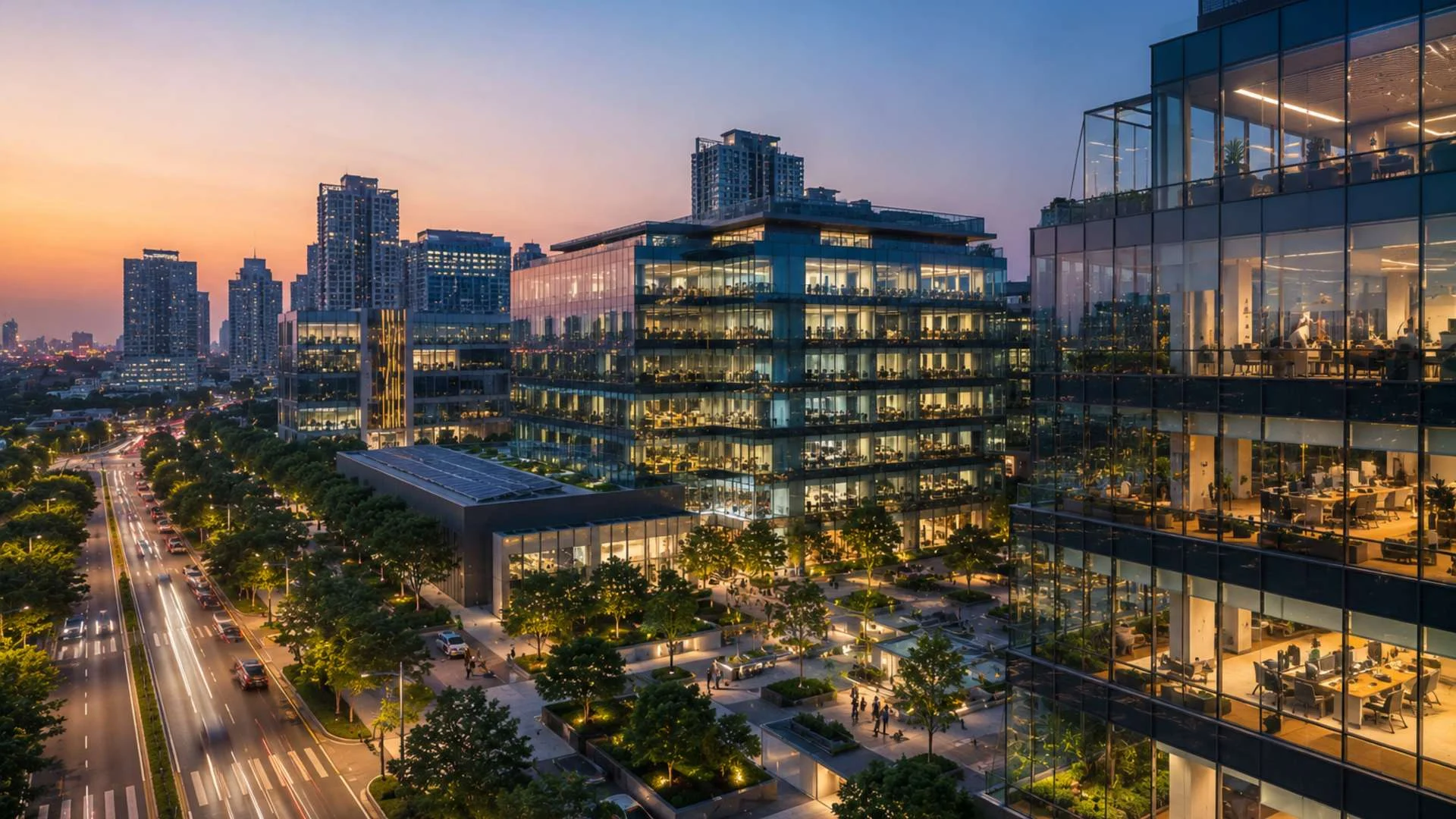
Global Capability Centers (GCCs) are dedicated offices set up in India by multinational corporations for functions like technology, artificial intelligence, engineering, analytics, finance and research. GCCs contributed 46% of the total leasing in H1 2026, leasing approximately 16.6 million sq. ft of grade A office space in the top seven cities in India.
India’s office market is on the cusp of a new chapter and this time the biggest demand story is not just IT outsourcing. India is at the center of global innovation, product development and high-value decision-making as a consequence of the growth of the GCC.
That shift is putting Grade A offices, premium business districts and emerging commercial corridors on the radar.
GCCs Are Taking Nearly Half the Office Market
The numbers explain why developers and institutional investors are paying close attention.
According to Colliers’ GCCs in India Report 2026, GCCs have leased approximately 118 million sq ft of Grade A office space since 2021, representing 37% of overall demand across the top seven cities. In H1 2026 alone, GCC leasing reached 16.6 million sq ft. (Colliers)
Colliers expects annual GCC leasing to reach around 35–40 million sq ft over the next two years, potentially making GCCs responsible for nearly half of India’s office demand in 2026 and 2027. (Colliers)
The Economic Times, citing the same Colliers research, reported that GCCs could account for 45–50% of overall office demand in 2026, with annual leasing estimated at 30–35 million sq ft. (The Economic Times)
This is more than a temporary leasing spike. It reflects a structural change in how global companies are using India.
Why GCCs Want More Grade A Offices
GCCs are no longer just back-office operations. Their growing responsibilities require larger teams, specialised infrastructure and workplaces designed around collaboration, technology and innovation.
Technology remains the largest GCC demand generator, but BFSI, engineering and manufacturing are expanding rapidly. Colliers says technology accounted for 39% of cumulative GCC demand since 2021, while BFSI contributed 22%. (Colliers)
This is also changing what developers build. Companies increasingly want:
- Grade A and ESG-compliant offices
- Large contiguous floor plates
- Premium workplace amenities
- Strong digital and physical connectivity
- Flexible expansion options
For commercial real estate developers, this creates an opportunity to build larger, institutional-quality office campuses rather than relying solely on traditional corporate buildings.
Bengaluru Leads, But Pune Is Gaining Ground
Bengaluru remains India’s biggest GCC hub, supported by its technology talent pool and established office ecosystem. Hyderabad and Pune are also strengthening their positions.
JLL recorded 37.9 million sq ft of office leasing across India’s top seven cities in H1 2026, making it the second-highest H1 on record. GCCs accounted for 15.8 million sq ft, or 41.7% of leasing in JLL’s dataset. (JLL)
Pune is particularly interesting. JLL recorded 6.02 million sq ft of gross leasing in Pune during H1 2026, up 23.4% year-on-year, while net absorption more than doubled to 4.42 million sq ft. (JLL)
That puts corridors such as Hinjewadi, Kharadi and Baner in a stronger position as GCCs expand their footprints.
Meanwhile, Anarock notes that GCC leasing grew 22% in H1 2026, faster than the 11% growth in overall gross leasing across the top seven markets. It also identifies Hyderabad and MMR among the markets with the sharpest GCC growth. (Anarock)
The Bigger Real Estate Impact
The GCC boom does not stop at office buildings.
As multinational companies establish large centres, they create demand for housing, retail, hotels, co-working spaces, transportation and social infrastructure around employment hubs.
At the same time, declining vacancy is strengthening the position of quality commercial assets. JLL reported that pan-India office vacancy fell to 14.5% in H1 2026, a five-year low, while Mumbai recorded its lowest vacancy in 16 years. (JLL)
That combination of rising absorption and tighter supply could support rental growth in well-positioned Grade A buildings.
India’s Next Office Cycle Could Be GCC-Led
The most important change is that GCCs are moving from being large office tenants to becoming one of the defining forces shaping India’s commercial real estate market.
With companies expanding into AI, engineering, R&D and product ownership, the demand is increasingly for high-quality, scalable workspaces rather than simply more seats.
For developers, investors and occupiers, the message is clear: India’s next major office growth cycle may be built around global capability, not just outsourcing.
Want to track India’s emerging GCC-led commercial real estate corridors and investment opportunities? Explore more insights with RealtyConnect.