Delhi Flags 21,000 Properties: When Can Homes Legally Host Businesses?
Delhi Flags 21,000 Properties Over Commercial Use Violations
SHARE:
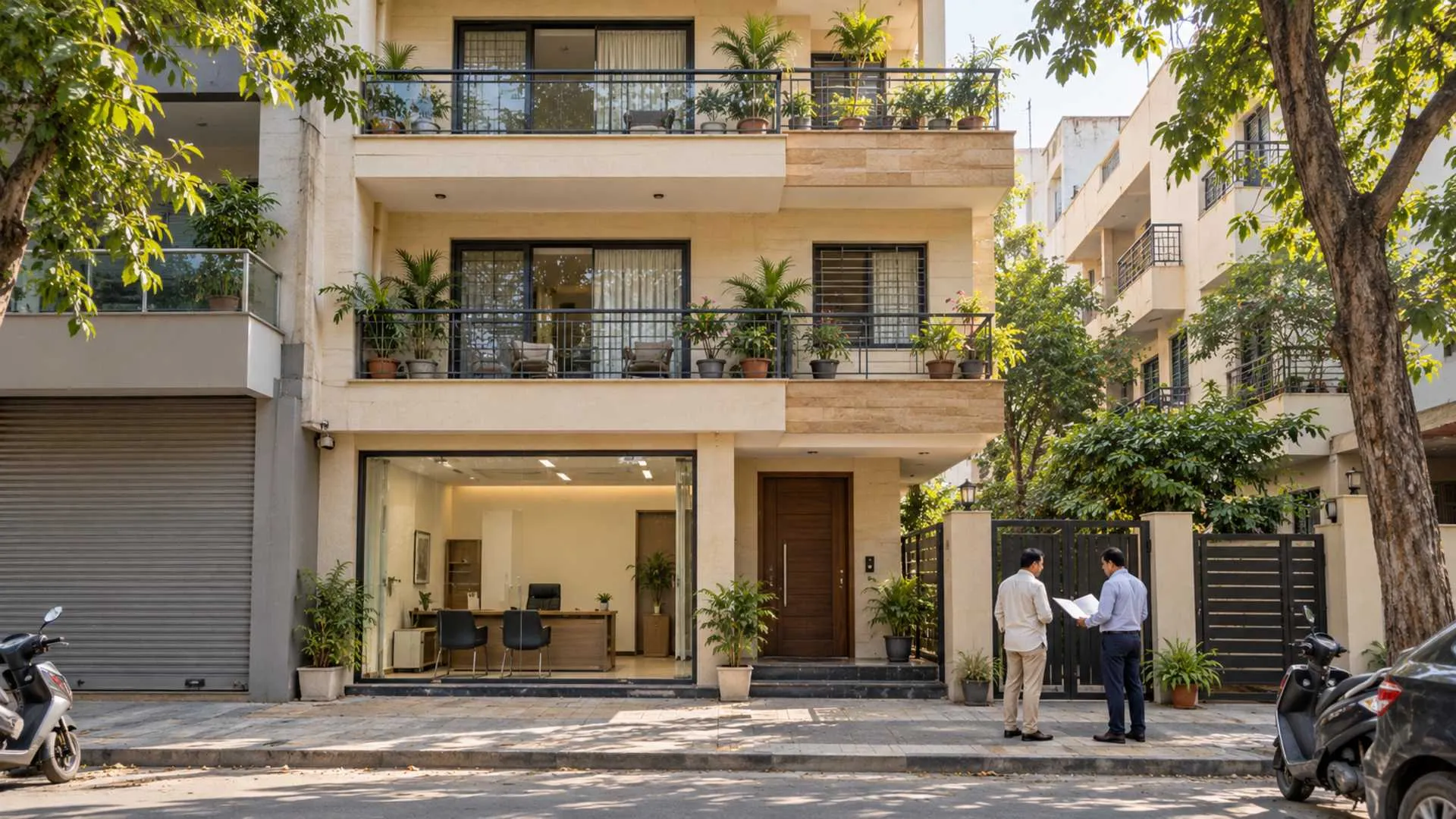
A residential address, a tenant and a business signboard can look like a straightforward rental opportunity. Delhi’s latest enforcement exercise shows why the paperwork deserves equal attention.
The Municipal Corporation of Delhi has identified around 21,000 properties involving commercial activity in residential areas after surveying nearly four lakh properties, according to The Tribune’s October 19 report. Authorities are examining individual cases and taking action in phases.
For owners, tenants and property investors, the distinction matters: a property being flagged does not mean that every activity inside it is automatically unlawful, or that sealing is inevitable.
The real question is whether the particular business is permitted at that particular address, on that floor, under the applicable approvals.
When can a home legally host a business in Delhi?
A Delhi home can accommodate business activity where the applicable planning rules permit that activity and the premises meet the relevant conditions, approvals and payment requirements. MCD’s 21,000-property exercise concerns suspected misuse and compliance gaps; it is not a blanket ban on every home-based occupation.
That answer requires more than checking whether neighbouring houses also contain shops. The legal position depends on the property’s permitted use, street status and the nature and scale of the proposed activity.
What the 21,000-property figure actually means
The initial October 14 PTI report carried by ThePrint described scrutiny of establishments including coaching centres, restaurants and shops. It reported that some owners claimed conversion compliance, while other properties stood on mixed-use roads.
The later Tribune account provided a different breakdown: approximately 12,000 identified properties had paid conversion charges, while around 9,000 had unpaid required charges or activities considered impermissible. It also reported show-cause notices and sealing action at some locations. These categories should not be combined with the earlier report as though they describe one identical assessment.
The takeaway is practical. Owners should establish their own property’s position rather than assume that a headline number determines the outcome.
A payment receipt may be important evidence. So may the approved plan, street notification and description of the activity actually taking place.
The crucial 2026 update: MPD-2047 is already in force
Much online advice still refers exclusively to the Master Plan for Delhi 2021. For an article published now, that is incomplete.
DDA’s official MPD-2047 FAQ states that MPD-2047 took effect on August 20, 2026, and supersedes MPD-2021. It also explains that earlier approved plans continue under earlier norms, with new norms applying in specified circumstances, including revised sanctions or additional FAR.
This creates an important verification task: determine which approval history and current provisions apply to the premises.
DDA directs users to examine land-use information, approved layout or site plans, and the relevant permitted-activity annexures. A broad map designation alone does not answer every building-level question.
For buyers evaluating residential property with advertised commercial potential, this should happen before the price negotiation. A seller’s description of “mixed use” needs supporting documents.
Mixed-use streets, commercial streets and professional practice
Delhi’s planning framework provides different routes for non-residential activity. They should not be treated as interchangeable.
Under MPD-2047, the following distinctions are relevant:
| Situation | Key distinction |
| Existing notified mixed-use street | Commercial use of an abutting plot is generally limited to the ground floor, subject to prescribed conditions. |
| Existing notified commercial street | Commercial use can extend to the permissible FAR, subject to applicable conditions. |
| Eligible residential plot on another road with at least 30-metre right-of-way | Conditional commercial use is provided for on the ground floor or first lower floor where there is a stilt. |
| Registered professional practice | Separate provisions govern eligible practices, with floor and area restrictions depending on the housing format. |
The notified plan also retains existing notified streets and provides that no new mixed-use or commercial streets will be notified during the plan period. This is separate from the conditional provision for qualifying wider roads.
A doctor’s consulting practice, for example, should not simply be assessed as though it were an unrestricted commercial establishment. Equally, calling premises an “office” does not settle their classification.
Owners should describe the intended operation accurately when seeking confirmation: who will use it, what services will be offered, which rooms will be occupied and whether customers or patients will visit.
Do conversion charges make commercial use legal?
Payment is part of compliance where required; it is not a substitute for eligibility.
MCD’s General Trade/Storage Licence portal requires applicants to address applicable property-tax, conversion and parking-charge payments. It also expressly warns that receiving a trade or storage licence does not provide immunity from enforcement.
This is a particularly important point for tenants. A licence associated with the business should not be mistaken for confirmation that every planning and building requirement has been satisfied.
There is also no responsible basis for quoting one universal conversion bill for all Delhi homes. Obtain the current official assessment for the exact premises and proposed use.
Ask the authority to identify the applicable notification, calculation basis, period covered and any outstanding interest or penalty. Keep the assessment alongside payment receipts.
MCD’s conversion and parking records portal provides fields for these separate components. Checking the account is more useful than relying on an old receipt without establishing what it covers.
What should owners do after a notice, or sealing?
A show-cause notice should trigger a document review immediately.
Check the property identification, alleged violation, relevant provision and response deadline. Then compare the allegation with the sanctioned plan, approved use, street notification and records of payments and permissions.
A concise response supported by documents is more useful than a general assertion that similar businesses operate nearby.
If the property has already been sealed, obtain the sealing order and seek advice on the appropriate remedy, forum and deadline. The route depends on the authority and legal basis of the action. Do not assume that paying a fee automatically secures de-sealing.
For landlords, the tenancy agreement should also be reviewed. Establish what activity was authorised between the parties and whether the actual operation matches it. Private contractual permission, however, does not settle the public-law position.
Does the Supreme Court direction apply across India?
The proceedings extend beyond Delhi, but they do not create one identical home-business rule for every city.
In its March 25, 2026 order in Loganathan v. State of Tamil Nadu, the Supreme Court brought municipal bodies of state and Union Territory capitals into the proceedings and directed inquiries into non-residential misuse of areas earmarked exclusively for residential use.
The important distinction is between enforcing applicable restrictions and inventing a nationwide prohibition on all work conducted at home.
An owner in Mumbai, Bengaluru or another city must examine the relevant local framework. Delhi’s mixed-use provisions cannot simply be transferred to a different jurisdiction.
Before buying or leasing, verify the proposed use
For property buyers and business tenants, the Delhi exercise makes permitted use a central part of due diligence.
Before committing, request:
- The approved building plan and relevant use permissions.
- The street notification, where the proposal relies on one.
- Written confirmation that the intended activity and floor are eligible.
- Applicable licence, conversion and parking records.
- Details of outstanding notices, proceedings or restrictions.
For developers and sellers, clearly documented permissions can strengthen an offer. Buyers need to understand what the property can lawfully accommodate, especially where commercial income forms part of the sales pitch.
Delhi’s 21,000-property exercise brings the question of when homes can legally host businesses into sharper focus. The answer rests on the premises and its permissions, rather than the popularity of the activity.

FAQs:
 AI Turns Property Panoramas Into 3D Homes: What Research Shows