Commercial Shops Inside Townships: Rental Returns and Risks
Township Commercial Shops — Rental Returns & Risks
SHARE:


A township shop can deliver attractive rent and still leave its owner funding the EMI. Consider an illustrative ₹50 lakh shop earning ₹35,000 monthly: its gross yield is 8.4% on the purchase price, but falls to 6.52% after assumed acquisition costs, one vacant month and maintenance, before other expenses. Add borrowing, and cash flow can turn negative. That is the central trade-off when assessing commercial shops inside townships: rental returns and risks. Nearby residents create potential customers, but occupancy, shop visibility, tenant strength and financing determine whether that demand becomes dependable income. For investors comparing Pune’s township retail options, the strongest purchase is one supported by sustainable rent and manageable costs.
What Rental Yield Can You Actually Expect from a Shop Inside a Township?
There is no verified national average covering every township shop. Sankalp Builders’ commercial investment guide cites approximately 5–8% for retail property generally; this is useful context, rather than a township-specific return promise.
For anyone searching “commercial shop rental yield township,” the important distinction is between advertised gross yield and income retained after expenses.
Table 1: Gross versus net yield, what investors should compare
| Parameter | Township shop | Township flat | Independent high-street shop |
|---|---|---|---|
| Gross rental yield | Verify rent against total acquisition cost | Calculate using comparable local rents | Calculate using the specific frontage and location |
| Vacancy | Depends on tenant demand and competing shops | Depends on local housing demand | Depends on trading activity and access |
| Effective occupancy | Check actual rent-paying months | Check actual tenancy history | Check actual rent-paying months |
| Operating net yield | Deduct vacancy and owner-paid expenses | Deduct vacancy and owner-paid expenses | Deduct vacancy and owner-paid expenses |
| Loan cost | Obtain a commercial-property sanction quote | Obtain a home-loan sanction quote | Obtain a commercial-property sanction quote |
| GST on rent | Depends on registration and applicable rules | Depends on use and parties involved | Depends on registration and applicable rules |
The commercial shop rental yield vs flat rental yield in same township comparison must use consistent assumptions. Higher shop rent does not automatically produce better returns once borrowing and vacancy enter the calculation.
What should investors know about commercial shops inside townships, rental returns and risks?
Township shops can benefit from nearby residents, but returns depend on purchase cost, sustainable rent, occupancy and expenses. In the illustrative calculation below, an 8.4% purchase-price gross yield becomes a 6.52% operating yield before additional costs and financing. Vacancy, tenant failure, GST treatment, management and resale liquidity require separate checks.
How Much Do Commercial Shops Cost Inside Pune’s Major Townships?
A single township-wide rate can conceal substantial differences between a visible ground-floor shop, an upper-floor unit and an office marketed alongside retail.
For a Magarpatta City commercial shop price reference, NoBroker displayed a Destination Center shop asking ₹1.40 crore for 233 sqft. The listing did not establish whether that measurement was carpet or built-up area, so it cannot support a reliable carpet-area rate.
Table 2: Pune township commercial price checks
| Township | Location | Price per sqft | Advertised area | Asking price/status | Resident catchment |
|---|---|---|---|---|---|
| Magarpatta City | Hadapsar | Area basis requires confirmation | 233 sqft | ₹1.40 crore; Destination Center listing | Verify occupied homes and office footfall |
| Amanora Park Town | Hadapsar | Obtain a unit-specific quote | Verify sanctioned carpet area | Confirm exact retail building and sale availability | Verify occupied catchment |
| Life Republic | Marunji/Hinjewadi corridor | Not established for comparable shops | A commercial listing stated 264 sqft | ₹1.05 crore listing was categorised as office space | Verify occupied catchment |
| Megapolis | Hinjewadi Phase 3 | Obtain a current shop quote | Unit-specific | Confirm retail inventory and permitted use | Verify occupied catchment |
| Blue Ridge | Hinjewadi Phase 1 | Obtain a current shop quote | Unit-specific | Separate internal shops from nearby listings | Verify occupied catchment |
| Ivy Estate | Wagholi | Obtain a current shop quote | Unit-specific | Confirm internal retail availability | Verify occupied catchment |
These are listing checks, not township-wide valuations or completed transaction prices.
The Life Republic example illustrates the classification problem: its NoBroker page identified the property as office space, despite the shop-related URL. It should therefore be excluded from a shop-price benchmark.
When comparing Amanora Park Town commercial retail shops, establish whether the offer concerns township retail, a mall unit, or a nearby property. For township commercial property investment in India 2026, the exact unit matters more than a broad locality label.
Why Township Shops Attract Better Tenants (The Captive Demand Advantage)
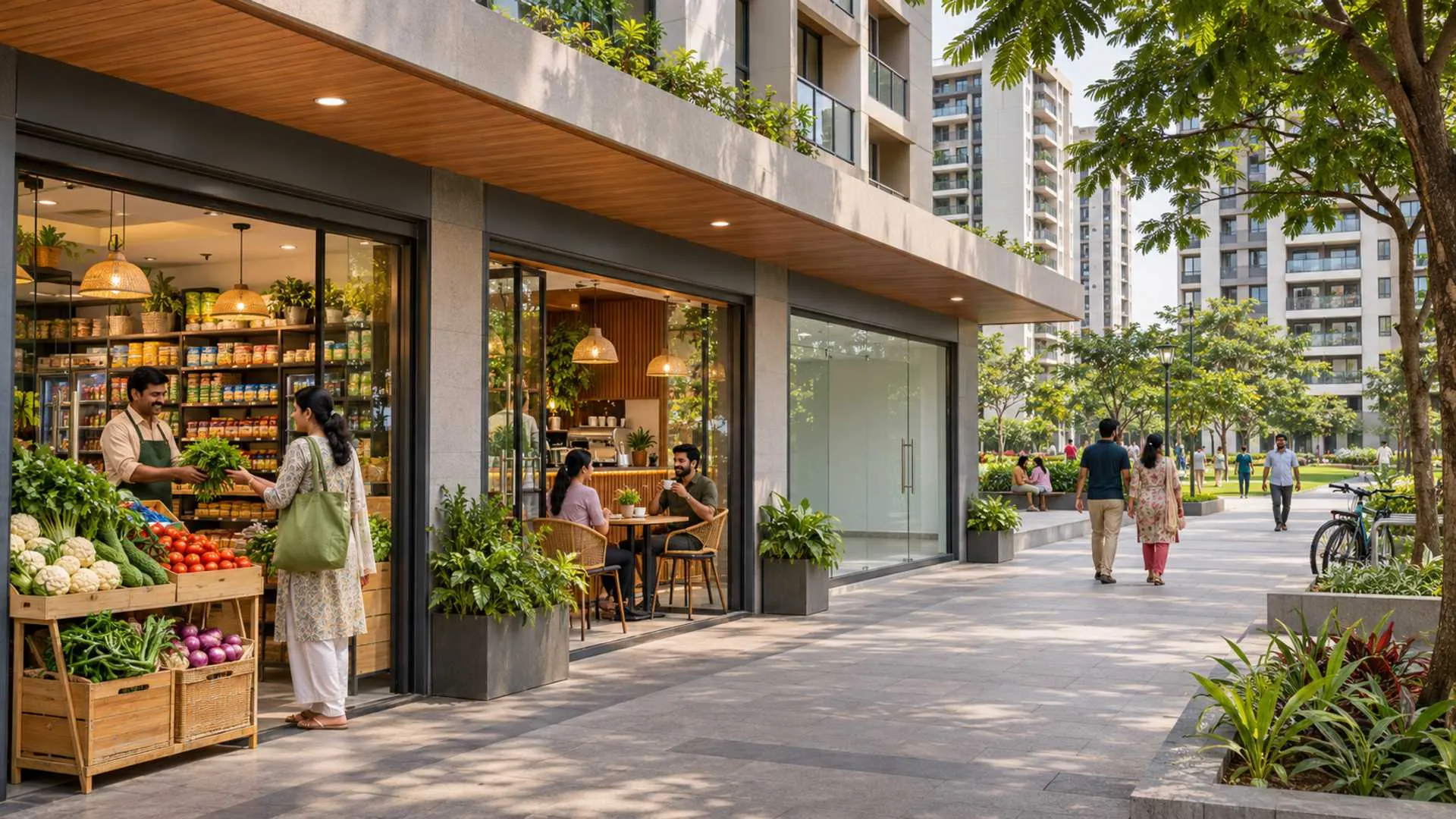
The attraction is straightforward: people living nearby need groceries, medicines, meals and everyday services. Commercial Noida’s township retail guide identifies this proximity between homes and daily-needs retail as a central investment argument.
However, nearby customers do not automatically mean better tenants. A pharmacy may value convenient access; a café may need visibility and evening activity. Food businesses also need suitable services and permissions.
For township high street shops, rental income counts occupied homes rather than planned apartments. Ask how many competing shops already serve those households, whether outsiders can enter easily, and whether delivery platforms capture a substantial share of spending.
Visit on a weekday morning, an evening and a weekend. Watch where residents actually walk. A shop beside their daily route can have a different business case from one hidden behind parking or inside an unfinished commercial block.
A captive catchment is an advantage only when customers can find and choose the shop.
The 5 Real Risks of Buying a Commercial Shop Inside a Township
1. Vacancy can overwhelm an attractive headline yield
Among the risks of buying a shop in a township project, prolonged vacancy deserves particular attention. Integrow AMC identifies vacancy and tenant-related risks as important commercial-property considerations.
Test six and twelve months without rent rather than assuming uninterrupted occupancy. The phrase “township retail vacancy risk India” describes a local underwriting problem: competing supply, weak access and incomplete residential occupancy can each affect leasing.
2. GST is more complicated than a ₹20 lakh shop-rent threshold
The ₹20 lakh figure is not a blanket exemption for each shop. Registration requirements depend on aggregate turnover and applicable provisions.
A Ministry of Finance parliamentary reply confirms the 18% tax treatment for taxable renting and explains the commercial-property reverse-charge changes. Under relevant rules, renting by an unregistered landlord to a registered business can attract reverse charge, with an exclusion for composition taxpayers.
Clarify whether the negotiated rent includes GST or whether tax is additional.
3. Borrowing can create negative cash flow
Compare the property’s operating return with the actual borrowing cost. A quoted yield before expenses cannot establish whether rent will cover EMI.
Request the interest rate, tenure, processing charges, reset terms and required equity contribution in writing. Stress-test affordability before relying on future rent increases.
4. Multiple owners can complicate management
Individually owned shops need clear arrangements for maintenance, signage, access and permitted businesses. Selling units to separate investors does not automatically remove all management controls; the governing documents determine responsibilities.
Inspect the commercial block’s condition and understand who can enforce payment and maintenance obligations.
5. The exit may depend heavily on the lease
Integrow AMC also highlights commercial-property liquidity risk. A buyer assessing rental income will scrutinise tenant quality, lease duration and realistic replacement rent.
Do not assume a quick resale or a fixed appreciation rate. A vacant unit and an occupied shop can attract very different offers.
Pre-Leased Shop vs Vacant Shop: Which Is the Safer Township Investment?
A pre-leased shop in township projects can offer clearer income visibility, provided the lease and collections withstand inspection.
Table 3: Pre-leased versus vacant shops
| Factor | Pre-leased shop | Vacant shop |
|---|---|---|
| Entry price | May reflect the existing income stream | Negotiated without established rental income |
| Day-one income | Only if rent is payable and being collected | None until rent commences |
| Yield visibility | Supported by verified lease and receipts | Based on achievable rental assumptions |
| Key risk | Tenant exit, arrears or inflated contractual rent | Leasing delay, incentives and fit-out costs |
| Best suited to | Buyers prioritising evidenced income | Buyers able to fund a leasing period |
Check the remaining lease term, lock-in, break clauses, arrears, rent-free periods and security-deposit transfer. Request evidence of actual payments.
Compare the contractual rent with neighbouring transactions. An unusually generous lease can make a sale look attractive while creating renewal risk. A tenant’s presence is evidence to investigate, not a substitute for due diligence.
Township Shop vs Independent High-Street Shop: Which Gives Better Returns?
Neither format wins automatically. The comparison depends on what the shop costs and how effectively its location supports the tenant’s business.
Table 4: Township versus independent high-street retail
| Parameter | Township shop | Independent high-street shop |
|---|---|---|
| Footfall source | Residents, visitors and accessible nearby offices | Local customers, destination visits and passing traffic |
| Tenant suitability | Depends on resident needs and permitted uses | Depends on the surrounding commercial catchment |
| Gross yield | Calculate from sustainable rent and acquisition cost | Apply the same calculation |
| Vacancy risk | Sensitive to occupancy and internal competition | Sensitive to access, visibility and competing markets |
| Appreciation | Depends on income growth and buyer demand | Depends on income growth and location demand |
| Maintenance | Check township or commercial-association obligations | Check owner and market-association obligations |
| Entry price | Compare equivalent floor, frontage and carpet area | Compare equivalent floor, frontage and carpet area |
For a practical comparison, obtain rental evidence for three similar occupied units in each location. Record frontage, floor, parking access and rent-free incentives.
A busy independent market may outperform an inward-facing township block. Conversely, a well-used township convenience centre may support stable everyday trading. The stronger location is the one whose tenant can sustain the rent.
How to Calculate the Real Return on a Township Shop Investment
Start with total acquisition cost, then deduct vacancy and owner-paid expenses. The following is an illustrative scenario, not a property quotation or market forecast.
Table 5: Worked example, ₹50 lakh shop
| Line item | Illustrative amount |
|---|---|
| Purchase price | ₹50,00,000 |
| Assumed acquisition expenses | ₹3,50,000 |
| Total initial investment | ₹53,50,000 |
| Monthly base rent, excluding GST | ₹35,000 |
| Annual scheduled rent | ₹4,20,000 |
| Gross yield on purchase price | 8.40% |
| Gross yield on total initial investment | 7.85% |
| Less one month without rent | −₹35,000 |
| Less owner-paid maintenance | −₹36,000 |
| Operating income after these deductions | ₹3,49,000 |
| Operating yield before other expenses | 6.52% |
| Illustrative loan: 75% of purchase price | ₹37,50,000 |
| Interest and tenure | 9.5% annually; 15 years |
| Approximate monthly EMI | ₹39,158 |
| Vacancy-adjusted average monthly cash flow after EMI | −₹10,075 |
The assumed acquisition costs are just a modelling adjustment and do not reflect stamp duty or registration fees. If there were property tax, insurance, maintenance, brokers’ fees, fit-out, and income tax to pay, then your returns would be even less. GST will not be added to the rental income as it will be collected for remittance purposes.
If the property was empty for 6 months instead of 1, the above model would result in an approximate operating yield of 3.25%. This illustrates how important it is to consider your assumptions regarding the property being occupied.
Although negative cash flow has not been taken into account (as EMI includes the repayment of the principal), you will have to cover this cost. When considering future rent increases, it should be based on the actual lease arrangement and not an assumed annual increase.