

Could Factory-Made Building Components Change How India Delivers New Homes?
Prefab Homes in India: Buyer Checks & Real Facts
SHARE:
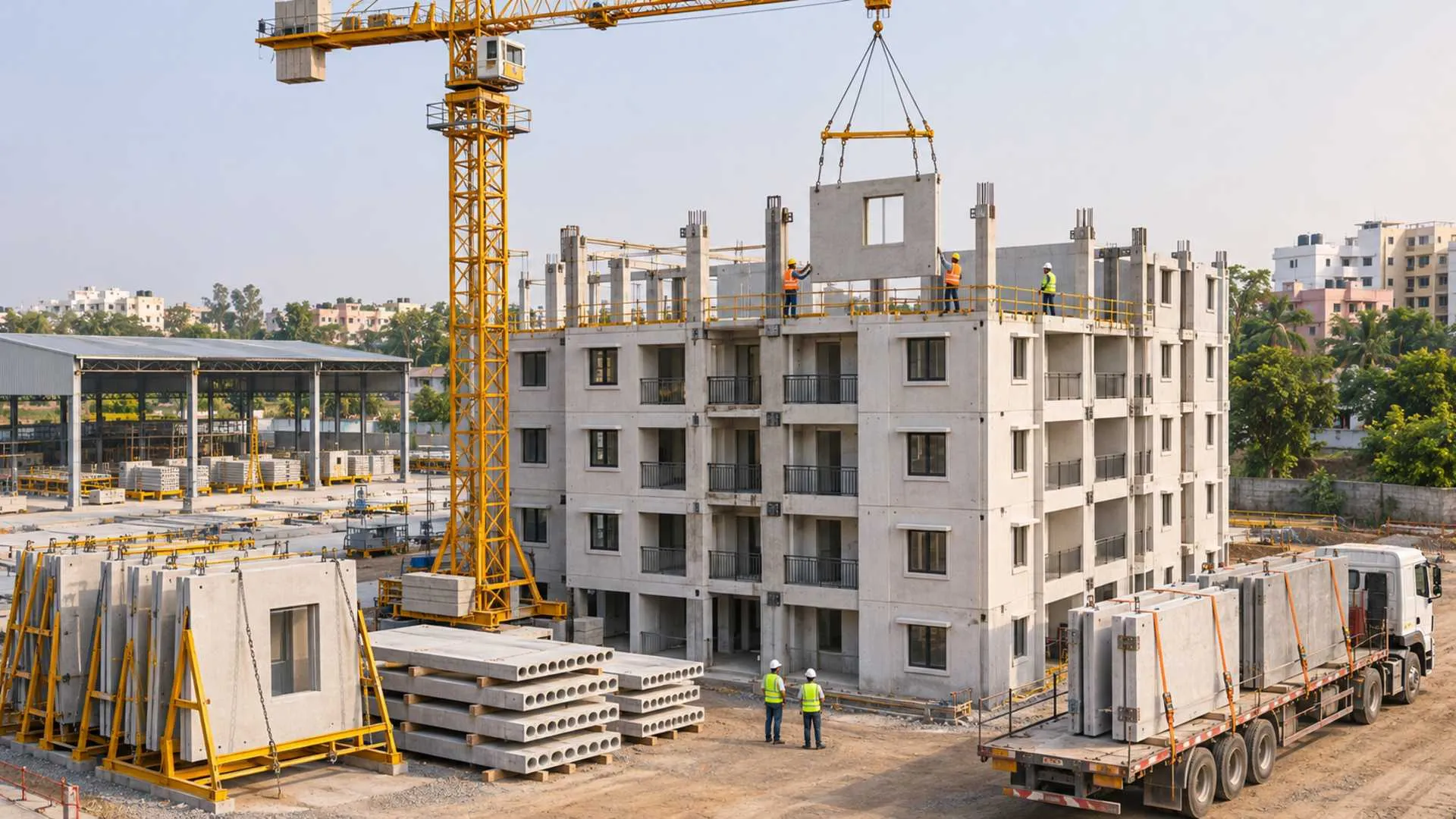


Factory construction methods can increase the speed of delivery of homes in India. Using precast beams and panels, or even entire rooms, can reduce the amount of work carried out at the construction site. Alternative methods have been trialled in state housing in India. However, what matters to the buyer is whether it results in timely delivery, good quality and manageable maintenance of the homes. Just because it looks very quick to build in a video does not mean it will be!
Could Factory-Made Components Help India Build Homes Faster?
Yes. Prefabricated construction allows building components to be manufactured while site preparation and foundation work proceed. This can shorten the overall programme, particularly where designs repeat. However, timely housing delivery still depends on approvals, logistics, skilled assembly, service connections and quality checks. Faster construction does not automatically guarantee earlier possession.
What Is Prefabricated Construction and What Arrives From the Factory?
Prefabricated construction is an umbrella term. A project might use individual precast concrete elements, flat panels, or complete three-dimensional modules. It does not necessarily involve transporting an entire house.
Rinac’s modular construction guide distinguishes panelised systems from volumetric modules: panels arrive as separate elements for assembly, while volumetric units arrive as room-sized sections with varying levels of completion. Transport and crane access help determine which approach suits a site.
| Approach | What is manufactured beforehand | What buyers should establish |
|---|---|---|
| Precast concrete | Elements such as beams, columns, slabs and stairs | How components are connected and inspected |
| Panelised construction | Wall, roof or floor panels | Material specification and joint detailing |
| Volumetric modular construction | Three-dimensional room-sized units | What is factory-finished and completed on-site |
For an apartment buyer, the useful starting point is: “Which parts of this building are factory-made?” The answer reveals more than a general claim that the project uses modern construction technology.
India Already Has Housing Examples Beyond the Prototype Stage
Factory-made construction is not merely a future possibility for Indian housing.
The Ministry of Housing and Urban Affairs, in a March 2026 parliamentary response published by PIB, confirmed that six Light House Projects using six distinct technologies had been constructed under the Global Housing Technology Challenge–India. The programme shortlisted 54 technologies for consideration across different regional conditions.
Chennai provides a relevant example. GHTC-India’s project documentation records 1,152 homes built using precast components, including columns, beams, slabs and stairs manufactured in a casting yard and assembled at the site.
This also clarifies an important distinction: off-site production can happen in a casting yard serving a development. It need not mean sourcing every component from a distant factory.
The demonstration matters, but it does not establish that one technology suits every residential project. A repeatable housing layout presents a different challenge from a constrained urban plot or a highly customised home.
The next step is choosing suitable systems and consistently delivering occupied, functioning homes.
Can Prefab Construction Shorten the Wait for Possession?
The strongest scheduling advantage comes from overlapping activities.
In conventional construction, many tasks depend on the previous trade finishing its work. Off-site production can allow components to be prepared while foundations and other enabling works progress.
McKinsey’s 2019 research on modular construction reported examples of project timelines shortened by 20–50%. This is international evidence from an earlier study, rather than a universal Indian housing benchmark or a promised saving for a particular project.
Buyers should therefore ask developers to connect the technology claim to the actual construction programme. Which activities happen simultaneously? When will components arrive? What work remains after structural assembly?
A quickly assembled structure is still several steps away from a home ready for possession. Buyers need to understand the remaining schedule for finishes, lifts, utilities, inspections and handover.
For someone paying rent while financing an under-construction apartment, credible progress information matters more than a headline speed percentage. Ask to see milestones for the whole project, rather than the assembly stage alone.
Will Factory-Made Homes Cost Less?
Potentially, but manufacturing efficiency and apartment sale prices are different questions.
Repeated components can spread production setup costs across a larger order. A development with recurring layouts may therefore offer a stronger manufacturing proposition than a one-off bespoke building.
However, transport, lifting equipment, installation and coordination all contribute to the final cost. Rinac’s guide identifies early design decisions and logistics as important constraints, particularly when large modules must reach restricted sites.
McKinsey’s research similarly cautioned that logistics or material costs can outweigh labour savings. Its analysis identified potential cost reductions alongside the risk of increased costs.
For buyers comparing prefabricated homes in India, request equivalent specifications. A component supply quote cannot fairly be compared with a fully finished home price.
Establish whether a quotation includes foundations, transport, assembly, services, finishes and external works. Then consider the total amount payable.
There is no defensible universal discount for a home simply because some components were manufactured off-site.
Construction Quality: The Factory Is Only Part of the Story
Factory production offers opportunities to standardise processes, but the final building still depends on design, handling and assembly.
Metal Tree’s discussion of prefabricated buildings highlights controlled manufacturing and early coordination of electrical, plumbing and other services as potential benefits. Its examples include steel and panel systems, so buyers should establish whether the same approach applies to the residential project they are considering.
The critical buyer question is how quality is checked throughout the process.
Who inspects components before dispatch? How is damage recorded? Who signs off connections after assembly? Who resolves a defect involving both the component supplier and installation contractor?
Request clear responsibility for the completed building. Buyers should not have to determine which contractor is accountable before a complaint receives attention.
The government’s March 2026 update also describes third-party quality monitoring provisions within relevant PMAY-U 2.0 housing categories. That reinforces an important principle: adopting new technology does not remove the need for inspection.
Is Prefabricated Construction Greener?
A cleaner site can be encouraging, but it is not a complete environmental assessment.
IDEAS Nagpur’s guide to modular and prefab construction identifies material efficiency and reduced waste as potential advantages. It also stresses that architects must consider manufacturing requirements early in the design process.
Buyers should ask what supports a project’s sustainability claims. Does the developer provide waste records, material information, or measured building performance? What do the specifications say about comfort and operating requirements?
“Factory-made” describes a production method; it does not, by itself, prove lower environmental impact.
The more useful comparison considers the proposed materials, transport, construction waste and expected operation of the finished home. Ask for evidence relevant to that project rather than relying on a general claim about the technology.
What Should Homebuyers Ask Before Booking?
Construction technology should make a project easier to evaluate. Use these questions to turn a sales presentation into a practical discussion:
- System: Which components are prefabricated, and which are built on-site?
- Delivery: What schedule covers construction through final handover?
- Quality: Which inspections and test records are available?
- Responsibility: Who handles defects after possession?
- Maintenance: Are repair guidance and replacement arrangements documented?
- Alterations: What restrictions apply to future changes?
- Track record: Can buyers inspect an occupied project using the same system?
An occupied building is particularly informative. Speak with residents about maintenance responses and everyday comfort. Their experience can help you assess whether the delivery method has translated into a satisfactory home.
A Different Way to Deliver Homes, With the Same Final Test
Factory-made building components could become a larger part of India’s housing delivery toolkit. The opportunity is strongest where design, production, logistics and site execution are planned together.
For developers, the competitive advantage will come from demonstrating predictable delivery and accountable quality. For buyers, the decision should remain grounded in the finished home, its documentation and the people responsible for maintaining it.
The future may involve more manufacturing before construction reaches the site. A home’s performance after handover remains the decisive test.