

Mumbai Metro Line 3 and Property Prices: What We Know
Explore Mumbai Metro Line 3 property prices, station-wise trends, rental demand, appreciation potential
SHARE:
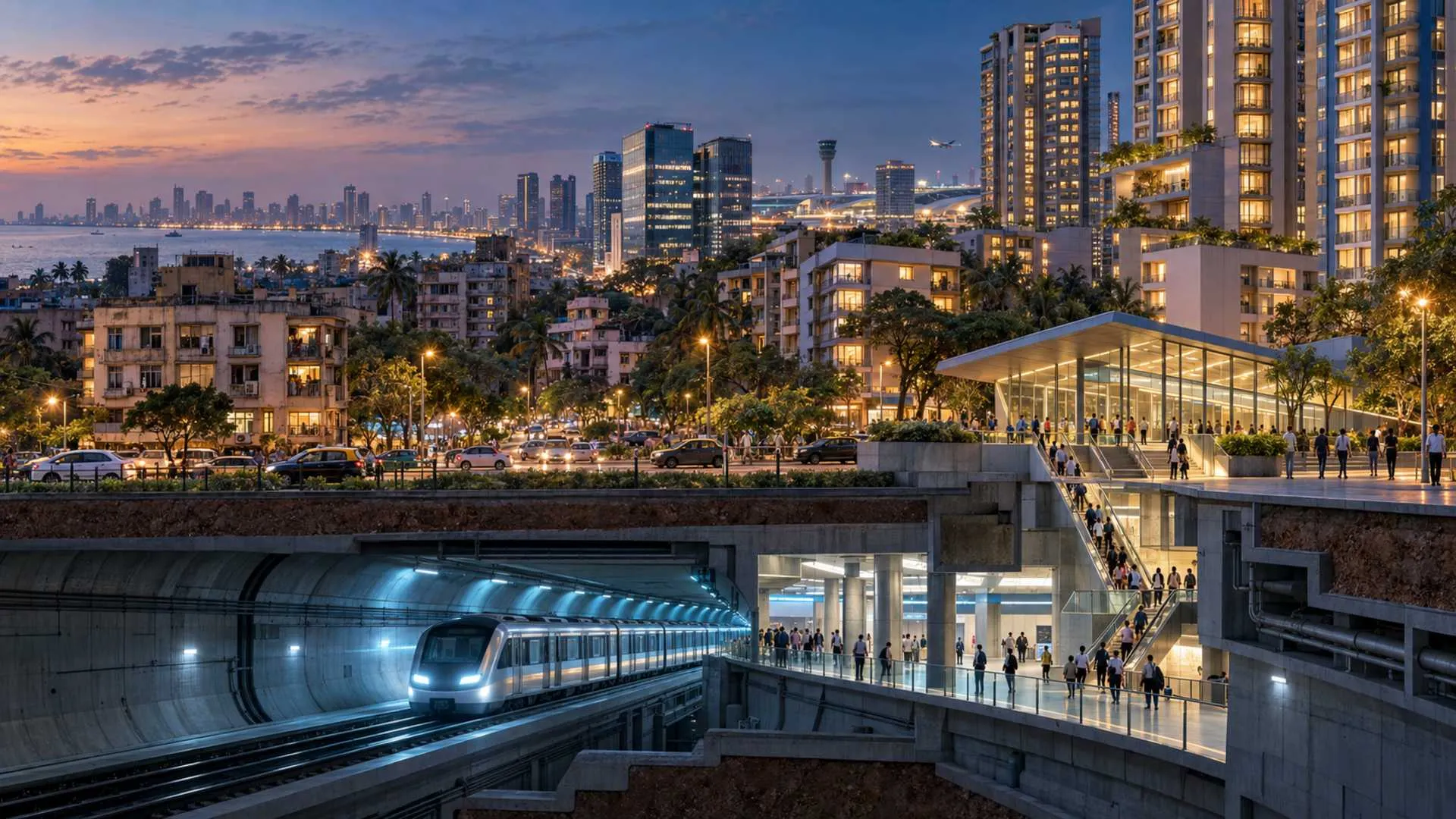
The new north-south spine of Mumbai is no longer a promise on a planning map. The Aqua Line now connects office centers, airports, rail hubs and some of the country’s most expensive residential addresses. For anyone currently hunting for property in Mumbai, it raises a pressing question: Has the connectivity premium already arrived, or is there still meaningful upside to a flat near metro Mumbai?
The answer is less flashy, more practical than the sales hype. Metro access can increase a home’s appeal, rental liquidity and resale pool, but it doesn’t elevate every building equally. It is still all about walkability to an entrance, last mile access, usable carpet area, project quality, title, redevelopment risk and the price paid. The Aqua Line is a robust value driver, not a guaranteed percentage return.
How much will property prices rise near Mumbai Metro Line 3 stations?
Market publications commonly estimate an 8%–15% station-proximity premium, while some project 10%–20% appreciation for well-located homes within roughly one kilometre. These are indicative market estimates, not an official forecast. Much of the first uplift may already have been priced in before the full line opened. Future gains should differ sharply by locality, building quality, entry price and genuine walking access.
The Aqua Line changes Mumbai’s commute map
The official case for the line is substantial. According to the Press Information Bureau, the complete Mumbai Metro Line 3 was dedicated in October 2025. It spans 33.5 km between Cuffe Parade and Aarey JVLR, with 27 stations, and was designed to connect with suburban rail, airports, other metro lines and the monorail. The government described it as Mumbai’s first fully underground metro corridor and estimated capacity at up to 13 lakh passengers a day.
That matters because Line 3 joins employment centres that previously depended heavily on congested roads or crowded suburban rail: SEEPZ and MIDC in Andheri East, the airport terminals, BKC, Dadar, Worli, Mahalaxmi, Mumbai Central, CSMT, Fort and Cuffe Parade. A buyer considering a 2BHK flat in Mumbai, a 3BHK flat in Mumbai, an office-linked rental, or a ready-to-move flat in Mumbai can now compare homes using dependable rail access rather than theoretical travel times.
The route also fills an important gap: existing lines improved east–west movement, while the Aqua Line creates a north–south link through the central business corridor. Station entrances and pickup activity can still create local congestion, so “nearest” is not automatically “best.”
What reported price gains do and do not prove
Several supplied market sources point to a sizeable uplift. The Propertist says homes within about 500 metres of stations can command an 8%–15% premium, and reports appreciation in BKC-adjacent, Worli, Dadar and northern catchments. Property Butler reports strong growth around Worli Naka and argues that the station-side mill corridor has gained more directly than Worli Sea Face.
These figures are useful signals, but they require discipline. They may reflect portal listings or brokerage-tracked asking rates, not a repeat-sales index based solely on registered transactions. The comparison period can include the Coastal Road opening, redevelopment announcements, luxury launches, interest-rate changes and citywide inflation. A 20% rise in Worli cannot be assigned entirely to Metro Line 3 merely because both occurred together.
That distinction is especially important when a claim says some micro-markets rose 30%–40% between 2021 and 2026. Over five years, construction progress and final operations can certainly influence expectations, but so can the starting price and the type of new supply launched. Metro-caused appreciation and appreciation near the Metro are not the same statistic. Buyers should ask for registered comparables in the same building or immediate lane, measured on carpet-area pricing and adjusted for floor, view, age, parking and condition.
Which areas could receive the biggest property boost?
Andheri East, MIDC and the airport belt
For rental demand, Andheri East may offer the clearest everyday use case. Direct access to MIDC, SEEPZ and both airport terminals expands the tenant pool for an apartment near a metro station in Mumbai. It also connects business travellers and employees to BKC and South Mumbai without relying entirely on the Western Express Highway.
The strongest candidates are not simply projects with “Metro Line 3” in an advertisement. A Metro Line 3 flat in Mumbai needs a safe walk and reasonable station-entry distance. Buildings near Marol Naka gain interchange value. Andheri East may offer broader rental liquidity at a lower ticket size than the southern corridor.
BKC, Bandra East and Kalina
BKC is the line’s corporate demand engine. Faster access from Andheri, Dadar, Worli and South Mumbai may widen the residential choices of employees, while homes close to BKC can appeal to tenants who value a short commute. The Wadhwa Group highlights the resulting attention on Bandra East.
Yet BKC station proximity needs street-level inspection. Large blocks, busy roads and security perimeters can turn a short map distance into a difficult walk. Bandra West and Khar may receive an indirect accessibility benefit, but they are not Line 3 station neighbourhoods in the same way as Bandra Colony or BKC. A quoted “Bandra Metro premium” should therefore identify the building, station entrance and actual walking time.
Dadar, Dharavi and the central interchange belt
Dadar’s advantage is network depth. Suburban rail, arterial roads and the Aqua Line reinforce one another, giving residents alternatives when one mode is disrupted. That can support end-user demand and help older societies considering redevelopment.
A supplied Property Butler Dadar analysis contains useful observations about commute-driven demand, but its phase chronology conflicts with the official October 2025 completion record. Verify current station access before using projected travel times or premiums. In mature Dadar, Line 3 is more likely to strengthen liquidity than transform the entire price base.
Worli, Mahalaxmi and the premium central corridor
Worli combines Metro Line 3 with the Coastal Road, major redevelopment and scarce premium land. That makes it one of the most watched locations, but also one of the hardest places to isolate the Metro effect. Sobha discusses the combined influence of the Aqua Line and Coastal Road on South Mumbai rather than treating either project as the sole driver.
The geography within Worli matters. Homes around Worli Naka and the mill-land corridor gain more direct walking utility than sea-facing properties whose premium is driven primarily by views, luxury specifications and scarcity. Reported figures such as 20.9% or higher appreciation should be treated as a micro-market observation, not a promise for every luxury flat in Mumbai. Mahalaxmi and the Science Museum catchment may similarly benefit where new projects combine station access with established road connectivity.
CSMT, Fort, Churchgate catchment and Cuffe Parade
The southern stretch improves access to government offices, courts, banks and heritage business districts. That may deepen demand for high-value residential and commercial assets, but the supply response is constrained by heritage rules, old buildings, tenancy structures and limited land. In Cuffe Parade or Colaba, where entry prices are already high, the Metro may protect desirability and marketability more than create explosive percentage gains.
Investors should also distinguish a station’s name from its catchment. Churchgate is served through the wider South Mumbai network and nearby Line 3 stations; the property must still offer a practical last mile. A premium address with a poor approach road may underperform a less glamorous building with a clean, shaded walk and better maintenance.
Aarey JVLR, SEEPZ and Goregaon East
The northern end offers relatively lower entry points than Worli or Cuffe Parade and connects to the employment-heavy SEEPZ–MIDC belt. That supports the case for an Aarey JVLR Metro Line 3 station property investment or a home in nearby Goregaon East and Jogeshwari East.
But “near Aarey Metro station” must not be confused with unrestricted development inside ecologically sensitive land. Buyers should verify land status, access roads, flood exposure, approvals and construction quality. A cheaper new flat in Mumbai 2026 is not value if legal or environmental constraints impair resale.
The 500-metre rule: useful filter, poor guarantee
Real estate marketing often calls 500 metres the sweet spot. It is a reasonable screening distance because many people will walk it daily. In practice, the best catchment may extend to 800 metres or roughly one kilometre where pavements, crossings and feeder services are good. A 400-metre route across a hostile junction can be worse than a 900-metre, weather-protected connection.
Proximity has trade-offs. Beside a busy entrance, residents may face queues, autos or reduced driveway access. A quiet building five to ten minutes away may outperform one at the gate. Compare within 500m versus 1km by real walking route, not a brochure radius.
Capital appreciation and rental yield are different bets
Near BKC and Andheri East, a landlord may benefit first through shorter vacancy periods and a wider corporate-tenant pool. That does not mean the gross rental yield will surge: if the purchase price rises faster than rent, yield can stay flat or even fall. In Worli and South Mumbai, the investment thesis may rely more on capital preservation, scarcity and long-term appreciation than income.
For a flat for sale in Mumbai, divide annual rent by the total acquisition cost and subtract maintenance, tax, vacancy, brokerage and furnishing. Test a case in which prices merely track inflation. If the purchase works only with another 10%–15% rise in 12–18 months, it is speculation.
Is it too late to invest near Line 3?
Not necessarily, but the easy “announcement discount” has gone. The first re-rating usually begins during construction and accelerates as commissioning becomes credible. Now that the full corridor is operating, the next phase depends on demonstrated ridership, reliable service, improved station approaches, feeder connectivity and sustained office demand.
That changes the buyer’s task from predicting infrastructure to selecting assets. Before you buy flat Mumbai, check:
- The walking time to the correct station entrance at peak hour and in monsoon conditions.
- Registered sale and rent comparables from the same building or nearby societies.
- MahaRERA status, title, occupancy certificate, carpet area and possession record.
- Building maintenance, redevelopment exposure, parking and total monthly outgoings.
- Whether the asking premium can be recovered through rent, daily time saved, or superior resale liquidity.
An under-₹2 crore home in the northern catchment has a different risk-return equation from a high-ticket Dadar or Worli purchase. Buyers seeking a high-rise flat in Mumbai, an apartment for sale in Mumbai, or a metro-connected flat in Mumbai should compare a non-Line 3 alternative to expose the access premium.
The measured verdict
Mumbai Metro Line 3 has permanently improved access across a corridor containing airports, office districts, railway hubs and premium residential markets. That should support demand and liquidity near well-connected stations, but there is no credible citywide rule that every nearby property will rise by 10%, 20% or 40%.
The most defensible opportunities are homes where the Metro solves a real commute problem, the walk is practical, the building is legally and physically sound, and the entry price does not assume all future appreciation in advance. Andheri East and BKC-adjacent areas may lead on tenant depth; Dadar on interchange strength; Worli and Mahalaxmi on premium connectivity; and the Aarey–JVLR catchment on comparative entry price.
Before choosing a property in Mumbai, visit the route at commuting time, verify transaction data and compare the all-in cost with a similar non-metro home. Use the Aqua Line as a decision advantage, not as a substitute for due diligence. Shortlist suitable Line 3 properties, check their walking routes and legal records, and speak with an independent property lawyer and financial adviser before paying a token.