

Will Solar-Ready Homes Become a Standard Buyer Expectation by 2030?
Solar-Ready Homes in India: Buyer Checklist & Facts
SHARE:


Solar-ready homes may become more of an expected feature in housing by 2030 as more households seek cheap energy and adaptable buildings. However, just because a house is solar ready, does not necessarily mean it has solar panels installed, that you will get solar energy in your flat, or that your lights will be on during a power cut. It is important to know if you can access the roof, if the building is suitable for solar, and if there are any electrical, metering and maintenance requirements. This article shows what you can reasonably expect, what India’s growing rooftop solar industry indicates, and how to identify realistic solar-ready features in properties.
Will solar-ready homes become a buyer expectation by 2030?
They could become an increasingly important preference, especially where suitable roofs, electricity tariffs and installation support make solar attractive. A genuinely solar-ready home anticipates future installation through roof planning, structural assessment, electrical routes and equipment space. However, buyer expectations will vary, and solar readiness alone does not guarantee savings, backup power, or higher resale value.
Why Rooftop Solar Is Becoming a Homebuying Question
India’s rooftop-solar expansion is moving the discussion beyond a small group of environmentally conscious households.
A November 2026 Press Information Bureau factsheet reports that 65.26 lakh households were benefiting from rooftop installations under PM Surya Ghar as of November 2. The programme was launched with an outlay of ₹75,021 crore and an ambition to reach one crore households.
That does not prove every buyer now demands solar. It does suggest that more households will encounter the technology through neighbours, family members and housing societies.
The forecasts also need careful reading. ETEnergyworld reports an Indian Solar Manufacturers Association assessment of a 132-GW rooftop-solar opportunity. Further industry coverage distinguishes this market potential from expected annual installations of 9–15 GW through 2030. Potential capacity is not a guaranteed installation target.
Globally, Saur Energy covers the ambition for 300 million solar homes by 2030. The Global Solar Council describes this as a voluntary initiative, not a forecast that every participating market will achieve a fixed number of installations.
For real estate, the implication is straightforward: buyers may increasingly ask whether a building enables solar adoption or makes it unnecessarily difficult.
What Does “Solar-Ready Home” Actually Mean?
A vacant terrace is a starting point, not sufficient evidence.
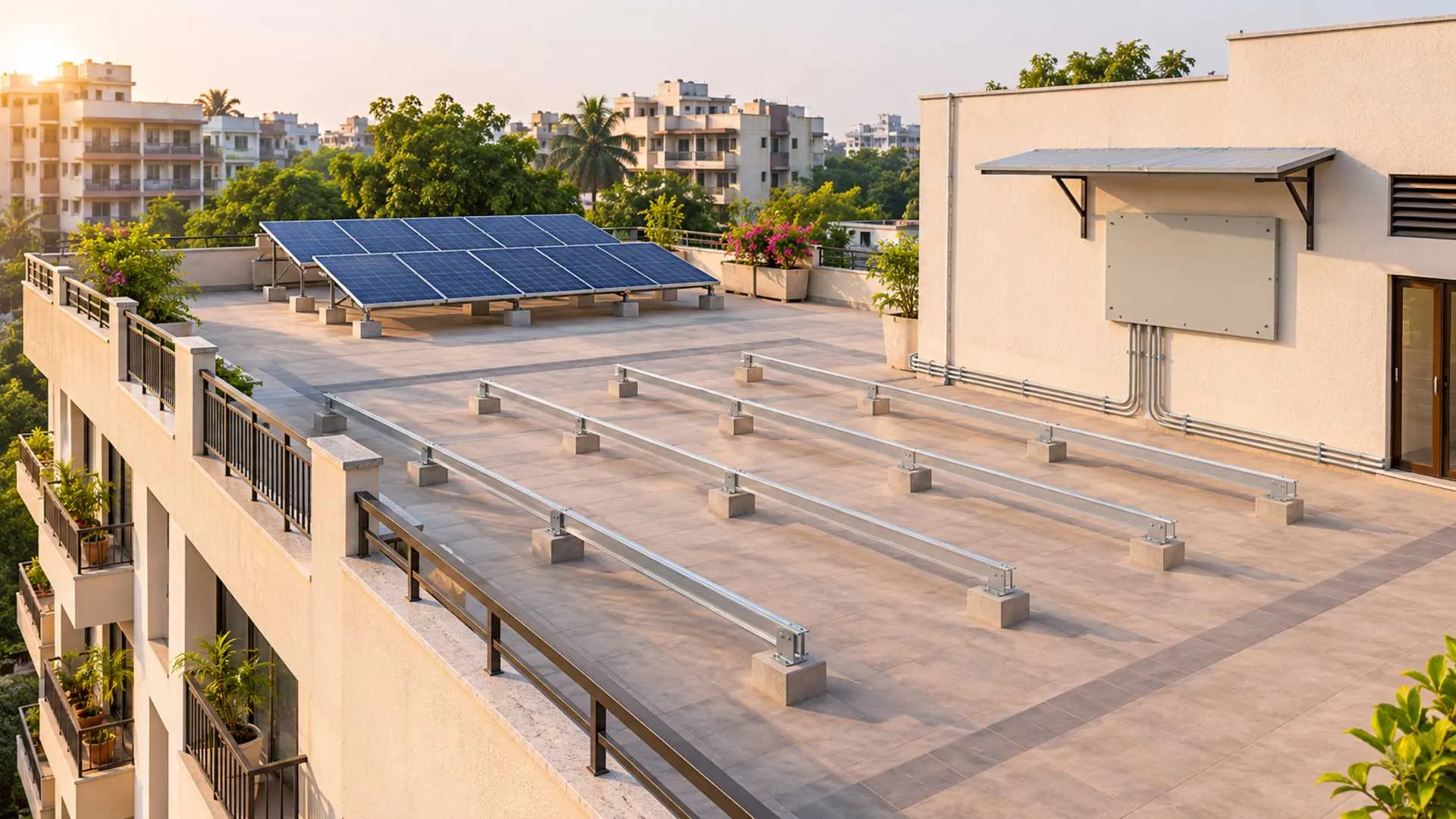
Solar-ready design considers shading, structural loads, usable roof space, equipment access, wiring routes and electrical integration. The National Renewable Energy Laboratory’s guidance identifies provisions such as roof-to-panel conduits, inverter space and suitable structural support. Its guidance offers design principles, rather than Indian approval requirements.
Solar-ready, solar-powered and battery-backed: the difference
| Description | What buyers should establish |
|---|---|
| Solar-ready home | Provisions exist for a future installation; generation may not have started |
| Home with installed rooftop solar | Panels, inverter and associated equipment are installed; commissioning and metering need verification |
| Solar-plus-storage home | Batteries store electricity; backup capability depends on system configuration |
| Society with common-area solar | Generation serves designated shared loads or an approved allocation arrangement |
Developers should explain exactly which category applies.
A solar water heater is different again: it heats water rather than generating electricity for appliances. Likewise, a few solar streetlights do not establish that a township’s residential electricity needs are solar-powered.
The specification matters more than the adjective. Ask what is installed, what is merely provided for, and who pays for the remaining work.
Can Apartment Buyers Benefit Without Owning the Roof?
Yes, but the benefit may arrive through the society’s electricity account rather than the flat’s meter.
Government rooftop-solar guidance identifies common lighting, lifts and pumps as potential society loads that rooftop generation can offset. Individual billing benefits depend on the approved arrangement.
For a high-rise buyer, the decisive questions are:
- Who controls the available roof?
- Which meter receives the generation benefit?
- How will savings appear in society accounts?
- Who owns and maintains the equipment?
Do not assume a penthouse purchase includes exclusive installation rights. Verify the relevant property documents and society arrangements.
Maharashtra provides one example of evolving access. MERC’s 2024 amendments enable specified virtual net-metering arrangements for residential consumers in multi-storeyed buildings, while MSEDCL provides an application route. Eligibility and implementation still require checking with the distribution licensee.
“Solar for common facilities” can be valuable, but it should not be marketed as a promise to eliminate every resident’s electricity bill.
Rooftop Solar Savings: Calculate the Benefit Before Paying a Premium
Solar-panel cost is only one part of the financial calculation.
Savings depend on generation, shading, electricity consumption, tariffs, export-credit arrangements and recurring expenses. A household using substantial electricity during sunny hours may have a different outcome from one whose consumption peaks after sunset.
Ask for an annual generation estimate and its assumptions. Then compare:
Net annual benefit = avoided electricity charges + eligible export credits − recurring operating costs.
A simple payback calculation divides the net upfront investment by that annual benefit. For illustration, an investment of ₹90,000 generating ₹18,000 in annual net benefit has a five-year simple payback. This is arithmetic, not an installation quotation or promised return. Financing, equipment replacement and changing performance can alter the result.
For an apartment, ask whether the projected saving belongs to your household or the society.
A resale premium is a separate question. Documented performance and transferable equipment rights may help buyers assess value, but a “solar-ready” label does not establish a fixed appreciation percentage.
PM Surya Ghar Subsidy: What Buyers Should Understand
Government assistance can improve affordability, but eligibility must be checked before treating a subsidy as confirmed.
Published central assistance for eligible residential installations
| Installation capacity | Published central assistance |
|---|---|
| 1 kW | ₹30,000 |
| 2 kW | ₹60,000 |
| 3 kW or higher | ₹78,000 maximum under the standard schedule |
MSEDCL also provides assistance of ₹18,000 per kW for eligible group-housing common facilities, including EV charging, subject to the stated 500-kW limit and per-household capacity conditions.
A builder’s solar-ready promise is not itself subsidy approval. Confirm the applicant, eligible equipment, installer requirements, commissioning process and responsibility for documentation through the official portal and DISCOM.
Ask for the price before subsidy and the expected price after subsidy separately.
The Solar-Ready Homebuyer Checklist
The strongest solar-ready homes will make future installation easier to understand, rather than simply easier to advertise.
What to ask before booking
| Check | Evidence or explanation to request |
|---|---|
| Roof suitability | Shading assessment, usable area and equipment layout |
| Structural capacity | Assessment by an appropriately qualified engineer |
| Installation rights | Relevant ownership, common-area and consent documents |
| Electrical readiness | Planned conduits, equipment locations and integration details |
| Waterproofing | Mounting method and responsibility for repairs |
| Metering | DISCOM-approved arrangement and beneficiary account |
| Equipment ownership | Developer, society, individual or service-provider ownership |
| Maintenance | Cleaning, monitoring, warranties and service responsibilities |
Where panels already operate, request generation records rather than relying only on a modelled estimate.
For an under-construction project, obtain the promised solar scope in writing. “Provision for solar” should identify the actual provisions included in the purchase.
Also ask who can access monitoring data. A society cannot evaluate performance effectively if residents receive only an unexplained statement that the system is working.
The Home of 2030: Solar, Storage and Smarter Energy Use
Schneider Electric’s vision of the 2030 home centres on coordinating solar, batteries, appliances and electric-vehicle charging. Its article primarily discusses European conditions; Indian households must evaluate their own tariffs, equipment and grid arrangements.
The broader design idea is useful: generation works best when the home can manage when and how electricity is used. r-solar’s future-of-solar discussion similarly highlights storage and hybrid systems, although actual independence depends on system sizing and configuration.
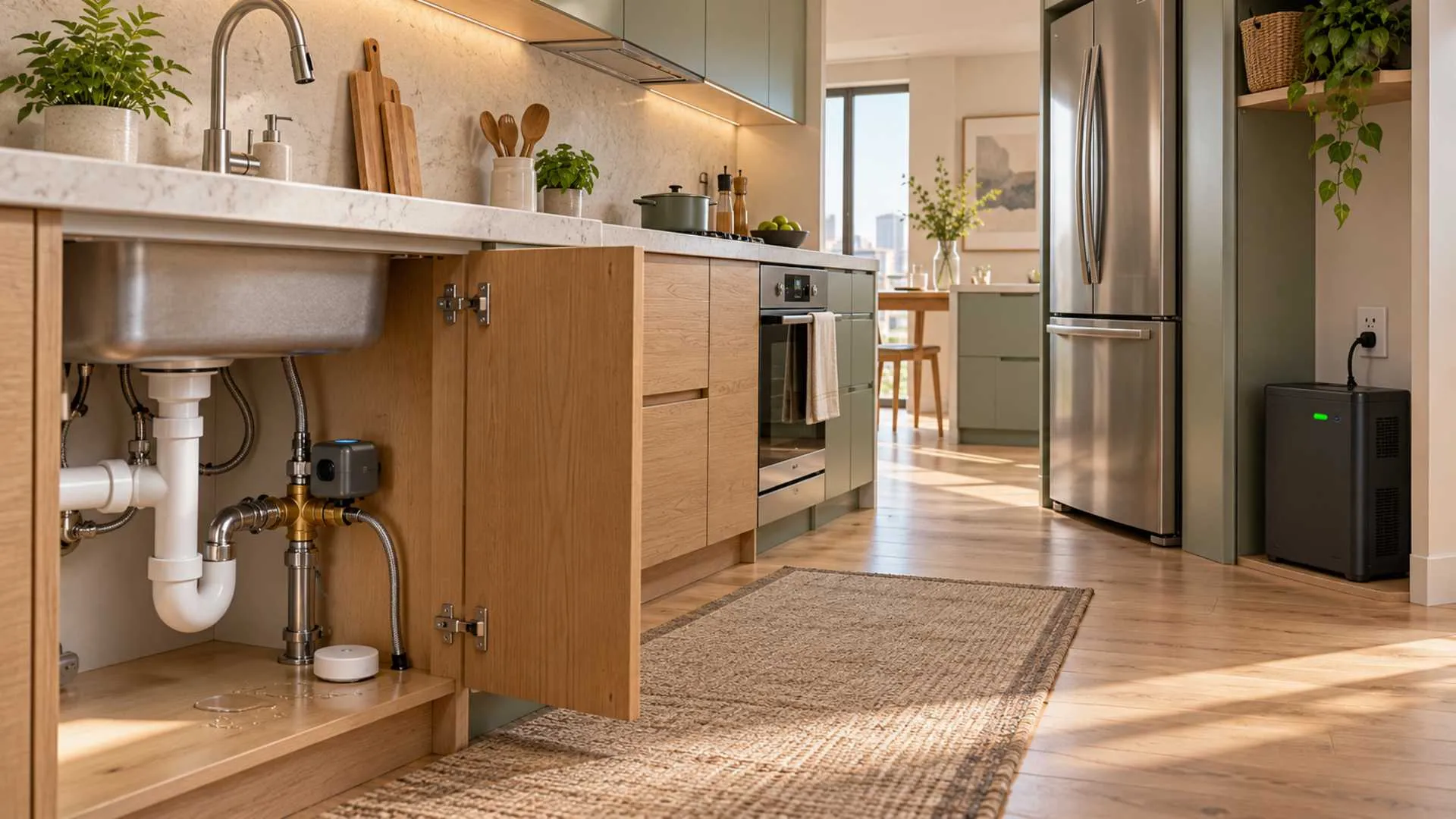
One misconception deserves particular attention: ordinary grid-connected rooftop solar generally switches off during a grid outage for safety. Backup requires appropriately configured equipment, often including storage; panels alone do not guarantee uninterrupted electricity.
By 2030, buyer expectations may therefore shift from “Does this project have solar?” to “What does its energy system actually deliver?”
Solar-ready homes could become a stronger buying preference, but readiness should be demonstrated through design, documents and a workable operating plan.