Leak Detection and Backup Power Reshape the Modern Kitchen Conversation
Smart Kitchen Design: Leak Detection & Backup Power
SHARE:
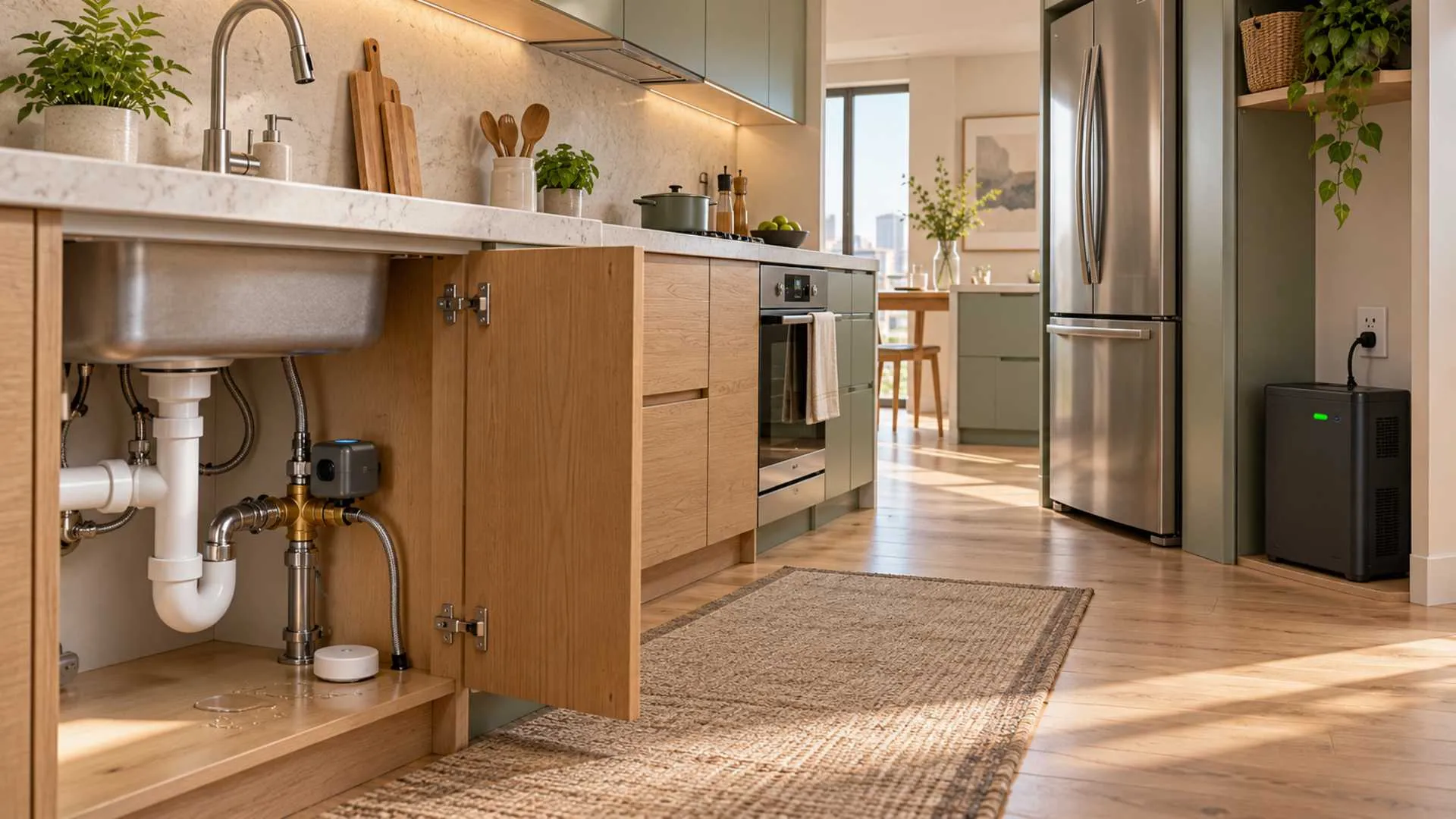


What’s next in your kitchen upgrade?
In addition to cabinet styles and statement lighting, homeowners want to know if there will be anyone at home to notice a leaking pipe. Will their fridge keep running if there is a power cut? How will the safety system function without power to the router?
As a designer, you will need to consider how to incorporate leak detection and backup power. This will mean looking at the systems that run behind the cabinets and ensuring they are working together.
Whilst it may appear that a kitchen has been finished to a high standard, it is important to ensure the key services can easily be seen and maintained. As a designer, there is an opportunity to build in daily protection.
Why Are Leak Detection and Backup Power Part of Kitchen Design Now?
Leak detection and backup power help kitchens cope with plumbing failures and electricity interruptions. Compatible sensors and automatic shut-off valves can limit continued water flow, while appropriately specified backup systems support selected appliances and controls. Their usefulness depends on installation, maintenance and what remains operational during an outage.
The NKBA Data Puts Resilience on the Design Agenda
The National Kitchen & Bath Association’s 2027 Kitchen Trends Report gives the conversation a measurable foundation.
Its official release cites 65% of designers agreeing on leak detection systems and automatic shut-off valves as climate-resilience priorities, 62% citing backup power solutions, and 53% pointing to ventilation and air filtration.
The survey involved 830 industry respondents, with designers representing 62% of responses. It draws on the NKBA community in the US and Canada.
These figures describe industry views, not the percentage of Indian kitchens already fitted with the technology. They also do not establish that refrigerator batteries have become a standard feature.
For kitchen design trends in 2026 and 2027, the significance is practical: resilience is being discussed alongside appearance and layout.
Here, climate resilience means planning for disruption and recovery. A leaking dishwasher hose is not necessarily a climate event, but reducing the impact of water escape and power interruptions can form part of a more resilient home.
Water Leaks and Gas Leaks Need Different Systems
The supplied research adds an important distinction to the smart kitchen technology conversation: “leak detection” does not always mean water.
The 2024 paper “Design and Development of an IoT-Based Leakage Detection System for Kitchens,” available through ResearchGate and published in Archives of Current Research International, concerns LPG leakage.
The researchers describe gas monitoring, user alerts, remote monitoring and a valve-controlled response. Their design also includes battery and solar support to keep the detection system powered.
That battery does not power a refrigerator. The paper demonstrates a research system, rather than establishing that a particular retail appliance is certified for Indian homes.
A separate study hosted by Scholarlink Institute in the Journal of Emerging Trends in Engineering and Applied Sciences also examines kitchen gas detection and automatic gas shut-off.
The design lesson is to specify each function clearly.
| Feature | What it addresses | What to confirm |
|---|---|---|
| Water leak sensor | Water reaching the sensor’s location | Placement, alerts and battery condition |
| Water shut-off system | Continued flow through the controlled supply | Valve coverage and compatible controls |
| Gas detector | The specified gas hazard | Correct gas type and professional installation |
| Backup power | Electricity interruption | Supported loads, capacity and operating behaviour |
A water alarm cannot replace an LPG detector, and a gas research prototype should not be treated as a do-it-yourself installation guide.
How Smart Water Leak Detection Works in a Kitchen
A basic water alarm alerts someone after water reaches its sensor. A connected system may also send a phone notification. Automatic intervention requires a compatible shut-off valve and appropriate control arrangements.
Moen Solutions’s support documentation, for example, explains that its Flo Detector can communicate with the Flo Shutoff to turn off water when a leak is detected. The detector and shut-off device perform different jobs.
That distinction matters when comparing smart leak detection with a basic water alarm. A notification is useful only if someone can respond; a correctly configured valve adds a means of limiting further supply.
Placement matters too. Dr. Fixit’s kitchen water-damage guide identifies under-sink cabinets, purifier outlets, countertop joints and spaces behind appliances as areas where moisture problems can develop.
For a kitchen renovation in Mumbai or smart modular kitchen design in Pune, those locations provide a useful inspection checklist. Ask the installer where escaping water would collect and whether the sensor can be reached for testing.
A water leak detection system for the home supplements sound plumbing and waterproofing. It does not repair a loose fitting, damaged seal or seepage already present in a wall.
Backup Power for Kitchen Appliances: Start With the Refrigerator
Backup power becomes a kitchen design feature when the electrical plan identifies which appliances need continuity.
For many households, the refrigerator is a sensible item to assess. The US Food and Drug Administration says an unopened refrigerator generally keeps food cold for about four hours during an outage.
That is preparedness guidance, not a guarantee for every food item or situation. Temperature monitoring and the duration of interruption still matter.
A smart refrigerator, however, should not be assumed to contain an emergency battery simply because it has Wi-Fi or an app. Check the exact model specifications.
For external backup, EcoFlow’s refrigerator guidance distinguishes running power from compressor-starting surge. Both matter when assessing whether a power source can operate a particular fridge.
Ask the appliance manufacturer and a qualified electrical professional to confirm compatibility, suitable transfer arrangements and expected runtime. An existing home inverter may already carry other loads, so its advertised capacity is not all available to the kitchen.
Backup power should be specified for selected loads, rather than promised vaguely as “the kitchen is covered.”
The Safety System Needs Its Own Power Plan
A refrigerator backup circuit and a leak detector’s backup supply are separate design decisions.
Moen offers a battery-backup accessory for its Flo Shutoff, with its specifications stating up to four hours of operation during a mains interruption. That is a product-specific claim for the shut-off device, not a kitchen-wide runtime.
Designers should ask what happens if mains electricity, internet connectivity, or a phone connection fails. Which functions remain local? Can the valve still operate? How does the household receive a low-battery warning?
These questions turn a connected appliance ecosystem into a clear operating plan.
They also apply to the small details of kitchen infrastructure planning. Locate serviceable outlets and controls before cabinetry is fixed. Have an electrician specify earthing, residual-current protection and circuit capacity; USB-C outlets, power strips and smart circuit breakers serve different purposes.
An app cannot compensate for an inaccessible valve or an unsuitable electrical installation.
What Indian Homeowners Should Ask Before Paying for “Smart”
Smart kitchen technology for Indian homes should begin with the building’s existing services, not a catalogue of gadgets.
In an apartment, establish which water supply a valve controls and whether work affects shared plumbing. Check who approves alterations and who services the system after installation.
For premium kitchen design in Bengaluru or kitchen safety integration in Delhi NCR, ask for the same written details: device models, coverage, offline behaviour, testing requirements, warranty and local servicing.
Built-in appliance protection is another layer. Bosch India lists AquaStop leak protection on selected dishwasher ranges. Confirm the feature on the model being purchased; it should not be presented as protection for every pipe in the kitchen.
Similarly, a touchless faucet is not automatically a leak detector. Flow monitoring, water-quality monitoring and automatic shut-off are separate capabilities. A smart faucet specification must identify which are actually included.
When comparing Moen Flo, LeakSmart or other systems, prioritise compatible plumbing, service support and documented functions over a universal “best gadget” ranking.
For Pune homeowners briefing a practice such as Imperial Infra Design, the useful request is a coordinated luxury kitchen plan that addresses plumbing access, electrical provision and safety-device integration alongside finishes.
For new-launch flats in Pune or Mumbai, ask developers whether smart kitchen features are installed, optional or merely provisions for future installation.
Make Protection Part of the Kitchen Brief
There is no single verified modular kitchen cost in India for 2026 that can price every sensor, valve, inverter and installation. Obtain itemised quotations separating cabinetry, repairs, devices, electrical work, installation and maintenance.
The best smart kitchen upgrade is one whose purpose and operating limits the household understands.
Leak detection and backup power expand kitchen design beyond aesthetics by making water damage prevention, appliance continuity and service access part of the conversation.

FAQs:
 Does Your Wardrobe Really Reveal Your Ideal Home Colour Palette?