Data Centres Take 29% of Property PE Inflows: What Changed?
Data Centre Investment in India: 29% of PE Inflows in 2026
SHARE:
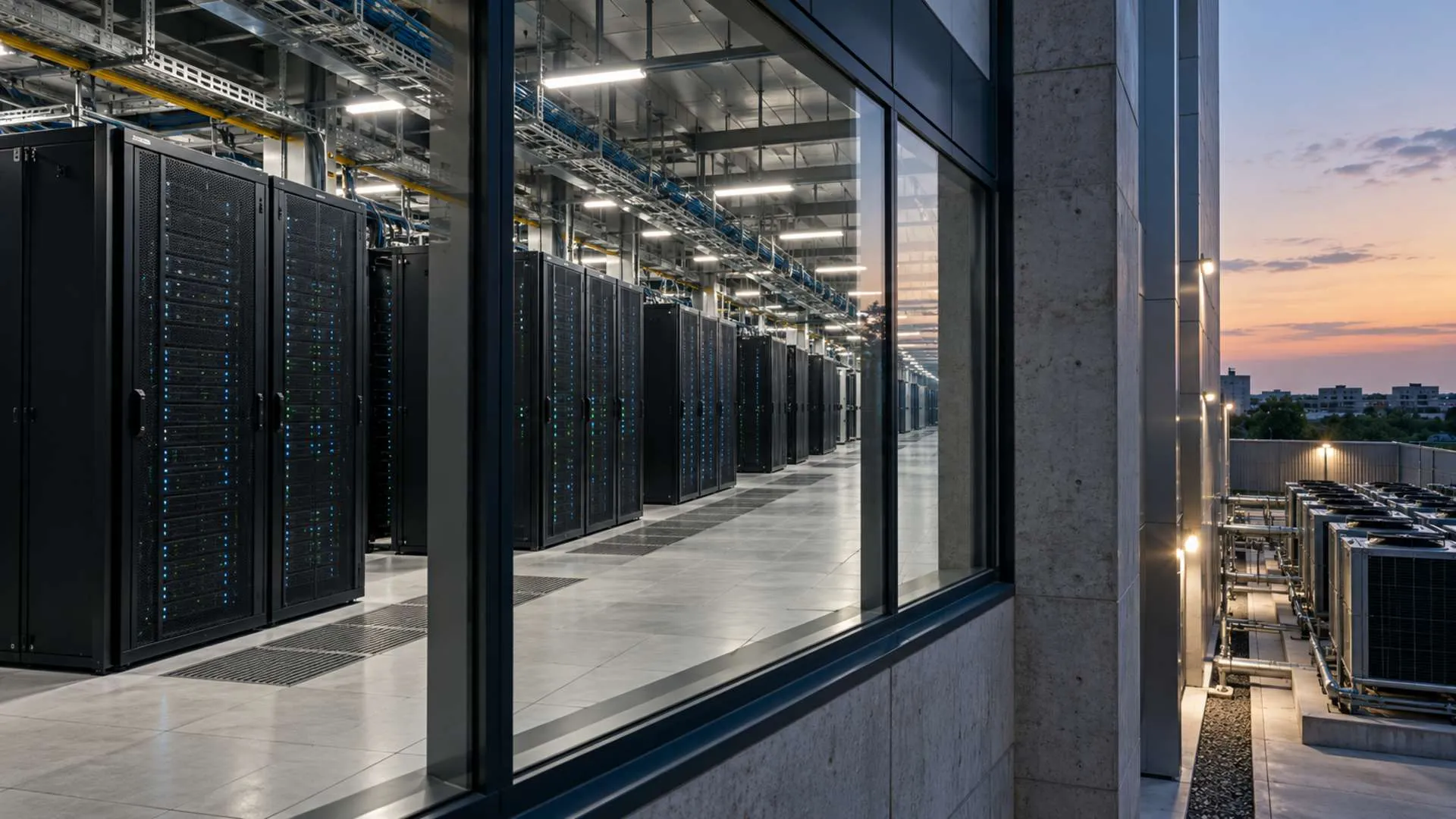
The next major real estate investment may have few windows, restricted entry and rooms designed for servers rather than people.
Data centres have captured 29% of private equity inflows into Indian real estate in H1 FY27, compared with 4% in FY26, according to ANAROCK’s FLUX findings reported by Business Standard. The latest half-year covers April–September 2026.
That is a striking change in where institutional money is going. Investors are increasingly treating the physical infrastructure behind digital services as part of the property investment universe.
For developers, it broadens the definition of a valuable real estate asset. For homebuyers, however, the implications require careful interpretation.
A surge in data centre investment is evidence of changing capital allocation—not automatic proof that neighbouring flat prices will rise.
Why are data centres getting 29% of real estate private equity in India?
Data centres are attracting capital as cloud computing, artificial intelligence and other digital services expand demand for infrastructure. ANAROCK’s H1 FY27 findings, reported by The Economic Times, attribute the jump in investment share partly to large foreign platform deals. Investors are backing operating businesses and expansion opportunities alongside physical property assets.
The headline also needs a denominator. The 29% figure refers to the tracked real estate PE inflows during that period. It does not mean data centres received 29% of all investment in India, or 29% of the money spent buying homes.
PE investment involves institutional capital committed through transactions. It is different from an individual purchasing an apartment, taking a home loan or paying a developer’s instalment.
Understanding that distinction prevents a compelling investment statistic from becoming a misleading housing-market prediction.
The money is returning, but its destination is changing
The Economic Times reports that Indian real estate attracted approximately $2.7 billion in PE inflows during H1 FY27, up 23% from $2.2 billion a year earlier. The period recorded 30 deals, compared with 22 previously.
This makes the data centre story part of a broader recovery in investment activity.
Offices still led the allocation. Selected sector shares reported by Business Standard show how institutional interest is spreading:
| Asset class | Share of PE inflows in H1 FY27 |
| Office | 35% |
| Data centres | 29% |
| Residential | 14% |
| Hospitality | 12% |
Selected sectors from ANAROCK’s findings; this table does not represent the complete allocation. Personal Finance – Business Standard
Data centres are gaining ground without displacing offices from first place.
The comparison between a half-year and a full financial year must also remain explicit. The rise from 4% in FY26 to 29% in H1 FY27 compares investment shares across different-length periods. It should not be described as a like-for-like annual growth rate.
Large transactions can materially change a sector’s share. The size and timing of deals therefore matter alongside the underlying demand story.
Why digital demand has become a real estate story
Digital services depend on physical facilities. Servers need buildings, suitable equipment and dependable operating conditions.
In its supplied explainer, The Indian Express links demand to AI, streaming, cloud computing, digital payments and e-commerce. It also highlights suitable land and power availability as important development challenges.
The investment logic follows from that combination: expanding digital activity creates demand, while delivering suitable infrastructure requires substantial physical development.
However, an empty commercial building does not become a successful data centre simply because it has enough space. Investors must assess whether the location, infrastructure and operator can support the intended use.
That makes execution central to the investment case. Capital must translate into a functioning facility with customers, rather than merely a completed structure.
The Indian Express article also uses a separate dataset and reporting period, describing a 38% data centre share in April–June 2026, based on Savills India findings. That number should not be combined directly with ANAROCK’s 29% figure for April–September.
Different periods and methodologies can produce different results without either figure being contradictory.
The opportunity lies in building infrastructure that customers need. The risk lies in assuming demand will absorb every proposed development.
Platforms, domestic investors and the shift towards equity
The change is about how investors deploy money as well as where they deploy it.
A platform investment can back a business spanning several assets or locations. Instead of acquiring only one completed property, investors may support an operator’s wider development and operating strategy.
According to The Economic Times, pan-India and multi-city transactions accounted for 49% of inflows in H1 FY27, compared with 18% in FY26. Domestic investors deployed approximately $1.3 billion, nearly six times the $220 million invested in H1 FY26. Foreign investors remained active, contributing approximately $1.4 billion.
The domestic increase therefore should not be presented as foreign capital disappearing.
Platform investing offers a possible route to expansion, but it also changes the assessment. Investors must examine management quality, development commitments and the performance of the wider business.
Business Standard reports that equity accounted for 83% of inflows, the highest share since at least FY23.
Equity represents an ownership interest. Debt represents a lending relationship. Their contractual rights, exposure and potential returns differ.
The interpretation is that investors are committing more capital through ownership positions. It does not establish that every participating business will succeed, or that equity is inherently safer than debt.
Data centres versus offices: different investment questions
An office investment and a data centre investment both involve property, but evaluating them requires different questions.
For an office asset, an investor might begin with occupancy, tenant quality, lease terms and the location’s appeal to employers.
For a data centre, those commercial questions must sit alongside an assessment of operating requirements and infrastructure delivery.
| Comparison | Office property | Data centre property |
| Intended use | Workspace for people and organisations | Infrastructure supporting digital operations |
| Core assessment | Occupancy, leases and workplace demand | Customers, operating capability and infrastructure suitability |
| Development question | Will the building attract occupiers? | Can the facility meet customers’ technical requirements? |
| Expansion question | Is there demand for additional workspace? | Can infrastructure and customer demand support additional capacity? |
Neither format is universally the better investment. The answer depends on the asset, operator, contracts, price and risks.
An AI-related narrative may attract attention, but it cannot replace scrutiny of what has been delivered, what has been contracted and what still requires funding.
What does this mean for Pune and Mumbai homebuyers?
For someone searching for a flat in Pune, a flat in Mumbai or a broader property investment, the effects are potentially indirect.
A major infrastructure development could influence demand for particular land parcels, construction services or supporting infrastructure. Whether it strengthens nearby housing demand is a separate question.
A data centre’s investment value is not a measure of how many households will move into the surrounding area. It should not be treated as equivalent to an office campus employing a large workforce.
The supplied PE findings do not establish a data-centre-driven appreciation forecast for Navi Mumbai, Thane, Airoli, Powai, Hinjewadi or Kharadi.
Before accepting a “future hotspot” claim, homebuyers should ask:
- What exists today? Distinguish an announcement from construction and operation.
- What supports housing demand? Look for employment, services and actual occupancy.
- What is the price evidence? Compare local transactions and realistic rents.
- What serves daily life? Assess roads, schools, transport and utilities independently.
Institutional investment is useful context. It is not a substitute for evaluating the residential property itself.
What should the market watch next?
The durability of this shift will become clearer through subsequent investment periods and completed developments.
Watch whether new capacity attracts customers, whether infrastructure is delivered and whether investment remains broad-based rather than concentrated in a few exceptional deals.
The 29% share of property PE inflows puts data centres firmly in India’s real estate investment conversation. It also shows why the sector can no longer be understood solely through homes, offices and shopping centres.
For residential buyers, the practical response is to investigate the local evidence behind the headline. Explore your property options through RealtyConnect, and compare actual connectivity, neighbourhood services and documented prices before committing to a claimed growth corridor.

FAQs:
 Beyond the Metros: India’s Next 11 Real Estate Markets to Watch