East Pune vs West Pune: Where Should You Buy in 2026?
East Pune vs West Pune: Prices & Growth in 2026
SHARE:
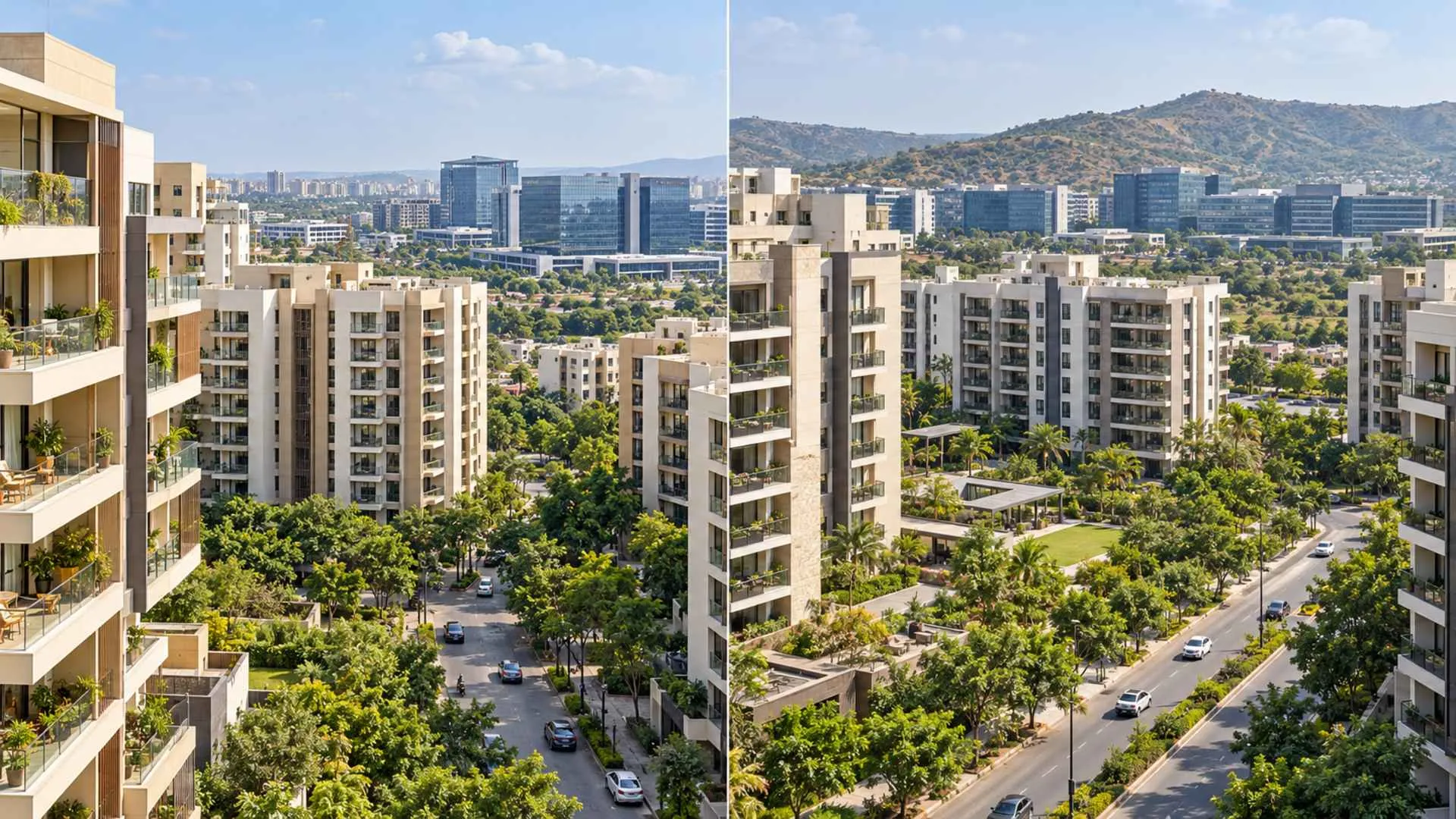


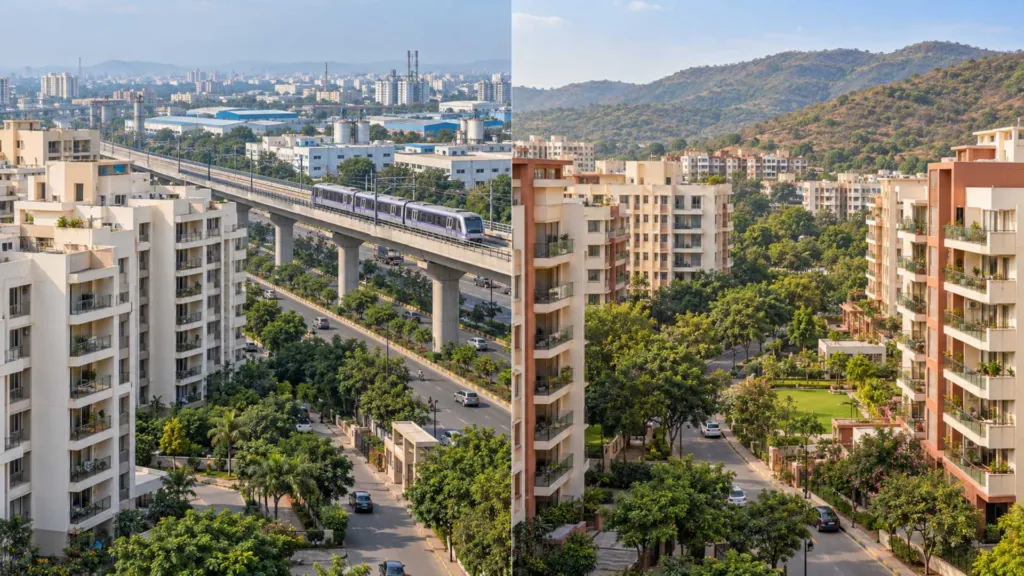
Two apartments, similar budget, different ends of Pune. One gets you closer to Kharadi’s offices; the other makes Hinjewadi an easier commute.
Two homes, comparable prices, contrasting edges of Pune. One will get you closer to Kharadi’s offices; the other makes Hinjewadi a reachable destination. Both promise connectivity, lifestyle and appreciation. Which warrants your investment buck?
The East Pune vs West Pune argument is better appreciated when viewed through the prism of what the home is capable of offering to your household – a smaller apartment closer to your workplace can deliver far greater value to your family than a larger home that requires a daily commute across the city. A lesser purchase price can also be compromised by the additional charges of getting to and from the workplace and recurring expenditures that come with being a unit owner.
The broader market also has a bearing on what you can expect from the local real-estate landscape. The report, put out jointly by CRE Matrix’s July 2026 report, produced with CREDAI Pune, shows that 44,265 homes were sold across the city in H1 2026 against ₹37,048 crore worth of transactions. The average residential price clocked in at ₹10,543 per sq ft. However, these are citywide numbers that don’t necessarily apply to an individual flat in Pune.
For an individual considering purchasing a flat in Pune, the decision comes down to a more relevant assessment of the workplace, local environment, the apartment and your overall budget.
Should you buy in East Pune or West Pune in 2026?
Choose East Pune when Kharadi, Magarpatta, Hadapsar, or airport access drives your routine. Investigate West Pune when Hinjewadi, Baner–Balewadi or Mumbai-bound travel matters more. Neither side is uniformly cheaper or a better investment: compare similar homes, verified connectivity and total ownership costs within the corridor you will use.
This is a practical buying framework drawn from the employment and location distinctions discussed in Aishwaryam’s East–West comparison.
East Pune vs West Pune property prices: Compare neighbourhoods first
There is no single East Pune property price against which every West Pune flat can be measured. Each side contains established premium addresses, employment-led neighbourhoods and developing alternatives.
For an indicative comparison, 3BHKFlat’s 2026 guide publishes the following broad 3 BHK budget ranges:
| Locality | Corridor | Published indicative 3 BHK range |
|---|---|---|
| Wagholi | East | ₹65 lakh–₹1.1 crore |
| Hadapsar/Magarpatta | East | ₹95 lakh–₹1.6 crore |
| Kharadi | East | ₹1.2–2 crore |
| Hinjewadi/Wakad | West | ₹1–1.6 crore |
| Baner/Aundh | West | ₹1.3–2.5 crore |
| Kothrud | West | ₹1.2–2 crore |
These are the publisher’s guide ranges, rather than verified quotations for currently available apartments. Carpet area, building age, specifications and possession status can substantially change the price.
A separate GHAR.tv July 2026 comparison reports asking-price reference points of approximately ₹10,700 per sq ft in Kharadi and ₹11,700 in Baner. It also lists Wakad at ₹9,350 and Hinjewadi at ₹9,900. These are asking-price measures from that publication, with a different basis from the citywide CRE Matrix report.
The lesson is to compare like with like. Ask whether the quotation uses carpet, built-up, or saleable area. Then establish what the price includes.
A ₹1.2 crore ceiling does not automatically secure a preferred 3 BHK in Baner–Balewadi. Similarly, an under-₹60 lakh East Pune search needs apartment-specific evidence; a locality’s affordable reputation is insufficient.
Where should IT professionals buy a flat in Pune?
Start with the office you actually attend.
East Pune’s employment references include EON IT Park and World Trade Center in Kharadi, alongside Magarpatta and Hadapsar’s business catchments. West Pune’s central employment anchor is Rajiv Gandhi Infotech Park in Hinjewadi. These distinctions appear in both the 3BHKFlat comparison and Apna Vaastu’s investment guide.
For a Kharadi employee, a flat in Kharadi deserves an initial comparison with Mundhwa and Wagholi. Investigate whether the alternative offers enough additional space or budget relief to justify its actual approach to work.
For a Hinjewadi employee, compare the relevant phase with Wakad, Baner–Balewadi and other practical western options. A flat in Hinjewadi should be assessed against the exact office gate, rather than the IT park’s general address.
Dual-income households need a joint decision. Map both commutes, school travel and the days each person must attend work. Choosing solely around the shorter journey can leave the other household member carrying a substantial daily burden.
Test the route during your normal working hours before booking. A weekend site visit cannot establish a weekday commute.
This is where a Pune IT hub property earns its value: through a workable relationship between the apartment and the jobs supporting demand.
Kharadi or Baner, Wagholi or Wakad: Which suits your household?
Kharadi versus Baner is a useful comparison for buyers considering established employment-linked locations. Their appeal should be assessed through the home and surrounding routes, rather than a blanket claim that one locality is better.
Aishwaryam’s guide identifies Kharadi, Viman Nagar, Hadapsar and Wagholi among the eastern markets, and Baner, Wakad, Hinjewadi and Bavdhan among western options. Its account links the eastern corridor with airport and commercial access, and the west with Hinjewadi and Mumbai connectivity.
For frequent flyers, investigate Viman Nagar and suitable eastern locations using the actual airport route. Avoid assigning one airport distance to all of East Pune.
For buyers considering a flat in Baner, NOW Realty’s location guide highlights Baner–Balewadi’s residential and commercial setting. Since the developer also markets in Baner, use that perspective as a shortlist input and verify its convenience independently.
First-time buyers comparing Wagholi or Wakad should examine what their budget buys in each society: usable space, parking, water arrangements, maintenance and possession certainty.
Bavdhan and Kothrud deserve separate consideration for western buyers. A hillside view, school requirement, or preference for an established neighbourhood may matter more than proximity to an IT park.
An affordable flat in Pune is ultimately one the household can purchase and occupy comfortably. Keep registration expenses, interiors, recurring charges and a financial buffer within the decision.
Pune metro impact: Separate today’s services from future connections
Metro connectivity is important, but the project stage must be accurate.
The existing Vanaz–Ramwadi corridor provides a connection between western and eastern parts of the city. Pune Metro’s operational corridors were identified in The Indian Express’s September service report.
For West Pune, PMRDA identifies Line 3 as the approximately 23.2-km Hinjawadi–Shivajinagar project with 23 stations. October reporting still described commissioning preparations. Buyers should therefore verify passenger service on the relevant section before accepting a claim that the whole corridor is operational.
For the eastern corridor, Maha Metro’s Line 4 and 4A page describes the Kharadi–Khadakwasla route and the Nal Stop–Warje–Manik Baug spur. This is a separate expansion project, rather than an existing Kharadi train service.
Construction progress, safety clearance and passenger operations are different milestones. A “95% ready” statement does not answer whether residents can board a train.
Apply the same discipline to Pune Ring Road claims. Identify the relevant project, interchange and construction stage instead of treating a proposed regional connection as an immediate improvement to every local commute.
Even beside an operating station, check the walking route, crossings and feeder transport. The final kilometre can decide whether the metro becomes useful.
Which side offers better appreciation and rental yield?
Pune property investment requires two separate assessments: income during ownership and the price achievable on exit.
For appreciation, the period and measurement matter. CRE Matrix reported 20% growth in Pune’s average residential price between H1 2022 and H1 2026, while its broad South West and South East markets recorded different growth rates. These regional categories should not be substituted for individual localities.
Claims such as “Hinjewadi 65.3% versus Hadapsar 75% appreciation” need a named source, matching dates and consistent methodology before becoming a ranking. They should not be presented as one-year 2026 returns.
For rental yield, Apna Vaastu’s guide publishes broad estimates that favour the western corridor. Such estimates help frame questions, but do not establish the return available from a particular flat.
The same applies to a “Kharadi 4% versus Baner 3%” comparison. Calculate the result using achievable rent and the apartment’s complete purchase cost.
For illustration, a ₹1 crore home earning ₹30,000 monthly produces ₹3.6 lakh annually: a 3.6% gross yield. Vacancy, repairs and owner-paid expenses reduce the net return.
A Kharadi or Hadapsar investor should investigate competing rental homes near the relevant employment catchment. A Baner or Hinjewadi investor should do the same locally. Neither side provides a guaranteed tenant or resale buyer.
A buying decision that works beyond the brochure
Some references are useful for context but require careful dating. Magicbricks’ East–West guide was updated in February 2023. Its neighbourhood discussion should not turn its older price tables into current 2026 quotations.
Project comparisons need similar care. The supplied Godrej Properties MMR marketing portal compares offerings across several locations and housing formats. A project’s advertised starting price cannot establish the prevailing price of an entire corridor. Which Side Wins?
Before you buy property in Pune, compare three realistic apartments using:
- Documented carpet area and complete acquisition cost.
- Workplace, school and healthcare journeys.
- Water supply, access roads and recurring maintenance.
- Project-specific approvals, possession documents and delivery position.
- Comparable rents and resale competition, where investment matters.
Ask the developer to explain the exact building, phase and specifications behind the offer. A clear cost sheet and a usable floor plan make a stronger case than a broad promise of future appreciation.
For NRIs, add an independent inspection and a practical plan for maintenance or letting. Choose the property on evidence that can be checked remotely and locally.
East Pune vs West Pune: Where should you buy in 2026?
The best area in Pune depends on the household choosing it. East Pune warrants attention when Kharadi, Hadapsar, Magarpatta, or airport travel shapes daily life. West Pune deserves priority when Hinjewadi, Baner–Balewadi or Mumbai-bound journeys dominate.
For a Pune flat comparison, narrow the corridor first, then compare neighbourhoods and apartments. Buyers seeking rental income should test achievable returns; families should prioritise the home’s suitability and recurring journeys.
Before booking, visit both shortlisted locations during working hours and request written, complete quotations. In the East Pune vs West Pune decision, the strongest purchase is the home whose price, paperwork and everyday convenience remain convincing together.