North Pune vs South Pune: Prices, Infrastructure and Growth in 2026
North Pune vs South Pune: Prices & Growth in 2026
SHARE:
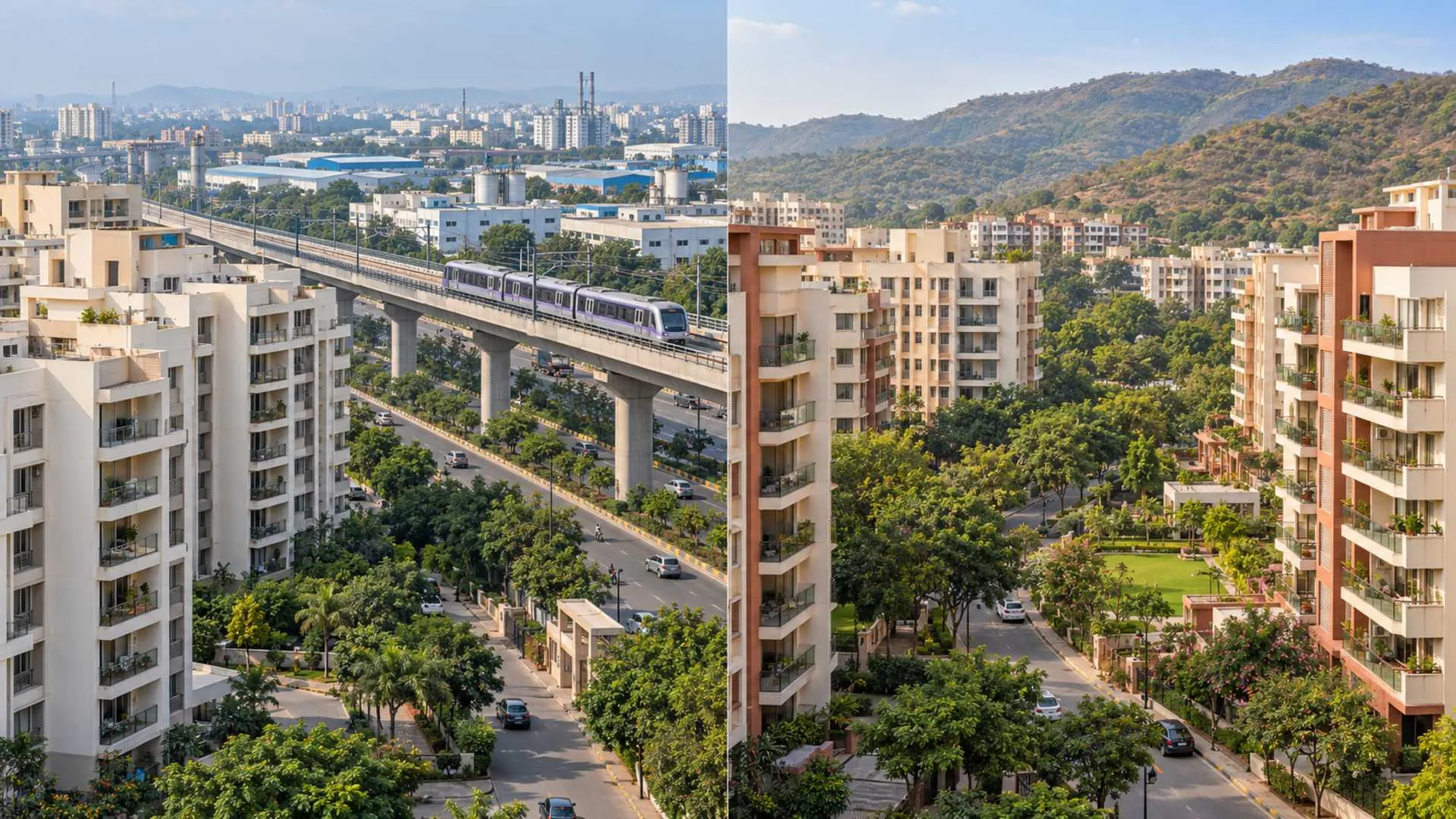


A metro-connected address in Pimpri. A bigger apartment in Undri. An affordable home near Chakan’s factories. A gated community along NIBM Road. Pune’s north and south neighbourhoods present different reasons to buy and different questions to ask.
The North Pune vs South Pune property comparison in 2026 goes beyond which side has the lowest advertised rate. Employment access, transport already available, society expenses and infrastructure still being developed can change the value of an apparently attractive deal.
There is also a geography problem. Pimpri-Chinchwad, Chakan and north-eastern locations such as Dhanori are often grouped into one property-search belt, although they are separate markets. South Pune likewise stretches across neighbourhoods with different routes, budgets and municipal-service conditions.
Compare the apartment’s location and everyday usefulness before buying into a broad “growth corridor” story.
Should you buy in North Pune or South Pune in 2026?
Investigate North Pune when Pimpri-Chinchwad, Bhosari or Chakan employment and access to the operational PCMC–Swargate metro suit your routine. Compare South Pune when Undri, Pisoli, Kondhwa, NIBM or the Katraj–Ambegaon belt fits your budget and family needs. Prices overlap, while proposed roads, metro links and Purandar Airport require separate verification.
The practical distinction is between convenience you can use today and benefits dependent on future delivery. Both can influence a purchase, but they deserve different weight.
North Pune vs South Pune prices: What do current references show?
Selected locality pages on Square Yards provide a useful, date-labelled starting point.
| Locality | Search belt | Portal-reported average asking price |
|---|---|---|
| Chakan | Northern industrial corridor | ₹4,900 per sq ft |
| Moshi | Northern residential belt | ₹7,900 per sq ft |
| Pisoli | South Pune | ₹6,650 per sq ft |
| Undri | South Pune | ₹8,100 per sq ft |
| Kondhwa | South Pune | ₹10,750 per sq ft |
| NIBM | South Pune | ₹12,350 per sq ft |
Sources: Square Yards’ Chakan, Moshi, Pisoli and Undri pages. The FAQs identify these as September 2026 references; the Undri page includes nearby Kondhwa and NIBM comparisons. These are portal asking-price indicators, rather than confirmed transaction values or quotations for every project.
The comparison immediately complicates a simple north-versus-south verdict. Chakan has a lower reference than the selected southern locations, while Moshi and Undri are much closer. Pisoli offers another budget position within South Pune.
A PCMC flat price should therefore be checked for the actual locality. An Akurdi apartment cannot be priced using Chakan’s average, just as a Pisoli flat cannot be valued from a premium NIBM development.
Area measurement matters equally. Confirm whether each quotation uses carpet, built-up or saleable area. Include applicable transaction expenses, interiors, parking arrangements and immediate repairs in the total budget.
The cheapest rate per sq ft is useful only when it describes space, condition and a location that meet your needs.
Employment and family life create different buying priorities
North Pune’s manufacturing economy gives many buyers a direct reason to investigate the region. The industrial connection is tangible: Mercedes-Benz identifies its production facility in Chakan, while Bajaj Auto’s annual-report material discusses its Chakan operations.
For manufacturing professionals, the relevant comparison is the journey to the exact plant or office. Check shift timings, company transport, heavy-vehicle movement and the approach road. “Near the industrial hub” can conceal an inconvenient final stretch.
A Moshi flat, a Pimpri-Chinchwad flat and Chakan property may therefore attract different households despite appearing within the same northern search.
Akurdi deserves a separate assessment for buyers exploring established PCMC neighbourhoods. Projects such as Shubh Veda, identified on Shubh Developers’ website, provide a project-specific starting point. Verify its phase, configuration and current quotation independently.
For South Pune, Square Yards’ regional overview identifies Undri, Pisoli, Mohammadwadi, Kondhwa and NIBM among the residential locations buyers investigate. Its neighbourhood descriptions help generate a shortlist, although parts of the page retain historical material that should not be used as current pricing.
Families comparing an Undri flat with an NIBM apartment should test school journeys, groceries, healthcare and both partners’ commutes. Ambegaon and Dhayari require a different route assessment from Undri–Pisoli.
Dhanori, meanwhile, belongs to a north-eastern airport-side search rather than being interchangeable with PCMC. Consider it when that location matches the household’s routine.
Metro connectivity: The north has an operational advantage along a specific route
The Purple Line between PCMC and Swargate is operational, as noted in the supplied Kolte-Patil investment guide, updated in September 2026. That provides a clear transport reference for homes with practical access to its stations.
It does not mean every North Pune property is metro-connected. A buyer in Moshi or Chakan must still establish the journey to an operating station.
Akurdi needs another distinction. Maha Metro’s project information identifies the PCMC–Nigdi extension as under construction. Buyers should assess existing transport separately from the extension’s future benefits.
South Pune’s transport story also contains different stages. Maha Metro identifies the sanctioned Swargate–Katraj extension, which should not be confused with trains already running to Katraj.
Separately, The Times of India reported surveys and alignment studies for the proposed Shivajinagar–Kondhwa–Yewalewadi corridor, including a planned NIBM–Undri spur. The report described a proposal dependent on approvals, rather than an operating service.
Pune metro impact should be evaluated station by station. Walk the route from the building, check feeder options and calculate the complete journey. An operational station with difficult access may be less useful than the brochure suggests.
Pune Ring Road and Purandar Airport: What could change?
The Pune Ring Road features heavily in property marketing, but buyers must identify the particular project and stretch behind the claim.
The supplied BeyondWalls investment guide, published in May 2025, discusses the Ring Road as an infrastructure driver. Its completion expectations are historical guidance, not proof that the entire road will open in December 2026.
More recent reporting reinforces the need for caution. The Indian Express reported in October 2026 on increased costs and changes affecting the MSRDC project.
For a Moshi, Chikhli or Chakan buyer, ask which interchange would improve the intended journey. For an Ambegaon or Dhayari buyer, request the same route-specific explanation. A road alignment on a map does not establish convenient entry and exit.
Purandar Airport introduces another long-term consideration. MADC’s project overview describes the proposed airport and associated planning. It is a future infrastructure proposition, rather than an existing airport serving South Pune residents.
Undri–Pisoli buyers should assess whether their shortlisted home works without assuming rapid airport-led appreciation. Regional development may create opportunities, but the effect on a particular apartment depends on delivery, access and competing supply.
Buy a home you can use comfortably while infrastructure is being delivered.
Growth and rental yield: Look beyond the headline percentage
The strongest warning in the supplied research is about affordability.
BeyondWalls’ Pune 2025 Market Trends report describes buyers becoming more price-conscious after substantial increases in several markets. Its 2026 outlook identifies Moshi–Chakan and Undri among locations attracting attention on affordability grounds. These are the publisher’s assessments, rather than guaranteed returns.
For Pune appreciation comparisons, ask for the period, property type and measurement basis. A project-specific resale gain cannot establish an annual return for an entire locality.
Rental yield requires similar discipline. Square Yards reports September 2026 reference yields of 4.25% for Moshi, 4% for Undri and 4.33% for Pisoli. These portal benchmarks do not establish the return from every home, or support a universal “PCMC 5% versus South Pune 3%” rule.
For a practical illustration, a ₹60 lakh property earning ₹20,000 monthly rent produces ₹2.4 lakh annually: a 4% gross yield. At ₹16,000 monthly, the same acquisition cost produces 3.2% gross.
Vacancy, repairs and owner-paid charges reduce the net return. Investors seeking manufacturing professionals as tenants should verify demand for that configuration, furnishing level and society.
A higher quoted Pune rental yield is less compelling if the apartment takes longer to let or carries substantial recurring expenses.
Which locations offer value and what should buyers inspect?
First-time buyers seeking a flat under ₹40 lakh can investigate smaller homes and resale options in northern and southern pockets. They should confirm live availability rather than assume a locality average guarantees a suitable apartment.
Likewise, a 3 BHK in Undri under ₹80 lakh is an apartment-specific search. Establish the carpet area, condition, possession status, and complete quotation before comparing it with PCMC options.
Inspect water supply carefully. Ask existing residents about the source, seasonal interruptions, tanker spending and the division of costs between the society and developer.
Check approach roads after dark, drainage, parking access, lift maintenance and the facilities already functioning. A municipal address alone does not establish that every service has reached the building.
The brief’s PCMC versus PMC/PMRDA comparison also needs property-level verification. Confirm the competent authority for the exact site and obtain the relevant approvals; avoid treating broad northern and southern labels as jurisdiction maps.
Before booking, request:
- A complete cost sheet and documented carpet area.
- Project-specific approvals and possession-related documents.
- Details of water arrangements and recurring society expenses.
- Current transport routes and realistic infrastructure status.
- Comparable sale and rental evidence for investment purchases.
For developers, transparent answers strengthen the offer. A usable floor plan, clear delivery position and verifiable service arrangements help buyers judge the home’s value more effectively than a distant infrastructure promise.
North Pune vs South Pune: Where does the stronger case lie?
The North Pune vs South Pune comparison in 2026 produces different answers for different households. Northern locations warrant attention when industrial employment, PCMC routines and access to the operational metro align with daily needs. Southern neighbourhoods deserve consideration when the home, budget and family journeys work better around Undri, Pisoli, NIBM, Kondhwa or the Katraj belt.
Both sides contain opportunities and compromises. Neither offers uniform prices, infrastructure or investment returns.
Shortlist three homes, visit during working hours and ask for complete written quotations. Choose the property whose affordability and convenience remain convincing before future projects are added to the sales pitch.