

India’s Flex-Office Firms Cross ₹2,250 Crore as Coworking Goes Mainstream
India’s flex-office sector crossed ₹2,250 crore in Q1 FY27
SHARE:
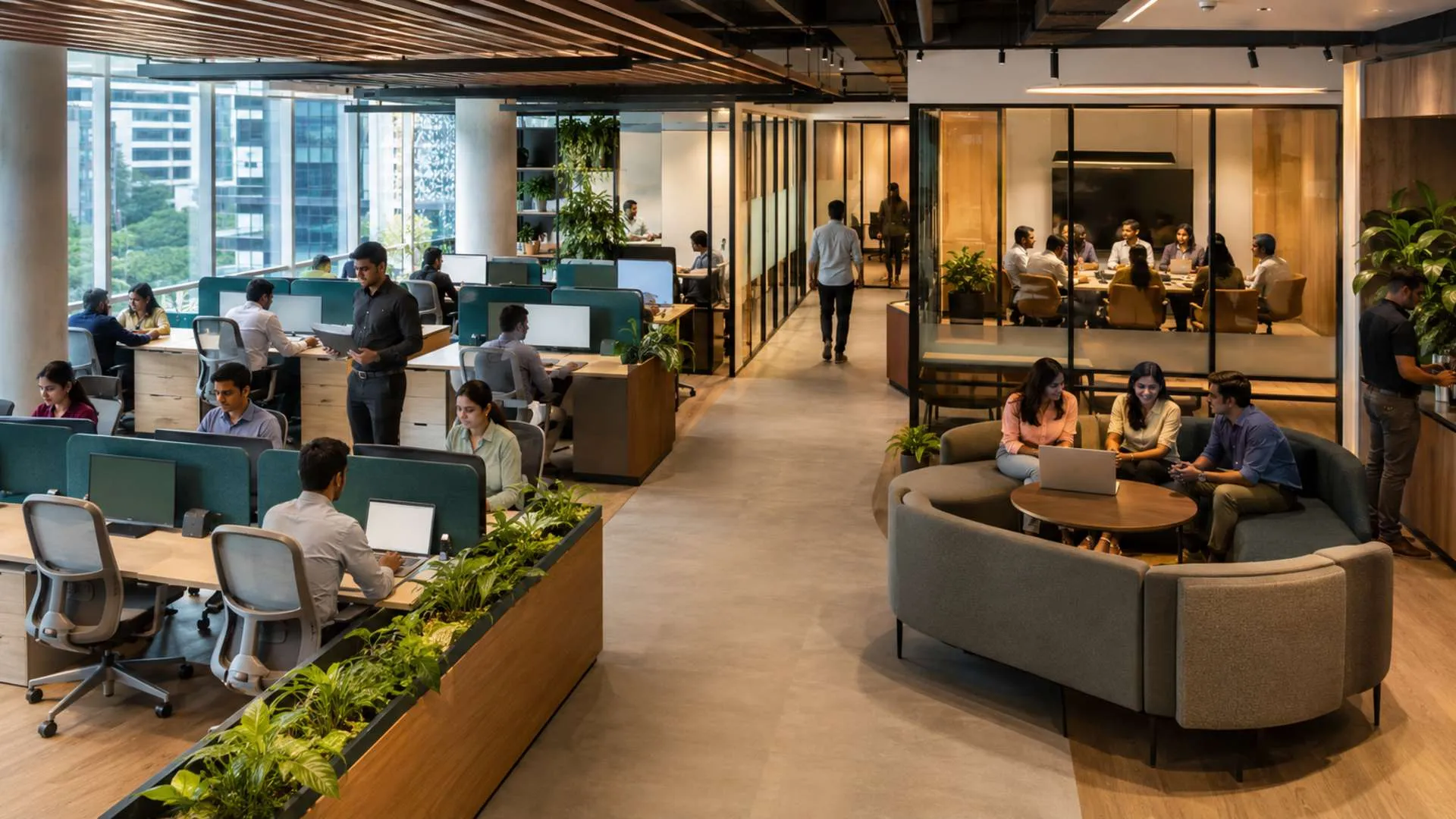
Coworking in India is shedding its old image of freelancers working beside startup founders in colourful cafés. The sector’s biggest customers are now global capability centres, multinational companies and established domestic enterprises.
Five listed flex-office operators generated combined revenue of more than ₹2,250 crore in Q1 FY27, with year-on-year growth ranging from 26% to 44%. The results correct the widely circulated “India flex office ₹2,240 crore” figure and provide compelling evidence that coworking has entered mainstream commercial real estate.
Flexible offices are no longer an alternative to India’s office market. They have become part of its core infrastructure.
How Much Does a Coworking Space Cost Per Month in India in 2026?
A coworking desk in India generally costs ₹4,000–₹15,000 per month. Basic hot desks usually start near ₹4,000, while dedicated desks range from approximately ₹7,000 to ₹15,000. Private cabins and enterprise-managed offices cost more, depending on the city, location, amenities, team size and lease term.
This featured answer to “India mein coworking space ka monthly cost kitna hota hai?” comes with an important caveat: there is no universal coworking rate.
Mumbai can average close to ₹16,000 per seat for premium centres, while Pune, Hyderabad and Noida may offer lower entry points. Smaller-city options can sometimes cost approximately ₹3,000–₹8,000 monthly, although availability and service quality vary.
A hot desk provides flexible seating, a dedicated desk reserves one workstation, and a private cabin offers greater privacy. Managed offices go further by creating customised, ready-to-use workplaces for entire corporate teams.
Revenue Growth Signals a More Mature Business
The Economic Times reported that WeWork India led the group with ₹698 crore in Q1 FY27 revenue, up 28.5% year on year. Its Ind-AS loss narrowed to ₹4.06 crore.
This distinction matters because the supplied claim of a ₹65.9 crore quarterly profit for WeWork India does not apply to Q1 FY27 and should not be attached to the latest quarter.
Smartworks recorded revenue of ₹546.2 crore, rising 44.04%, alongside profit after tax of ₹13.1 crore. IndiQube’s revenue increased 36.74% to ₹428 crore, while Awfis posted ₹425 crore in revenue and ₹24 crore in net profit.
Three operators reported profits, while others narrowed their losses. The bigger change is operating leverage: as mature centres fill up, additional revenue can grow faster than centre-level costs.
The race is shifting from collecting locations to converting scale into sustainable profit.
Why Are GCCs Driving India’s Flex-Office Boom?
The sector’s original customers, freelancers and startups, remain important, but large enterprises increasingly determine its direction.
Enterprise clients contributed between 64% and 92% of revenue across the operators studied by myHQ, according to The Economic Times. GCCs accounted for 45% of gross leasing across India’s top seven office markets during H1 2026, while flex operators contributed 25%.
Companies choose flex offices because they can:
- Enter a city without investing heavily in fit-outs
- Expand or reduce teams more easily
- Obtain IT, security and facility management in one contract
- accommodate hybrid teams across multiple business districts
- Avoid committing every employee to a conventional long lease
Daily Office News reports that flex operators represented 27% of gross office leasing in Q2 2026, ahead of technology companies at 21%. Across seven leading markets, operators leased 8.6 million sq ft during H1, up 32% annually.
That does not mean technology demand has vanished. Flex operators frequently lease space that is ultimately occupied by technology, financial-services and GCC teams.
Has India Crossed 100 Million Sq Ft of Flex Space?
The answer depends on how flex stock is defined.
Broader estimates covering business centres, managed offices and multiple building grades place India’s inventory near 110–114 million sq ft. Narrower studies focused on Grade-A flex stock across major cities place the market lower and project it to cross 100 million sq ft by 2027.
Therefore, the phrase “India coworking mainstream 100 million sq ft FY26” requires a methodology alongside the headline. Different reports can produce different totals without necessarily contradicting one another.
Cushman & Wakefield has described India as a global leader in flexible-office maturity. Its 2026 research also shows flex operators becoming a substantial source of leasing demand rather than a niche occupier class.
Bengaluru remains the country’s largest flex market, led by Whitefield and Outer Ring Road demand. Delhi-NCR spans premium Gurugram and more cost-conscious Noida options, while Hyderabad’s HITEC City and Pune’s Hinjawadi-Baner corridor continue to attract technology and GCC teams.
Mumbai offers deep corporate demand but carries higher seat costs. Chennai and Ahmedabad are expanding, while Jaipur, Indore, Kochi and Coimbatore are strengthening the case for affordable coworking outside metro cities.
Is Coworking Worth It for Freelancers and Smaller Businesses?
For a freelancer, coworking can be worthwhile when reliable internet, meeting rooms, networking and separation between home and work justify the membership cost. A hot desk may offer a practical middle ground between working from home and renting an independent office.
For growing businesses, the comparison is broader. A traditional lease may offer control and lower long-term occupancy costs at scale, but it also brings a deposit, fit-out spending, maintenance responsibility and a longer commitment.
Coworking can be better when speed and flexibility matter. A conventional office can become more economical when headcount is stable and the business expects to occupy the same location for several years.
Users should compare the desk price alongside meeting-room credits, internet standards, printing, parking, access hours, security deposit and notice period. The cheapest advertised membership is not necessarily the lowest total cost.
Coworking Has Gone Mainstream, but Risk Has Not Disappeared
The sector still faces rising rents, expensive fit-outs, debt commitments and the danger of expanding faster than occupancy. Competition between WeWork India, Smartworks, IndiQube, Awfis and regional operators will intensify as corporate clients demand consistent services across cities.
Investors should judge listed operators through occupancy, same-centre revenue growth, EBITDA, cash flow, lease liabilities and the time required for new centres to become profitable. A fast-growing portfolio does not automatically make a flex-office stock a buy.
Still, the direction of travel is unmistakable. India’s coworking boom is now being driven more by corporations than by startup culture. Managed offices have turned flexibility into a serious real-estate strategy, and quarterly revenue above ₹2,250 crore shows that customers are willing to pay for it.
For occupiers, the next question is no longer whether coworking looks professional enough. It is whether a flex operator can deliver a workplace faster, more efficiently and with less commitment than a traditional lease.
Looking for the right flexible workspace? Compare hot desks, dedicated desks, private cabins and managed offices across cities—and review the complete monthly cost before signing your membership or enterprise agreement.