Why Plotted Townships Are Drawing India’s Biggest Developers in 2026
Why Plotted Townships Are Attracting Big Developers in 2026
SHARE:


India’s largest developers are seeing an opportunity in the market.
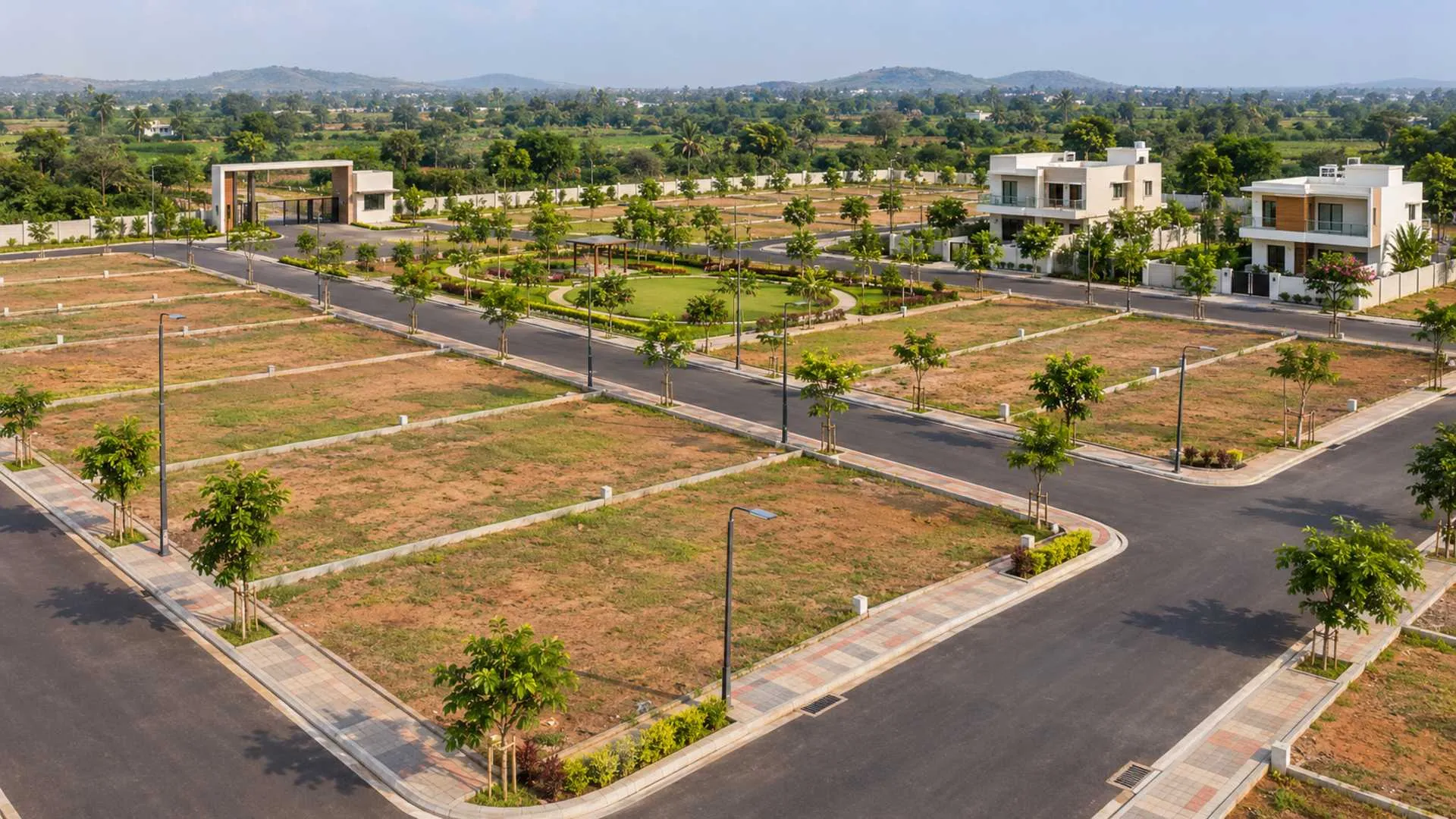
Branded plotted towns are attracting residential tower developers, land specialists and institutional players. It gives individuals land ownership but also town planning, roads, parks, security and common areas.
Collaborations have been emerging in this area. Developers are no longer just selling land to individuals but are also providing town-planning, lifestyle features and helping with building their homes.
Why are big developers entering plotted development in India?
Plotted townships can require less building expenditure than apartment projects and offer developers opportunities for faster cash generation. Buyers gain land ownership and flexibility to design a home, subject to approvals. Branded infrastructure, emerging-city demand and development partnerships are helping the format expand, although returns depend on location, pricing and execution.
Plotted townships attract major developers as partnerships gather pace
The latest development is the growing role of partnerships.
The Federal’s October 28 report highlights two announcements from the previous day: Krisala Developers and Hiranandani Communities’ proposed Nagpur township, and G Square’s home-building platform partnership with JSW One Homes.
The Nagpur proposal combines villas, townhouses and luxury plots. The G Square arrangement addresses another stage of ownership: helping plot purchasers navigate construction.
These approaches show why plotted development projects across Tier 1 and Tier 2 cities are becoming more than land-subdivision exercises. Developers can compete through planning, infrastructure and the services surrounding a future home.
However, a partnership announcement is not a completed township. Project approvals, contractual responsibilities and delivery commitments remain central to the buyer’s decision.
What do the launch numbers actually show?
PropEquity data reported by Business Standard counted approximately 4.7 lakh residential plots launched between January 2022 and May 2025 across ten tracked cities. Their estimated launch value was ₹2.44 lakh crore.
Seven Tier 2 markets contributed approximately 52% of the supply. Hyderabad, Indore and Bengaluru led cumulative launches over the period. The wider list included Chennai, Nagpur, Jaipur, Coimbatore, Mysore, Raipur and Surat.
These figures describe a defined historical sample, not all Indian plot launches through 2026. They nevertheless establish the scale behind developer interest in smaller cities and suburban corridors.
Godrej, Prestige and HOABL: Different routes into branded land
Branded plotted development by Godrej, Prestige and HOABL reflects distinct strategies rather than one identical business model.
Godrej Properties’ February 2026 announcement reported over ₹1,000 crore in plot sales at Evora Estate, Panipat, covering more than 600 plots since its December 2025 launch. Separately, the company announced the handover of more than 500 plots at Forest Estate, Nagpur, in May 2026. These milestones illustrate both customer demand and the importance of delivery.
Prestige offers an earlier example. Mint’s August 2024 report recorded approximately 600 first-phase plots sold at Prestige Kings County. Its reference to prices more than doubling concerned Prestige’s earlier Sarjapur Road plotted project launched in 2021, not proof that Kings County prices doubled in 2026.
HOABL has pursued branded land across destinations including Amritsar, Shimla, Varanasi, Vrindavan, Nagpur and Khopoli. Its company announcements document acquisitions across these locations.
The supplied 16% HOABL figure requires a separate label: company material citing ANAROCK’s Land as Capital report relates it to the size of land transactions in 2024. It should not be presented as HOABL’s share of national plotted-home sales in 2026.
Other developers demonstrate the format’s breadth. Puravankara’s Purva Land and Shriram Properties have Bengaluru plotted-development portfolios. Arvind SmartSpaces has a presence across Ahmedabad, Bengaluru and Pune and announced a roughly 92-acre horizontal township near Khopoli in MMR under a joint-development arrangement.
Institutional partnerships also predate the latest headlines. TVS Emerald and HDFC Capital’s ₹1,000 crore platform for Chennai and Bengaluru plotted projects was announced in 2023; it should not be described as a new 2026 agreement.
Why developers are shifting towards plotted townships
The financial attraction begins with the product developers must deliver.
An apartment project requires construction of the buildings as well as common infrastructure. A plotted township generally concentrates the developer’s work on land preparation, approved layouts, internal roads, utilities and promised amenities.
That can reduce exposure to the building expenditure associated with multiple residential towers. It can also allow developers to monetise land banks through a different product and, where sales proceed well, release working capital sooner.
“Capital-light” remains conditional. Buying land outright can require substantial funding. Joint development may reduce acquisition expenditure, but approvals, infrastructure and marketing still cost money.
For buyers, the appeal is different. Rustomjee’s guide connects demand with privacy, independent living and the ability to shape a home around personal needs. Vaarivana similarly discusses customisation and post-pandemic interest in spacious homes.
The resulting proposition is an individual home within a managed neighbourhood. Its value depends on whether the promised gated-community layout, roads, parks, security, clubhouse and utilities are actually delivered.
Plotted development versus a flat: Which is the better investment?
Plotted projects can record higher price growth than flats in particular markets. That is not a universal investment rule.
PropEquity’s tracked markets recorded a 27% increase in weighted average plot launch prices during 2024. That measures new-launch pricing, not the resale return earned by every plot purchaser.
Similarly, Prestige’s historical plotted-price realisations reported by Mint reflect that developer’s sales mix and period. They cannot establish a nationwide plot-versus-apartment return advantage.
| Buyer consideration | Branded plotted township | Apartment |
|---|---|---|
| Initial purchase | Land plus development-related charges | A completed or promised dwelling |
| Moving in | Usually requires subsequent house construction | Depends on possession and readiness |
| Rental income | A vacant residential plot generally produces no housing rent | A usable apartment can be rented |
| Customisation | Subject to planning and township restrictions | Usually more limited |
| Further expenditure | Construction, approvals and site-specific works | Interiors, repairs and applicable charges |
| Resale | Depends on documents, demand and location | Also depends on condition and society management |
Magicbricks’ Tier 2 township article highlights land availability, infrastructure and phased construction as attractions. Buyers should test those benefits against actual accessibility and their full building budget.
For example, a hypothetical ₹70 lakh plot plus ₹50 lakh construction budget already implies ₹1.20 crore before transaction expenses and contingencies. A branded plot under ₹1 crore is not necessarily a finished home under ₹1 crore.
Plots also differ fundamentally from REIT investments: a single site is a concentrated, directly managed asset, rather than a diversified portfolio of income-producing properties.
Where activity is growing and what RERA changes
Bengaluru provides a useful 2026 indicator. April reporting counted 32 plotted projects among 98 Q1 registrations, against 17 plotted projects a year earlier. That is approximately 88% growth, or near doubling, not more than doubling. The measure concerns project registrations, not plot sales.
Pune’s outskirts and the Mumbai region also warrant attention. Vaarivana identifies Urse, Talegaon, Hinjewadi and Wagholi as areas to examine, while Rustomjee discusses Kasara. These are research starting points, not a verified ranking of India’s best plotted investments.
Across Tier 2 and Tier 3 cities, distinguish operational connectivity from future promises. A highway nearby does not resolve access-road quality, water supply, drainage, or the distance to employment.
RERA rules for plotted development in India matter because the law covers qualifying plotted projects as well as apartments, subject to applicable exemptions. MahaRERA’s enforcement records include unregistered plotted developments. The Ministry of Housing and Urban Affairs also confirms the requirement to place 70% of amounts realised from allottees in a separate account for project land and construction costs.
Before purchasing, verify:
- The exact project phase, plot number and applicable RERA registration.
- Title, encumbrances, sanctioned layout, residential use and legal access.
- Promised infrastructure, completion dates and maintenance obligations.
- Building restrictions, construction deadlines and the complete acquisition cost.
RERA registration improves disclosure and accountability; it does not replace independent title and planning checks.
The growing developer presence makes plotted townships a category worth following in 2026. For buyers, the strongest opportunity combines usable land, reliable infrastructure and a financially workable plan for ownership.

FAQs:
 NBCC’s ₹5,191 Crore Auction Shows How Home Sales Rebuild Delhi