

Beyond EMI: What Will Your Apartment Really Cost Every Month?
Beyond EMI: What Your Flat Really Costs Monthly
SHARE:
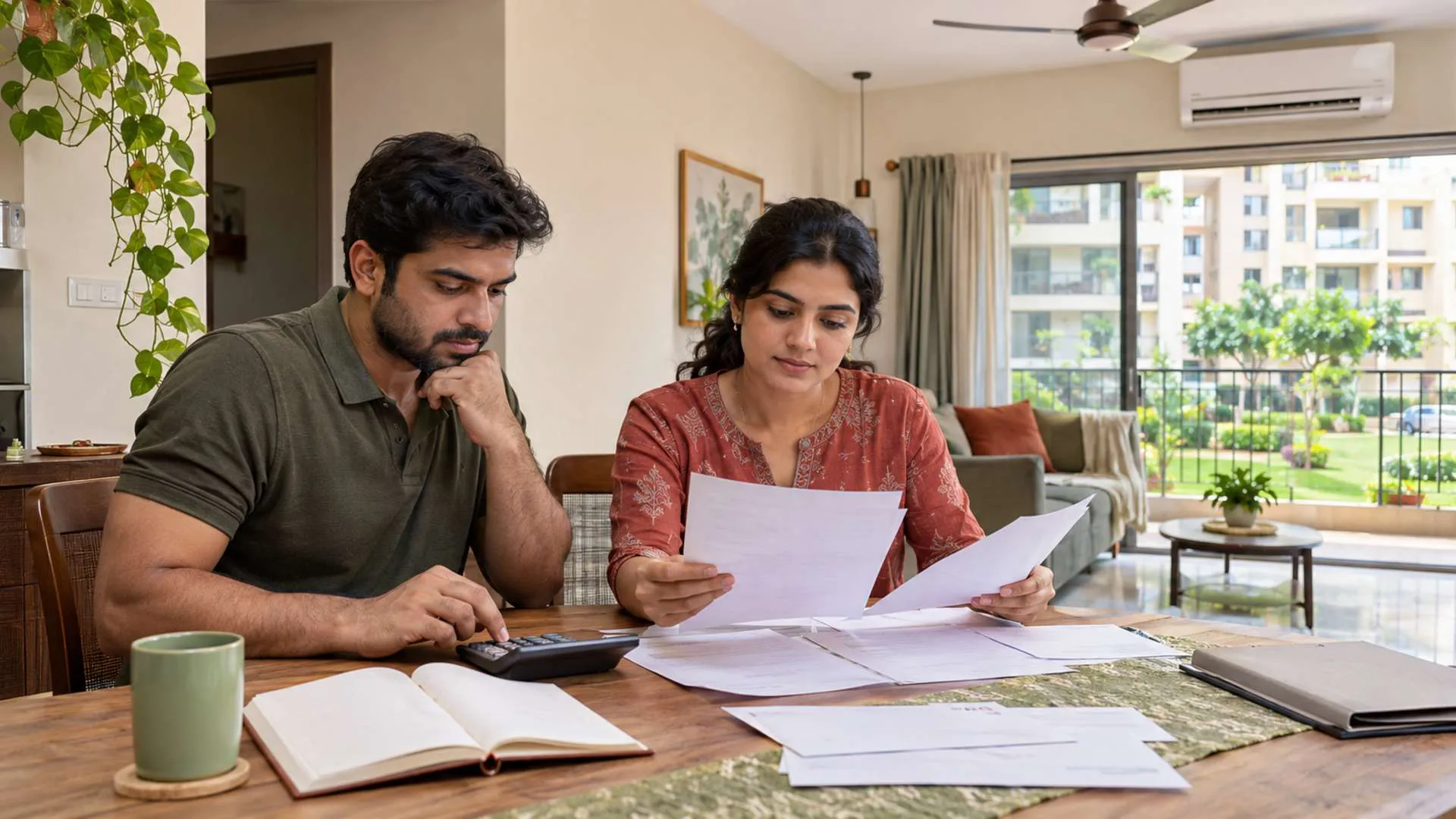


Apart from your EMI, you would have to pay around ₹20,190 every month in order to live in the flat (making the total housing expenditure equal to ₹85,300). This includes maintenance, property tax, insurance, electricity and water bills and contingencies. The actual amount may be much less or more than this. Therefore, it is very important to know the total monthly cost of owning the house as well as the one-time costs from when you book it to when you move in.
What is the total monthly cost of owning an apartment beyond EMI?
Monthly apartment ownership cost = EMI + society maintenance + applicable GST + annual property tax ÷ 12 + annual home insurance ÷ 12 + utilities + a repairs reserve. Calculate these expenses for the specific apartment: its purchase price alone cannot establish its running costs.
The ₹25,000 Surprise: What a ₹1 Crore Flat Can Cost Beyond EMI
The often-quoted ₹1 crore flat, ₹20,000–₹25,000 monthly upkeep figure is useful as a budgeting scenario, rather than a nationwide average. An older society with limited amenities and a premium tower with extensive services can have very different bills.
Consider an illustrative monthly budget: ₹8,000 maintenance, ₹1,440 maintenance GST where applicable, ₹3,000 property tax provision, ₹750 insurance, ₹4,500 utilities and ₹2,500 reserved for repairs. Together, these add ₹20,190 beyond EMI.
Moneycontrol’s examination of the rent-versus-buy question makes a similar distinction: ownership expenses can lift the effective monthly outflow above the instalment advertised by a loan calculator.
For under-construction purchases, there can also be an overlap between rent and loan payments. Kotak Bank explains that pre-EMI generally covers interest on the disbursed loan amount without reducing principal. Budget for that period separately from life after possession.
Society Maintenance Charges: What ₹2–₹25 Per Sqft Means
Maintenance pays for the building’s daily operation: security, housekeeping, lifts, pumps, common-area electricity and other agreed services. Pools, extensive landscaping and specialised equipment introduce additional operating expenses.
To understand society maintenance charges of ₹2–₹25 per sqft, test the quoted rate against the area actually used for billing. These calculations illustrate the difference; they are not surveyed market averages.
| Monthly rate | 1,000 sqft billing area | 1,500 sqft billing area |
|---|---|---|
| ₹2/sqft | ₹2,000 | ₹3,000 |
| ₹4/sqft | ₹4,000 | ₹6,000 |
| ₹8/sqft | ₹8,000 | ₹12,000 |
| ₹15/sqft | ₹15,000 | ₹22,500 |
| ₹25/sqft | ₹25,000 | ₹37,500 |
Ask whether the rate applies to carpet area, another contractual area, or a flat allocation. Also check which expenses are billed separately.
Before buying, request the society’s latest audited accounts, approved budget and information about outstanding repairs. A low maintenance bill can be attractive, but check whether it includes adequate reserves.
The apartment’s sinking fund, corpus fund and IFMS deserve particular attention. Their names alone do not tell you how the money will be held, spent or transferred.
Property Tax: Budget for Your Apartment’s Assessment
Property tax on a residential flat is an annual expense that varies across Indian cities and between buildings in the same locality.
A ₹1.5 crore apartment does not automatically attract a standard tax bill in Pune, Mumbai, Bengaluru, Delhi, Hyderabad or Chennai. Municipal assessment rules, property characteristics, exemptions and outstanding dues matter.
For example, Pune Municipal Corporation’s FAQ identifies carpet area, property use, construction type and ready-reckoner information among assessment factors. Owners can retrieve their bill using the property ID.
Use the actual annual bill to create a monthly provision:
| Actual annual property tax | Monthly amount to reserve |
|---|---|
| ₹12,000 | ₹1,000 |
| ₹24,000 | ₹2,000 |
| ₹36,000 | ₹3,000 |
| ₹60,000 | ₹5,000 |
These are conversion examples, not city averages. For a resale apartment, obtain the latest assessment and paid receipt. For a new building, request the assessment status and basis of any estimate.
Check whether an advertised rebate applies to the whole bill or only one tax component.
The 18% GST Rule: Why the ₹7,500 Threshold Matters
The phrase “18% GST maintenance above ₹7,500 per month” leaves out an important condition.
CBIC Circular 109/28/2019 explains that qualifying RWA contributions up to ₹7,500 per month per member are exempt. Its guidance also considers the society’s ₹20 lakh annual turnover threshold. Under the circular’s interpretation, when the relevant conditions are met, GST applies to the entire contribution exceeding the exemption limit, not merely the excess.
At ₹10,000 maintenance, that interpretation produces ₹1,800 GST, taking the bill to ₹11,800.
However, the full-amount interpretation has faced litigation. An April 2026 Madras High Court order recorded that the related Greenwood appeal was pending. Ask the society’s accountant to explain its applicable tax position and invoice treatment.
Home Insurance and Loan Insurance Cover Different Risks
Home insurance protects insured building components and, where selected, contents against specified events. Home loan protection generally addresses repayment following insured events affecting the borrower, subject to the policy.
SBI General’s Bharat Griha Raksha describes building cover on a replacement or reinstatement basis. That distinction matters: the apartment’s market price includes location and land value, while rebuilding cover serves a different purpose.
Treat a home insurance ₹5,000–₹15,000 annual premium allowance as a provisional budget, not a guaranteed quote. Obtain premiums for the required sum insured, contents, deductibles and exclusions.
Loan protection is a separate purchase decision. A government parliamentary response describes housing loan insurance as an optional product. If a premium is financed through the loan, include the resulting borrowing cost when comparing offers.
One-Time Costs: Why the Flat’s Price Is Only the Starting Point
Stamp duty, registration, interiors, lender charges and initial society payments can consume money reserved for the down payment.
The following illustration assumes a completed resale apartment. Its allowances must be replaced with actual quotations and applicable statutory charges.
| Cost item | Illustrative provision |
|---|---|
| Apartment purchase price | ₹1,00,00,000 |
| Stamp duty and registration | ₹7,00,000 |
| Interiors and fit-out | ₹12,00,000 |
| Initial society payments and advances | ₹1,00,000 |
| Lender charges, legal review and moving | ₹1,00,000 |
| Total initial budget | ₹1,21,00,000 |
This example adds 21%, demonstrating why neither a 25–40% uplift nor any other percentage should be assumed automatically.
Interior allowances such as ₹8–15 lakh for a 2BHK and ₹15–25 lakh for a 3BHK require a defined scope. Compare cabinetry, appliances, electrical changes and furnishing separately.
If a cost sheet lists parking at ₹3–10 lakh or clubhouse membership at ₹50,000–₹2 lakh, establish what is legally chargeable and whether it is already included. In Maharashtra, MahaRERA states that promoters cannot sell or allot open parking for monetary consideration.
For under-construction purchases, confirm applicable GST separately. Government FAQs distinguish the 1% and 5% residential rates according to the relevant project and apartment conditions.
Ask for one complete cost sheet, with taxes, exclusions and payment dates clearly identified.
Calculate Your Monthly Ownership Budget Before You Buy
For a ₹75 lakh loan at an assumed 8.5% annual interest rate over 20 years, the calculated EMI is approximately ₹65,087.
Add the earlier ₹20,190 illustrative ownership budget, and monthly housing outflow becomes ₹85,277, rounded to ₹85,300, approximately 31% above the EMI.
That percentage belongs to this example. A different loan, society bill, or municipal assessment changes the result.
Use the formula:
Total monthly housing budget = EMI + maintenance + applicable GST + tax provision + insurance provision + utilities + repairs reserve.
Avoid counting a repair reserve twice if adequate contributions are already included in maintenance. Also allow for rate changes, special society assessments and replacement of ageing equipment.
For buyers researching beyond EMI apartment monthly cost in India, the most useful evidence is the building’s actual bills. Collect them before committing your savings.
Can you afford the flat after paying the EMI? Compare the complete ownership budget with your household income, other commitments and emergency savings.

FAQs:
 Could Bhu-Aadhaar Make Property Verification More Connected Across India by 2031?