

Home Prices Rise 59% as Construction Costs Climb 34% Since 2021
SHARE:
India’s housing boom is confronting buyers with a striking price equation. Average residential values across the country’s top seven cities increased 59% between 2021 and 2025, while the cost of constructing a standard-plus residential project rose 34% over the same period.
The widening gap shows that steel, cement and labour are only part of the affordability story. Land acquisition, location premiums, infrastructure-led appreciation, developer pricing and strong demand have pushed selling prices substantially faster than building expenses.
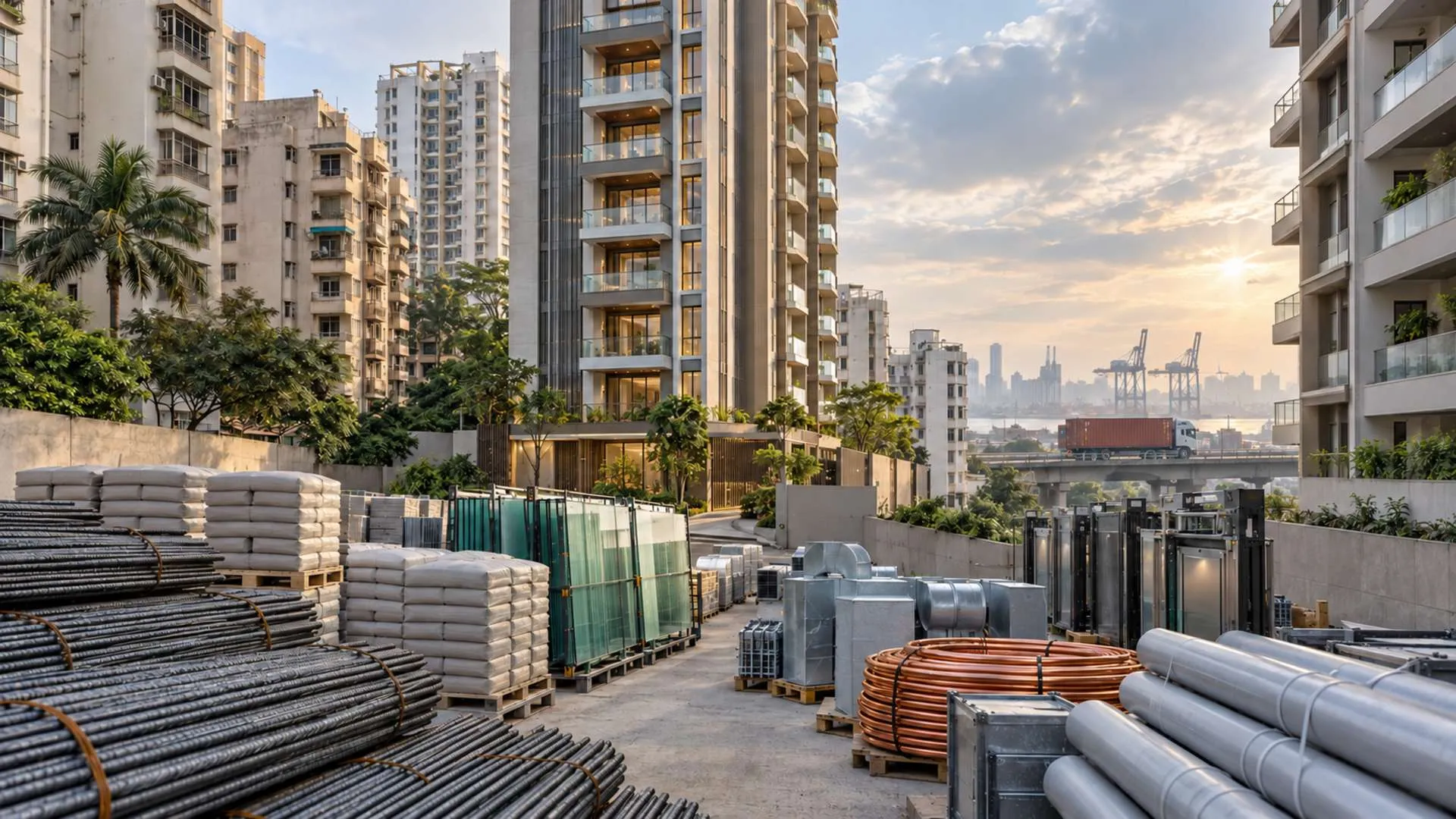
Fresh disruption linked to the West Asia conflict is now adding another layer of uncertainty. ANAROCK Research estimates that geopolitical conditions may have created an additional 8–10% pressure on overall construction costs, led by more expensive steel and fuel-dependent logistics.
For homebuyers, the message is clear: building a home is becoming costlier, but acquiring the land and securing a home in a desirable urban corridor are increasing prices even faster.
Why Are Indian Home Prices Rising Faster Than Construction Costs?
Indian home prices are rising faster because a property’s selling price includes much more than construction. Surging land values, infrastructure upgrades, location scarcity, financing expenses, regulatory costs, developer margins and demand-supply imbalances all influence the final price. Construction costs rose 34% between 2021 and 2025, but average residential values increased 59% across India’s seven leading housing markets.
Those markets comprise Mumbai Metropolitan Region, Delhi-NCR, Bengaluru, Pune, Hyderabad, Chennai and Kolkata. The figures represent a combined market average; they do not mean that prices increased by exactly 59% in every city or neighbourhood.
The Numbers Behind India’s 59% Housing-Price Rise
According to Moneycontrol, average residential capital values across the seven cities climbed from ₹5,826 per sq ft in 2021 to ₹9,260 per sq ft in 2025. That translates into a compound annual growth rate of approximately 12%.
Over the same period, the average construction cost for a standard-plus residential development increased from ₹2,681 to ₹3,604 per sq ft, representing a 34% rise and a compound annual growth rate of about 6.9%.
The difference becomes more tangible when applied to a home. At the reported averages, 1,000 sq ft would have carried a basic capital value of approximately ₹58.26 lakh in 2021. By 2025, that figure would be around ₹92.60 lakh, a rise of more than ₹34 lakh before stamp duty, registration, taxes, parking and other charges.
Business Standard reported that construction expenses accounted for an estimated 66% of the residential price increase analysed by ANAROCK. The remaining 34% was associated with factors such as land costs, developer margins and demand-supply conditions.
That does not mean construction represents 66% of every home’s sale price. It describes ANAROCK’s attribution of the measured price increase. The actual cost structure varies sharply by land parcel, city, project category, financing arrangement and development model.
Land Has Become the Bigger Pressure Point
In established urban corridors, land is scarce, fragmented and expensive. Developers must account not only for its purchase price but also for approvals, financing costs and the time required to assemble and develop a viable parcel.
ANAROCK Group Vice-Chairman Santhosh Kumar said infrastructure-led appreciation, location premiums, demand-supply dynamics and developer pricing had contributed to higher residential capital values.
Land values across the seven cities reportedly increased by roughly 50–120% between 2021 and the first half of 2026, excluding exceptional outliers. Delhi-NCR recorded increases of around 70–130%, while Bengaluru registered approximately 60–120%, according to India Today.
This explains why two projects with broadly similar construction specifications can carry dramatically different prices. A home near a metro corridor, business district, airport road, or established social infrastructure includes the market value of that location.
Buyers are not paying only for concrete and carpet area. They are paying for access, scarcity, future development potential and the developer’s ability to secure land in a competitive micro-market.
West Asia Conflict Creates Fresh Construction-Cost Pressure
The 34% increase covers the historical period from 2021 to 2025. The estimated 8–10% pressure associated with the West Asia conflict is a separate, more recent development; it should not simply be added to the earlier figure and presented as a confirmed nationwide increase.
Steel has experienced the sharpest movement. ANAROCK estimates cited by Moneycontrol place the increase at approximately 20%, with TMT bars reaching around ₹72,000 per tonne, compared with roughly ₹62,000 earlier.
Fuel and site-logistics expenses have reportedly increased by 15–20%. Imported finishing materials, including tiles, glass and hardware, have become approximately 8–12% more expensive, while mechanical, electrical and plumbing, or MEP, costs have risen by an estimated 9–13%.
Labour remains the largest construction component, accounting for around 25–30% of project expenditure, although its increase has been more moderate at 5–6%. Cement costs have moved up by about 4–5%.
The effect is not limited to the visible structure. ETConstructionWorld noted that between 2023 and 2025, core-building costs rose 13% to ₹2,212 per sq ft, while MEP costs increased by more than 17% to ₹788 per sq ft. MEP represented nearly 22% of construction costs in 2025.
Modern homes depend increasingly on electrical capacity, ventilation, fire-safety infrastructure, lifts, water systems, automation and other services. This makes MEP inflation particularly important for high-rise and amenity-heavy projects.
Will Developers Pass the Increase to Buyers?
The answer depends on when a project was launched, how much inventory remains unsold and how strongly its location is performing.
For an already launched project with many homes sold, developers have limited freedom to revise contracted prices. Higher steel, logistics and finishing costs may therefore compress margins. Builders could respond by negotiating procurement contracts, altering launch schedules or reassessing specifications where legally and contractually permissible.
New projects provide greater pricing flexibility because fresh costs can be incorporated into the launch rate. However, there is a ceiling: homebuyers can purchase only what their incomes and loan eligibility support.
Affordable and mid-income housing face the greatest pressure. These categories operate with thinner margins and highly price-sensitive demand. Even a modest per-square-foot increase can push a project beyond the budget of its target buyer.
Premium and luxury developments may absorb cost escalation more easily, especially in land-constrained locations where buyers attach greater value to design, privacy, amenities and address. This could reinforce the industry’s recent preference for higher-value housing.
The conflict does not guarantee an immediate 8–10% rise in home prices. Cost increases may be absorbed, passed on gradually, or reflected only in future launches.
Mumbai, Pune, NCR and Bengaluru Will Not Move Identically
The 59% figure is an average across seven metropolitan markets, not a city-wise forecast. Mumbai’s land scarcity, redevelopment economics and high entry prices differ from Pune’s expanding suburban corridors. Delhi-NCR contains both premium established areas and large emerging sectors, while Bengaluru’s technology-led demand interacts with infrastructure and water constraints.
Hyderabad, Chennai and Kolkata also have distinct inventory levels, employment drivers and affordability thresholds. Even within one city, a metro-linked neighbourhood can appreciate while an oversupplied peripheral pocket remains flat.
The practical question is therefore not simply, “Will Indian home prices come down in 2026?” It is: Does this particular micro-market have enough end-user demand, employment access and infrastructure delivery to support its quoted price?
A nationwide hard correction may be difficult when land and construction costs remain elevated, but that does not make every asking price sustainable. Projects with weak connectivity, excessive supply or speculative pricing may experience slower sales, incentives or localised adjustments.
Should Buyers Purchase Now or Wait?
The 59% rise can create fear of missing out, while construction inflation can make waiting appear risky. Neither emotion should determine a long-term property decision.
A buyer considering a home in 2026 should examine:
- The EMI as a percentage of stable take-home income
- The complete acquisition cost, not merely the advertised base price
- Ready-to-move, resale and under-construction alternatives nearby
- The project’s RERA registration, approvals and construction progress
- Local inventory, rental demand and upcoming infrastructure
- The developer’s delivery history and agreement terms
A home intended for long-term self-use may remain sensible when the location works, the EMI is manageable and sufficient emergency savings remain after the down payment. Investors need a stricter calculation involving rental yield, vacancy risk, maintenance, transaction costs and realistic resale demand.
Waiting solely for a nationwide price crash could prove unproductive. Buying solely because prices have already risen 59% could be equally costly.
The New Cost Reality for Indian Housing
Cement and steel alone cannot explain India’s housing inflation anymore. The 2021-2025 data suggests a broader re-pricing of urban land, access to infrastructure and scarce residential locations. Disruption in relation to West Asia now threatens to lift the construction floor further, particularly through steel, logistics, finishing materials and MEP systems.
The next phase will be to see how much of that pressure developers are able to absorb without releasing supply and buyers can absorb without sacrificing affordability.
Home prices may have exceeded construction costs, but the future will still be decided project by project, street by street.
Before taking a call, compare all-inclusive prices, check the local supply pipeline and stress-test the EMI against higher household expenses. If you need help assessing a project or comparing property options, start a chat with RealtyConnect.