India’s Healthcare Space Gap: 2.6 Billion Sq Ft More by 2035
India Healthcare Real Estate: 2.6 Billion Sq Ft by 2035
SHARE:
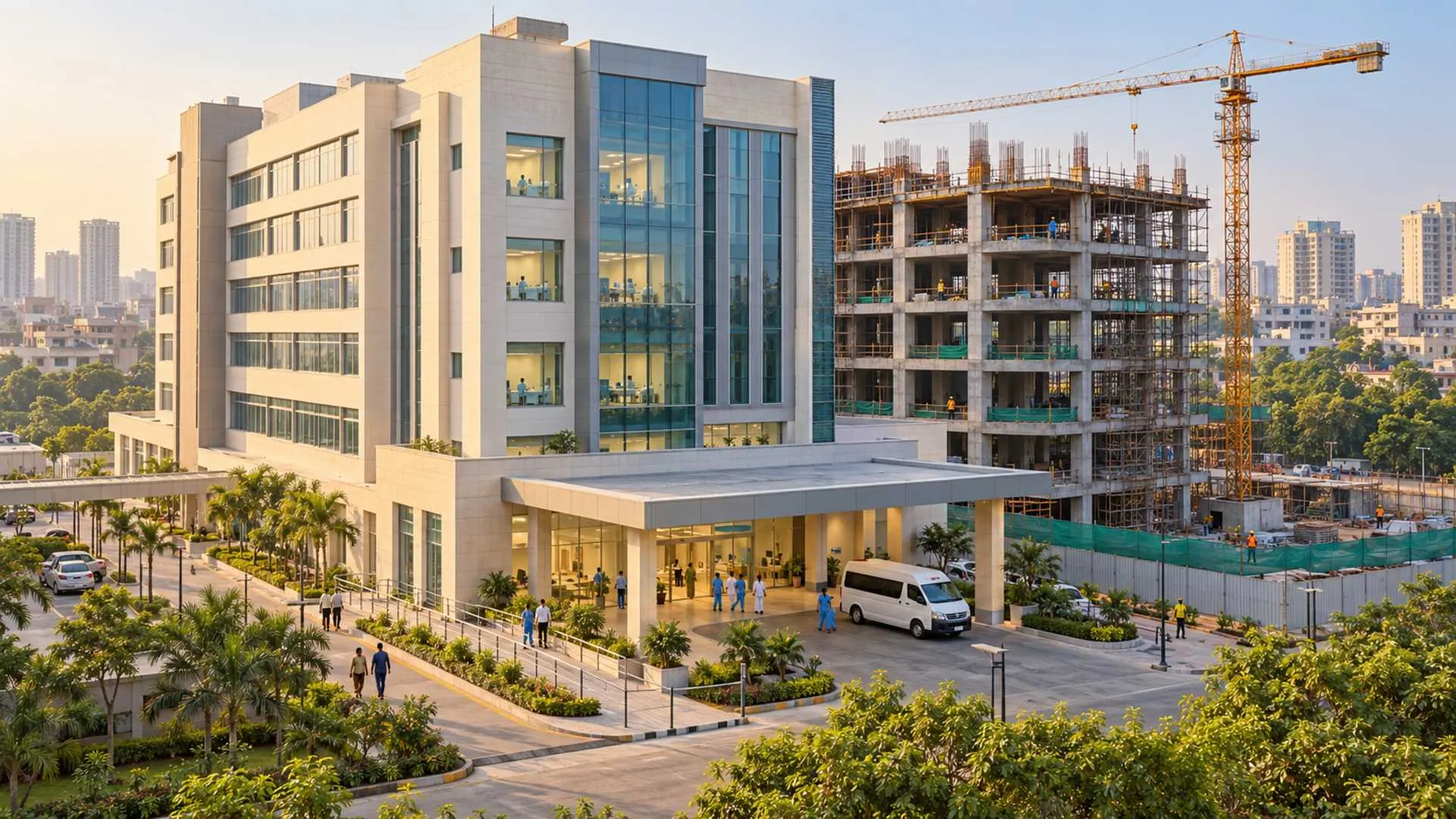
India’s next major real estate opportunity could emerge from a shortage of hospital beds.
The country may require approximately 2.6 billion sq ft of additional healthcare real estate by 2035, according to CBRE’s October 2026 report, Beyond Core: A 2035 View of India’s Alternate Sectors, Part One. The estimate places healthcare infrastructure firmly within the conversation about where developers and institutional capital could expand next.
The opportunity extends beyond buying land and building hospitals. It involves matching specialised buildings with capable operators, patient catchments and financially sustainable services.
For commercial real estate in India, this creates a compelling development question: can the property industry help expand access to healthcare while building viable, long-term assets?
Why does India need 2.6 billion square feet of healthcare space by 2035?
CBRE estimates that India may need 2.6 billion sq ft of additional healthcare space to accommodate approximately 2.9 million incremental hospital beds by 2035. Its illustrative model considers population growth and closing the gap between India’s estimated 1.6 beds per 1,000 people and the current global average of 3.3. This is a capacity requirement, not a committed construction pipeline.
The numbers reveal a gap bigger than today’s healthcare footprint
As reported by Fortune India, the estimate starts from a healthcare real estate footprint of approximately 2.1 billion sq ft in 2025.
| Measure | Estimate cited in CBRE’s analysis |
| Existing healthcare real estate footprint, 2025 | 2.1 billion sq ft |
| Additional space requirement by 2035 | 2.6 billion sq ft |
| Additional hospital beds required by 2035 | Approximately 2.9 million |
| India’s estimated beds per 1,000 people | 1.6 |
| Global average used for comparison | 3.3 |
The additional space requirement is larger than the estimated existing footprint, a striking indication of the scale involved.
However, the methodology deserves attention. CBRE’s full report uses bed-density data for 2021, updated by the World Bank in December 2025, alongside population projections and indicative space norms. CBRE explicitly treats the result as illustrative; policy, technology and delivery models could change actual requirements.
Healthcare need, investable demand and completed development are three different things. The headline measures the first. Developers and operators must establish the other two locally.
Where healthcare real estate demand could take shape
A national shortage does not mean every city needs the same type of medical facility.
Fortune India’s coverage identifies Chhattisgarh, Odisha, Madhya Pradesh and Jharkhand as having relatively low bed density against their disease burden. It contrasts them with Karnataka, Kerala, Tamil Nadu and Telangana, where stronger infrastructure and household incomes can support specialised services.
This points to two development strategies: expanding basic capacity in underserved catchments and adding specialised facilities within established healthcare ecosystems.
For developers assessing Mumbai, Delhi-NCR, Bengaluru, Hyderabad, Pune, Nagpur or Lucknow, the useful question is specific: which services are missing within the population that a proposed facility can realistically serve?
A city’s reputation cannot answer that alone. Feasibility should consider existing hospitals, patient affordability, referral networks, staffing availability and access.
Tier-2 and tier-3 locations also require careful evaluation. Lower land costs can help a project, but inexpensive land does not establish demand for a particular hospital or treatment format.
The development opportunity lies in connecting a demonstrable service gap with an operator equipped to address it.
Hospitals are only one part of the property opportunity
The changing delivery of care is widening the range of potential healthcare properties.
Mid-day’s coverage highlights diagnostic centres, day-care surgery facilities, rehabilitation clinics, eye-care centres, IVF facilities and preventive-health formats alongside conventional hospitals.
These formats create different development briefs. A hospital campus, an outpatient centre and a diagnostic facility cannot be assessed as interchangeable commercial buildings.
Medical office buildings offer another possibility: co-locating several healthcare services within one development. CBRE describes this institutional property format as nascent in India, with viability dependent on the catchment, tenants, leases and potential for reletting.
For property owners, the implication is practical. A medical tenant should influence building selection and design early, rather than appear after an ordinary commercial floor has already been constructed.
The strongest healthcare property proposition begins with the service and operator it must accommodate.
Ageing adds another dimension. CBRE cites a projection that roughly 15% of India’s population could be above 60 by 2036. That supports closer examination of healthcare access and rehabilitation needs, without making senior living interchangeable with hospital infrastructure.
Why developers and healthcare operators may work more closely
Built-to-suit development could provide a route between the need for specialised premises and an operator’s capital constraints.
As Mid-day reports, such arrangements can provide clinical infrastructure designed around operational requirements. They can allow healthcare providers to direct more capital towards services, equipment and technology, while offering property owners greater income visibility through long-term leases.
That is an important distinction from a speculative property strategy. The developer’s role becomes closely connected to the tenant’s intended service model.
However, a long lease does not remove risk. Investors still need to assess the operator’s financial strength, rent commitments, maintenance obligations and the building’s usefulness if the original occupier leaves.
Expansion will not always involve new construction either. Daijiworld’s report notes growing interest in acquiring operating hospitals, enabling entry into established markets through existing infrastructure and patient networks.
For real estate investors, an acquisition announcement therefore needs careful reading: buying a healthcare business does not necessarily mean acquiring ownership of its underlying property.
What investors and surrounding neighbourhoods should watch
Healthcare real estate in India presents a long-term investment theme, but a national capacity gap cannot establish the return on an individual asset.
The private sector already accounts for more than 60% of secondary and tertiary care bed capacity, according to the research cited by CBRE. That makes private participation important, while leaving the commercial case dependent on the facility and its market.
Before committing capital, examine:
- Catchment demand: Which services are required, and who can access and afford them?
- Operator capability: Can the proposed partner deliver and sustain those services?
- Property suitability: Does the site work for the intended facility and future adaptation?
- Financial resilience: Can the arrangement withstand slower occupancy or operating pressure?
The same caution applies to property development near hospitals. Staff and visitors may create demand for accommodation, food and everyday services, but this is a potential local effect, not evidence of automatic residential appreciation.
For Pune or any other city, verify the hospital’s actual development status, scale and access before attaching a property-price premium to its name.
The report identifies a healthcare infrastructure gap; it does not provide a guaranteed property-return forecast.
A development opportunity measured in usable capacity
India’s need for 2.6 billion more square feet of healthcare space by 2035 presents significant opportunities for developers to consider the sector. The most promising opportunities for developers will be in those markets where the right combination of land, design, operators, and accessibility come together.
The next step is to localize that national need across the different sizes of projects that are needed to meet the demand. Buildings that add value by addressing the care delivery and operational needs of the facilities in their catchment area.
Consider the opportunities in your market at RealtyConnect. Begin with your local market healthcare needs, investigate the operator, and determine the entire development package before investing.

FAQs:
 Old Warehouses, New Standards: Why Developers Are Pursuing Infill Logistics