

Joint Home Loans in Pune and Mumbai: Benefits, Risks and Tax Rules
Learn how joint home loans work in Pune and Mumbai
SHARE:

The challenge for many buyers in Pune and Mumbai is not to find the right home. It is qualifying for a big enough loan without stretching one salary too thin.
This is where a joint home loan guide for Pune-Mumbai buyers 2026 comes in.
If your family member or spouse is earning, then you can add them as a co-applicant, which can help improve your loan eligibility as the lender can consider the combined repayment capacity. However, a joint loan also means joint liability, has implications for future borrowing capacity and does not automatically mean higher tax savings unless the ownership and repayment conditions are structured correctly.
The biggest mistake is to think of a joint home loan as simply “two salaries, so twice the loan”.
How Much More Loan Can I Get With a Joint Home Loan Co-Applicant?
There is no fixed rule that a joint home loan increases eligibility by 50%. The increase depends on the co-applicant’s income, age, existing EMIs, credit profile and lender criteria. An earning co-applicant can improve total eligibility because the bank considers combined repayment capacity.
HDFC Bank confirms that adding an earning family member as a co-applicant can increase home-loan eligibility. It also notes that a spouse’s documented income can be considered while calculating the loan amount.
For a buyer trying to fund an ₹80 lakh home in Pune or a ₹1.5 crore-plus property in Mumbai, that additional income can make the difference between rejection and sanction.
However, if the second applicant already has large EMIs, unstable income, or a weak credit score, the benefit can shrink, or the joint application may even become less attractive to the lender.
Co-Applicant, Co-Borrower and Co-Owner Are Not the Same Thing
This is the distinction most first-time borrowers miss.
A co-applicant or co-borrower is jointly responsible for the loan. A co-owner legally owns a share of the property.
HDFC Bank states that all co-owners generally need to be co-applicants to the housing loan, but all co-applicants do not necessarily have to be co-owners.
That difference becomes critical when tax benefits enter the conversation.
If a husband and wife take a loan jointly but the property is registered only in one spouse’s name, the other spouse should not assume that being a co-borrower alone automatically creates a property-related tax deduction.
If tax sharing is part of the plan, ownership needs to be structured accordingly.
What Are the Tax Benefits of a Joint Home Loan With a Spouse?
This is where joint loans can become financially useful, but only when the conditions are satisfied.
For the tax framework traditionally applicable to relevant earlier assessment years, the Income Tax Department states that under the old tax regime, interest on a qualifying self-occupied home loan could be deducted up to ₹2 lakh under Section 24(b), while eligible principal repayment formed part of the ₹1.5 lakh Section 80C limit.
HDFC also explains that, in a qualifying joint loan, each co-owner/co-borrower can potentially claim separate deductions subject to the applicable tax rules.
But 2026 buyers need an important update.
India’s Income Tax Act, 2025 applies from Tax Year 2026-27, and the government has renumbered several provisions under the new law. The new tax regime also remains the default regime.
So rather than blindly assuming “₹2 lakh + ₹1.5 lakh each = ₹7 lakh guaranteed saving,” buyers should check:
- Which tax regime each borrower uses
- Whether both borrowers are legal co-owners
- Whether both contribute towards repayment
- The ownership ratio
- Whether the property is self-occupied or let out
- The tax law applicable for that tax year
A deduction limit is not the same as actual tax saved.
Can My Spouse Claim Tax Benefits if the Property Is Only in My Name?
Usually, this is where the structure breaks down.
A spouse may be a co-applicant whose income helps secure the loan, but that does not automatically make them a co-owner.
HDFC’s joint-home-loan guidance specifically distinguishes the two roles and notes that ownership is important for individual home-loan tax claims.
So the common pain point, “We took a joint loan but registered the flat only in my name”, can become costly if both spouses expect to claim deductions.
If joint tax benefits matter, determine ownership and repayment proportions before registration, preferably with tax and legal advice.
Can Parents Be Co-Applicants for a Home Loan in Pune or Mumbai?
Often, yes, but lender rules vary.
HDFC states that close family members can generally be co-applicants, and its joint-income guidance lists spouses, parents and children among eligible immediate-family relationships in relevant cases.
But adding an older parent can change the loan mathematics.
Home-loan tenure is partly influenced by age at loan maturity. HDFC, for example, states that repayment tenure depends on factors including the applicant profile and age at maturity.
That means a parent with high income may improve eligibility but could also affect the tenure structure depending on who is treated as the main borrower and the lender’s policy.
Similarly, sibling relationships are not accepted identically by every bank.
Never assume any relative can simply be added at the last minute. Verify the lender’s permitted relationship rules before paying a property booking amount.
Pune vs Mumbai: Does Joint Ownership Save Stamp Duty?
This is where many online explanations become misleading.
Maharashtra does provide a 1% stamp-duty concession for qualifying residential property purchased in the sole name of a woman.
Home First’s 2026 Maharashtra guide lists headline stamp-duty rates of 7% for men and 6% for women in Pune, and 6% for men and 5% for women in Mumbai. However, it also states that the women’s concession applies to sole female ownership; joint ownership with a male co-owner attracts the applicable standard rate.
Therefore:
Adding your wife as a co-applicant to a joint home loan does not automatically create a 1% stamp-duty saving.
And registering a husband-wife property jointly should not be marketed as a guaranteed women-buyer concession.
This distinction is especially important for buyers searching Pune joint home loan spouse stamp duty saving or Mumbai joint home loan spouse stamp duty women saving.
Joint Home Loan for Pune: When Does It Make Sense?
A joint loan can be particularly useful in Pune’s higher-priced corridors.
For buyers looking at Kharadi, Hinjawadi, Baner or Wakad, combining incomes may improve access to a larger loan while sharing the monthly burden.
HDFC’s Pune home-loan page confirms that eligibility depends mainly on income and repayment capacity, along with factors such as age, financial position, credit history and existing liabilities.
For example, one applicant may not qualify comfortably for a ₹1 crore loan alone, while two stable earners may present a stronger repayment profile.
But buyers should resist using the additional eligibility simply to maximise property price.
A joint loan should make the EMI safer, not justify buying the most expensive property the bank will permit.
Mumbai Buyers: Bigger Property Prices Make Joint Liability More Serious
Mumbai creates the same benefit, but at larger ticket sizes.
A couple considering a ₹1 crore to ₹2 crore joint home loan in Mumbai may find that combined incomes substantially improve loan eligibility.
But this also means both borrowers become jointly liable for a very large debt.
If one borrower loses employment, relocates overseas, or stops contributing, the lender still expects the full EMI.
And because both borrowers are attached to the outstanding liability, a joint loan can reduce each person’s ability to qualify independently for another loan later.
This matters for couples who may eventually want:
- A second investment property
- A business loan
- An education loan
- Another large personal credit facility
Joint eligibility today can reduce individual borrowing flexibility tomorrow.
What Happens if One Co-Applicant Loses Their Job?
Nothing happens to the bank’s EMI requirement.
The full payment remains due.
This is one of the biggest risks in the joint home loan vs single home loan decision.
Before choosing a joint loan, ask whether one income could temporarily carry the EMI during a job loss, maternity break, business slowdown, or relocation.
A six-month emergency fund becomes particularly valuable for joint borrowers.
Borrowers can also consider appropriate loan-protection or term insurance so that the surviving borrower is not left with the entire outstanding debt if one applicant dies.
The larger the joint loan, the more important income protection becomes.
What Happens if a Couple Separates During the Loan?
The bank does not automatically divide the loan because the relationship changes.
Both named borrowers remain responsible according to the loan documents unless the lender formally approves a restructuring or transfer.
Joint ownership can also complicate selling the property because legal co-owners generally need to participate in the transaction.
This is why ownership ratios, EMI contributions and documentation should be clear from day one.
A ₹2 crore Mumbai property can become a far more difficult dispute than a simple monthly EMI disagreement.
Under-Construction Property? Joint Buyers Need Another Tax Reality Check
For a Pune under-construction joint home loan, the lender may disburse the loan in stages as construction progresses.
HDFC describes pre-EMI as interest paid during the period before the housing loan is fully disbursed, with the regular EMI phase beginning after full disbursement.
Buyers should not assume that every rupee paid during construction immediately creates the same tax benefit as a completed property.
Construction completion and the applicable tax provisions matter.
This is another reason the tax discussion should happen with a CA before booking, not when filing returns two years later.
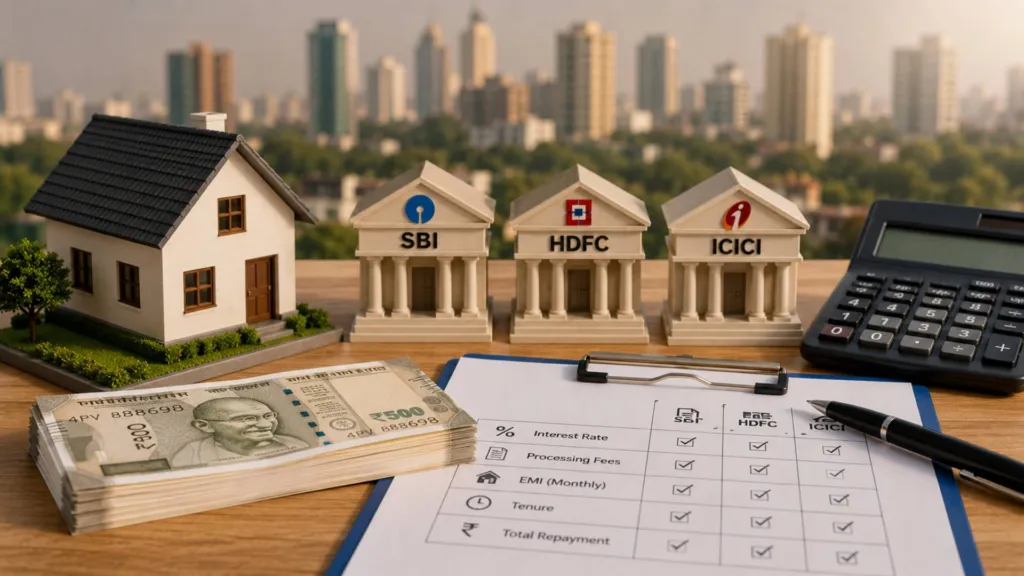
SBI vs HDFC vs ICICI for a Joint Home Loan: Is There a Winner?
There is no responsible universal answer.
The best joint home loan in Pune/Mumbai among SBI, HDFC and ICICI in 2026 depends on the final offer each bank gives the borrowers.
Compare:
- Combined-income eligibility
- Interest rate and benchmark
- Treatment of co-applicant income
- Maximum tenure
- Processing costs
- Property approval
- Disbursement timeline
- Prepayment terms
- Documentation requirements
Do not choose a bank because a developer says it is the “preferred lender.”
The easiest sanction is not necessarily the cheapest loan.
Joint Home Loan vs Single Home Loan: Which Is Better?
Choose a joint home loan when two stable incomes genuinely improve affordability, both borrowers understand the liability and the ownership structure supports the intended tax treatment.
Choose a single loan when one borrower already qualifies comfortably, the second applicant has weaker credit or uncertain income, or both buyers want to preserve independent future borrowing capacity.
The question is not whether a joint loan gives you a bigger sanction.
The better question is:
Does it make the home financially safer for both borrowers?
The Bottom Line for Pune and Mumbai Buyers
A joint home loan can be a powerful tool in cities where property prices increasingly require two incomes.
It can improve eligibility, spread the EMI burden and, when ownership, repayment and tax conditions align, allow qualifying co-owners to claim individual tax benefits.
But it also links two credit profiles, two financial futures and often two ownership interests to the same debt.
For Pune buyers considering Kharadi, Hinjawadi, Baner or Wakad, and Mumbai buyers evaluating Andheri, Thane, Navi Mumbai, Mira Road or Kalyan, the rule should be simple:
Do not take a joint home loan merely because it lets you borrow more. Take it when both borrowers can afford the commitment, understand the ownership structure and have planned for what happens if one income disappears.
Before signing a joint home-loan application, compare at least three lender offers, decide ownership shares before registration, calculate the EMI on one income as a stress test and have the current tax implications reviewed professionally. The right joint loan should strengthen your purchase, not simply increase your borrowing limit.