

No Utility Room? Plan a Laundry Corner in Your Apartment
No Utility Room? Plan a Laundry Corner That Works
SHARE:
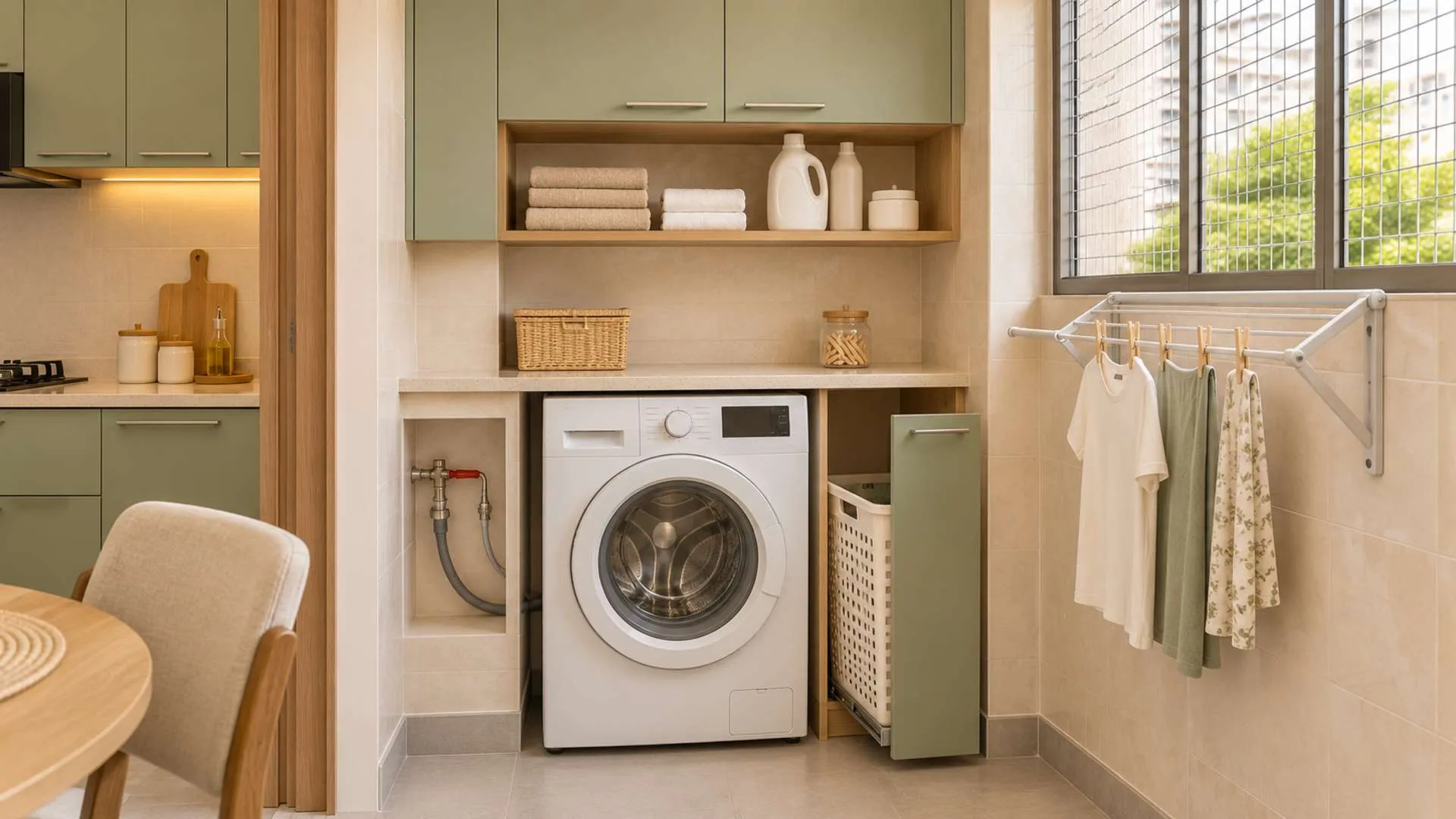


Apartments come with a breakfast bar, a feature wall and an unsuitable place to hang a bed sheet. The ideal laundry area should have appropriate water and electrical facilities, enough room for appliances and a means of drying. A sheltered service patio or kitchen alcove is a good choice. Corners of bathrooms and hallways require more detailed consideration. Fully assess your washing and drying requirements before purchasing cupboards and a washer-dryer. In Indian 1BHK and 2BHK houses that do not include a utility room, this process enables the laundry area to be effectively managed so that it does not encroach on the living room.
How do you plan a laundry corner without a utility room?
Choose a suitable location near existing plumbing, measure the selected appliance and its installation clearances, and provide accessible water, drainage and electrical connections. Add vertical storage and a drying solution suited to ventilation and monsoon conditions. Finalise the layout before cabinetry and tiling begin.
Why Small Apartments Still Need a Laundry Plan
A separate utility room is useful, but its functions can fit into other spaces. The problem begins when the floor plan accommodates the washing machine without considering wet clothes, detergent storage, folding or maintenance access.
Plan the entire laundry routine before choosing the machine’s location. Where will dirty clothes wait? Where will a bedsheet dry? Can someone load the washer while another person passes?
Magicbricks’ compact laundry guide illustrates balcony layouts, concealed cabinets, under-counter machines and vertical storage. These arrangements make laundry part of the home’s design rather than an activity scattered across several rooms.
For homebuyers, this deserves attention during a site visit. Open the proposed utility cupboard, locate the drain and imagine using the space with the appliance door open. A labelled “washing-machine provision” is only the beginning.
Five Places to Put Your Laundry Corner, Ranked by Practicality
The best location depends on existing services and safe installation conditions. This ranking is a starting point, rather than a rule for every apartment.
| Placement | Main advantage | What to check |
|---|---|---|
| Protected service balcony | Can combine washing and air-drying | Weather exposure, drainage and appliance suitability |
| Kitchen utility niche | Often close to water and waste lines | Cabinet clearances, access and noise |
| Bathroom dry zone | Nearby plumbing | Splash separation and electrical safety |
| Hallway closet | Conceals laundry from living areas | Drain route, ventilation and servicing |
| Under-staircase space | Uses otherwise awkward space in duplexes | Headroom, structural suitability and service connections |
A service balcony works only when the appliance can remain suitably protected. An open, rain-exposed ledge does not become an appropriate installation site simply because the machine has a cover.
A kitchen niche can be economical when suitable connections already exist. Houzz recommends considering locations near kitchen or bathroom plumbing and checking wiring, ventilation and other installation requirements before converting a cupboard.
Bathroom placement requires a genuinely dry area and professional electrical assessment. Hallway closets and under-staircase corners can look elegant, but a difficult drainage route may outweigh the space saved.
How Much Space Does a Laundry Corner Actually Need?
Buy cabinetry around a confirmed appliance specification, not around a generic washing-machine size.
Actual manufacturer examples show why:
| Appliance example | Height × width × depth | Planning implication |
|---|---|---|
| Bosch WAJ2426VIN front-loader | 84.8 × 59.8 × 59 cm | Check door opening, hoses and under-counter suitability |
| LG T90KMOB1Z top-loader | 90.4 × 54 × 58.5 cm | Keep the lid-opening area unobstructed |
These are product dimensions, not complete installation envelopes. Bosch and LG publish the measurements for these specific models; other machines differ.
A front-load washer measuring roughly 85 × 60 × 60 cm may suit a kitchen niche, but its door, connections and loading space require additional room. Do not assume that a top-loader is only 40 cm wide.
Similarly, allowances such as 120 cm in front, 60 cm above, or 15 cm behind are not universal manufacturer requirements. LG’s installation guide, for example, specifies at least 2 cm on each side and 10 cm behind in its airflow guidance, while directing buyers to detailed installation information. The selected model’s manual takes priority.
A 3 × 5-foot niche may accommodate an appliance and storage, but loading space may need to extend into the adjoining room. Measure that shared space too.
The Drying Problem: What Works Without a Terrace or Big Balcony?
A washer solves washing. It does not automatically solve laundry.
A ceiling-mounted pulley rack keeps its supports off the floor, although hanging clothes still occupy usable space. Check ceiling strength, fixing permissions and clearance from fans, doors and windows.
For preliminary budgeting, allow approximately ₹2,000–₹8,000 for a pulley rack and ₹500–₹2,000 for a basic retractable clothesline, subject to specifications and installation. Wall-mounted folding racks suit narrow balconies; freestanding airers suit renters because they can move with the household.
| Drying solution | Best suited to | Main limitation |
|---|---|---|
| Ceiling pulley rack | Protected, ventilated balconies | Needs secure overhead fixing |
| Retractable clothesline | Occasional loads | Limited capacity and anchoring needs |
| Folding airer | Rental homes | Occupies floor space while open |
| Ventless washer-dryer | Homes with little air-drying space | Higher purchase and running costs |
| Dehumidifier-assisted drying | Suitable enclosed drying areas | Requires correct sizing and electricity |
For monsoon drying, allow space between garments and provide airflow. A dehumidifier can help remove moisture where appropriately sized.
Electric ceiling racks need closer price checking. Motorised lifting, heated drying and fan assistance are different features. Kosmochem lists a ceiling rack with heater-fan functions at ₹27,965, demonstrating why a ₹5,000–₹15,000 allowance will not cover every heated model. UV marketing claims should not replace checks on drying performance and safety.
Washer-Dryer Combo or Separate Washing Machine?
A washer-dryer combo washes and dries in one drum, saving the floor footprint of a second appliance. It can suit a 1BHK without a usable drying balcony.
The important number is drying capacity. LG’s FHD0905STB, for example, is rated for 9 kg washing and 5 kg drying. A full wash load therefore cannot automatically become a full drying load.
For initial planning, a washer-dryer combo budget of ₹40,000–₹90,000 or more is worth investigating against current models. Samsung’s India page lists washer-dryer options from ₹66,400, with its 12/7 kg AI Wash option from ₹74,500; availability and offers need confirmation.
Choose a ventless condenser model if an external exhaust duct is impractical, and verify its water, drainage and ventilation requirements. “No external vent” does not mean “no installation requirements”.
| Arrangement | Main benefit | Main compromise |
|---|---|---|
| Washer plus air-drying rack | Simpler, potentially lower-cost setup | Weather-dependent drying |
| Washer-dryer combo | One appliance footprint | Shared drum and differing wash/dry capacities |
| Separate stacked appliances | Independent washing and drying | Greater cost and height requirements |
Stack separate appliances only with manufacturer-approved compatibility and installation hardware.
Plumbing, Ventilation and Finishes, The Practical Checklist
The least visible parts of the laundry corner deserve the earliest decisions.
Ask the installer to specify an accessible water inlet with a shut-off valve and a secure waste connection. Drain-hose height, trapping and any air-gap arrangement must follow the appliance instructions and applicable plumbing requirements. A floor trap does not replace a correctly installed appliance drain.
For an initial estimate, the brief’s ₹2,700–₹7,500 inlet-and-drain allowance can be used as a quotation starting point, not a standard tariff. Long pipe runs, concealed work and reinstating tiles can increase costs.
Provide an appropriately rated, earthed electrical connection with suitable protective devices. Keep it away from splash zones and avoid extension-board arrangements.
Where clothes dry indoors, address moisture through ventilation or appropriate mechanical extraction. An exhaust fan may help an enclosed drying area, but its need and specification depend on the layout.
Glazed wall tiles, slip-resistant flooring, sealed skirting and moisture-resistant cabinetry can simplify upkeep. PVC cabinets or suitably specified sealed boards are options; neither compensates for persistent leaks. Keep the machine level and leave valves, filters and service panels accessible.
What It Actually Costs, Three Laundry-Corner Budgets
Separate the appliance budget from the fit-out budget. A ₹20,000 corner using an existing washing machine is different from a ₹20,000 project that must also buy one.
The following are illustrative planning allowances, not supplier quotations:
| Setup | Appliance allowance | Services, storage and drying | Estimated total |
|---|---|---|---|
| Basic protected balcony, existing washer | ₹0 | ₹15,000–₹25,000 | ₹15,000–₹25,000 |
| Mid-range niche with new washer | ₹25,000–₹40,000 | ₹25,000–₹40,000 | ₹50,000–₹80,000 |
| Concealed niche with washer-dryer | ₹65,000–₹90,000 | ₹35,000–₹60,000 | ₹1–₹1.5 lakh |
Major civil changes or premium joinery can push costs higher. Request separate prices for plumbing, electrical work, waterproofing, cabinetry and installation.
Plan during interior fit-out, before finishes are fixed. This can avoid reopening walls or replacing completed cabinets, although a universal 30–50% saving cannot be assumed.
A successful laundry corner earns its space every day. For small apartments without a utility room, the winning design is one that washes, dries and stores clothes without blocking the home. Before approving your interiors, mark the appliance, connections, loading area and drying arrangement on the plan. Start your home-planning conversation at RealtyConnect.

FAQs:
 Will More Future Housing Projects Be Built on Partner-Owned Land?