

Pune Metro Phase 2: ₹13,500 Crore Routes and Property Impact
Pune Metro Phase 2 — Routes & Property Impact
SHARE:
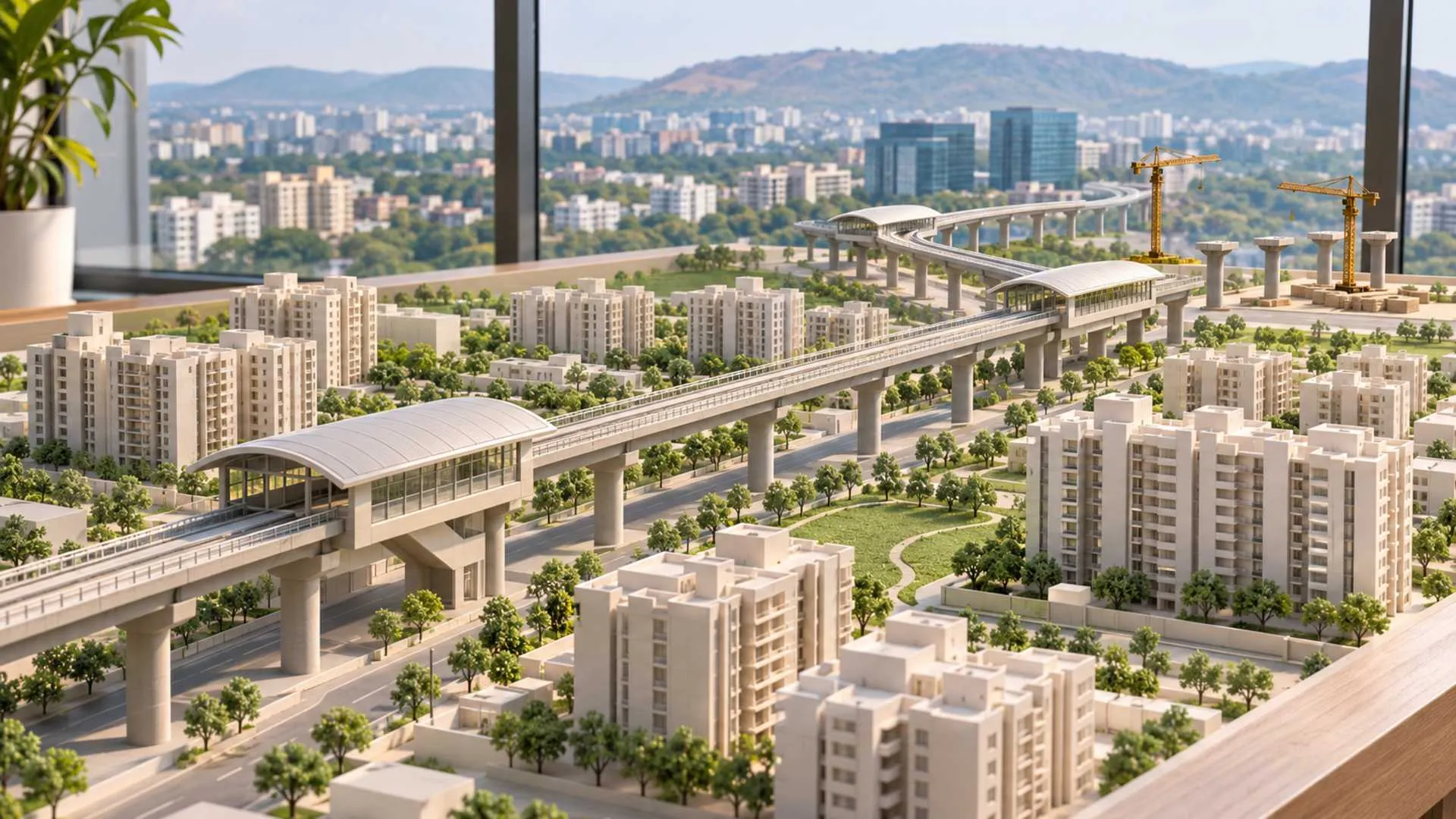


Pune Metro Phase 2 will transform into new, comfortable living areas for buyers, although there are four corridors (2A, 2B, 4 and 4A) that will have 44.39 km of distance and 41 elevated stations. This will connect Chandani Chowk, Wagholi, Kharadi, Hadapsar, Khadakwasla and Warje to the rest of the network. A tender has been released for Line 4A on the 14th of November, following the foundation stone ceremony on the 3rd of November. Buyers will have increased transport access to eastern, southern and western areas of Pune. Gains will be based on how well it gets delivered, station entrances, quality of infrastructure within the area and current price.
What Are the Four Pune Metro Phase 2 Routes?
The Pune Metro Phase 2 routes, stations and property impact in 2026 involve two distinct packages: extensions of the existing Aqua Line, and the new Line 4–4A network.
Table 1: Approved corridors at a glance
| Line | Route | Approved length | Elevated stations | Main housing catchments |
|---|---|---|---|---|
| 2A | Vanaz–Chandani Chowk | 1.12 km | 2 | Kothrud and Chandani Chowk/Bavdhan approaches |
| 2B | Ramwadi–Wagholi/Vitthalwadi | 11.63 km | 11 | Nagar Road, Kharadi-side approaches and Wagholi |
| 4 | Kharadi–Hadapsar–Swargate–Khadakwasla | 25.52 km | 22 | Magarpatta, Hadapsar, Sinhagad Road and southwestern Pune |
| 4A | Nal Stop–Warje–Manik Baug | 6.12 km | 6 | Karve Road, Karve Nagar, Warje and Manik Baug |
Source: Maha Metro’s Line 2A/2B information and Line 4/4A information. Lengths are rounded approved-corridor figures; individual construction-package measurements may differ.
The Pune Metro Line 2A and 2B extensions lengthen the existing Vanaz–Ramwadi corridor at both ends. Line 4 creates a cross-city connection through southern and eastern employment and residential areas.
What are Pune Metro Phase 2’s routes, stations and property implications?
Phase 2 comprises Lines 2A, 2B, 4 and 4A, adding approximately 44.39 km and 41 elevated stations at an approved combined cost of about ₹13,484 crore. It could improve access around Wagholi, Kharadi, Hadapsar, Sinhagad Road, Warje and Chandani Chowk. Buyers should verify station access and construction milestones rather than assume guaranteed appreciation.
Pune Metro Line 4 Route Map and Stations: What Is Confirmed?
The Pune Metro Line 4 Khadakwasla-to-Kharadi route passes through the Swargate, Hadapsar and Magarpatta catchments. Maha Metro identifies Solapur Road, Magarpatta Road and Sinhagad Road among the major roads served.
Station naming requires care. The current project page confirms 22 stations, while an older official draft DPR provides the following sequence.
Table 2: Line 4 station names in the older draft DPR
| Route section, travelling towards Kharadi | Draft station labels |
|---|---|
| Khadakwasla–Manik Baug | Khadakwasla, Dalvewadi, Nanded City, Dhayari Phata, Manik Baug |
| Sinhagad Road–Swargate | Hingane Chowk, Rajaram Bridge, Deshpande Udhyan, Dandekar Pool, Swargate North |
| Central/eastern section | 7 Loves Chowk, PCB, Race Course, Fatima Nagar, Ramtekdi, Hadapsar |
| Magarpatta–Kharadi | Magarpatta South, Magarpatta Main, Magarpatta North, Hadapsar Railway Station, Sai Nath Nagar Chowk, Kharadi Chowk |
These are draft labels, not a verified final 2026 station-naming list. Spellings and station positions should be checked against the latest approved alignment.
The same draft lists Paud Phata, Karve Putla, Dhanukar Colony, Karve Nagar, Warje and Daulat Nagar for the spur. The approved Pune Metro Line 4A route is described as Nal Stop–Warje–Manik Baug.
Official approval information identifies integration at Swargate, Nal Stop and Kharadi Bypass, alongside a connection with Hadapsar Railway Station. Some connections involve other sanctioned infrastructure, so they should not all be described as operational interchanges today.
What Is the Cost, Funding Structure and Completion Timeline?
The Pune Metro Phase 2 cost of approximately ₹13,500 crore combines two approvals:
- Lines 2A/2B: ₹3,626.24 crore, approved on June 25, 2025.
- Lines 4/4A: ₹9,857.85 crore, approved on November 26, 2025.
Together, these total ₹13,484.09 crore. The Press Information Bureau identifies the Union government, Maharashtra government and external bilateral/multilateral agencies as funding participants.
The approvals specified four years for 2A/2B and five years for 4/4A. Those delivery periods should not be converted into a single guaranteed “all lines open in 2030” promise.
A more current indicator is Maha Metro’s November 14 tender for Line 4A civil works. It covers six elevated stations between SNDT College and Manikbaug and specifies 36 months from the Letter of Acceptance. That contract period covers the stated works; it is not a passenger-service opening date.
Mahindra Lifespaces’ Phase 2 guide also distinguishes planning, approvals, procurement and construction. Buyers should track the milestone relevant to their station rather than treat every announcement as construction completion.
Property Prices Along the Corridors: Where Is Entry More Affordable?
The Pune Metro Phase 2 property-price impact will play out across markets with very different starting points.
Table 3: Selected locality price indicators
| Locality | Housing.com displayed average | Buyer implication |
|---|---|---|
| Dhayari | ₹6,608/sqft | Southwestern entry point worth comparing |
| Wagholi | ₹7,044/sqft | Lower-priced eastern alternative in this sample |
| Hadapsar | ₹10,570/sqft | Mixed established and premium housing stock |
| Kharadi | ₹11,495/sqft | Higher-priced employment-led market |
Portal listing indicators, not verified carpet-area transaction averages or prices within a fixed station radius.
For buyers comparing south Pune versus east Pune, Dhayari and Wagholi merit attention before assuming a premium address offers better value. Khadakwasla requires a unit-level comparison: the reviewed portal page had a very small sample and inconsistent summary figures.
For flats near Pune Metro Phase 2 stations in Dhayari or Khadakwasla, inspect approach roads, water supply and daily services. For Wagholi property near the Line 2B extension from Ramwadi, verify the distance to the proposed entrance rather than merely to Nagar Road.
Similarly, Chandani Chowk–Bavdhan flats near Line 2A and Warje–Manik Baug homes near Line 4A need practical feeder-route checks. A neighbourhood name does not establish walkable station access.
How Much Could Property Prices Rise by 2030?
No defensible fixed appreciation percentage applies to every Phase 2 property.
A Times of India report on Pune’s metro-linked markets records developer observations about stronger demand and price growth. However, it also identifies broader influences, including demand, housing configurations and infrastructure improvements. That is not proof that the metro alone caused a uniform premium.
The logic behind metro corridor real estate appreciation in India is straightforward: useful transport can widen a property’s buyer and tenant catchment. The result still depends on supply, employment, maintenance, purchase price and actual accessibility.
PropertyNivesh’s Phase 2 assessment similarly treats stronger demand as a prospect rather than a certainty and advises checking alignment before paying a premium.
Compared with Phase 1, these corridors reach additional catchments. But Phase 1’s experience cannot establish identical returns for Wagholi, Warje and Khadakwasla. Their housing markets and delivery timelines differ.
Which Developers and Projects Should Buyers Watch?
Developer presence matters only after confirming the property’s location relative to the actual corridor.
Mantra Properties’ Kharadi homes, including Melange, and Shubh Developers’ Mundhwa projects, including Tristar, can form part of an eastern Pune shortlist. Neither brand name establishes a verified station distance.
For ARV Group’s Undri projects, assess the feeder journey towards relevant southern transport nodes; Undri should not automatically be presented as directly on Line 4.
Likewise, Kolte-Patil Life Republic and Saheel Properties’ Wakad projects belong to the wider western Pune housing discussion. Do not confuse proximity to Line 3’s catchment with direct frontage on Phase 2’s Vanaz–Chandani Chowk extension.
The useful question is not “Which developer benefits?” It is “How does this particular home connect to the station and my workplace?”
Five Checks Before Buying Near a Phase 2 Station
- Verify the latest alignment. Distinguish an approved corridor, a draft station label and a confirmed entrance.
- Test the complete commute. Include walking, feeder transport, transfers and the final office approach.
- Compare complete costs. Use equivalent carpet areas, specifications, possession dates and maintenance obligations.
- Plan for construction disruption. Access, parking and noise may change before transport benefits arrive.
- Keep the purchase viable without rapid appreciation. Verify the exact MahaRERA phase and assess affordability if opening dates move.
Pune Metro Phase 2 expands the homebuying map, but value will remain property-specific. The best areas to buy a flat in Pune in 2026 are those that already suit your budget and routine, with future connectivity providing an additional benefit.

FAQs:
 Coworking for Doctors: How Managed Clinics Are Creating Property Demand