

Will Climate Scores Soon Decide What Your Indian Home Is Worth?
Climate Risk & Indian Property Values
SHARE:
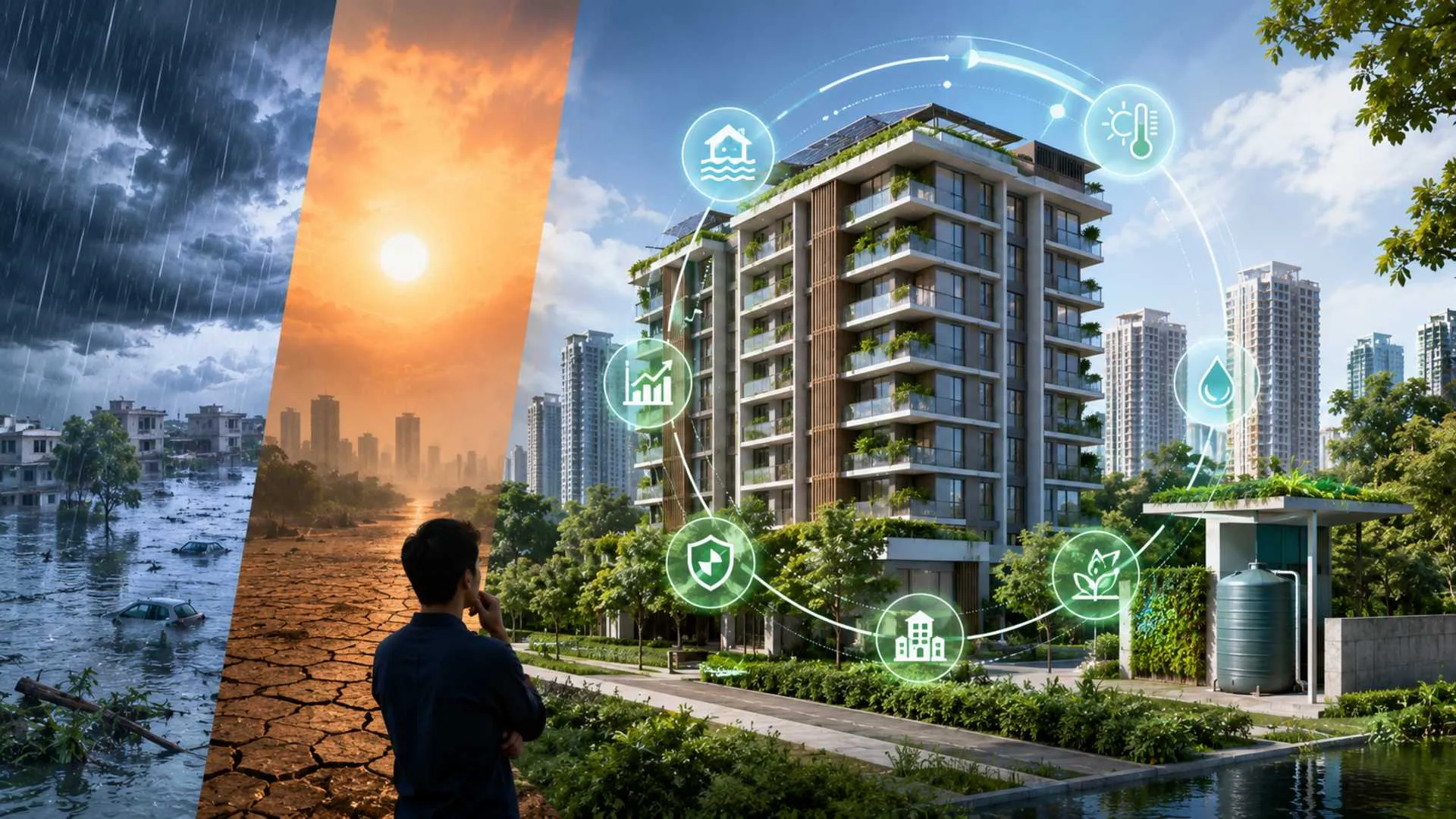
Indian property buyers have been asking the same questions for decades: Where is it? How big? How much per square foot?
The next question might be very different: How climate-safe is it?
Floods, extreme heat, water shortages, and coastal risks are becoming harder to ignore, and climate risk to Indian real estate property values in 2026 is becoming a serious investment discussion. India still has no mandatory nationwide “climate score” attached to each home. But the market is already heading toward something surprisingly close.
Will Climate Risk Affect My Home’s Resale Value in India?
Yes, increasingly. A home’s exposure to flooding, heat stress, water scarcity and coastal hazards can influence maintenance costs, liveability, insurance and future buyer demand. Climate-resilient properties with better drainage, energy efficiency, water management and green design could therefore command an advantage when owners eventually sell.
BeyondWalls notes that climate change is already influencing Indian housing decisions, with buyers considering tree cover, drainage quality and ventilation alongside traditional factors such as location and carpet area. It also points to weaker appreciation potential for flood-affected properties.
Your Next Property Search Could Include a Climate Score
This is no longer entirely hypothetical.
In June 2026, SquareYards introduced its Green Living Index, a 100-point framework designed to make residential sustainability easier for buyers to compare. It evaluates projects across resource efficiency, health and comfort, safety and resilience, and connectivity and mobility. The system draws on sources including RERA filings, developer disclosures and geospatial intelligence.
That is not the same as a universal climate-risk rating. But it provides a glimpse of where property discovery could be heading.
Imagine two ₹1.5 crore apartments in the same city. One experiences repeated waterlogging, has high cooling requirements and limited water security. The other offers better drainage, passive cooling, water recycling and resilient infrastructure.
Would buyers still value them equally in 2035?
Probably not.
What Could an Indian Home Climate Score Measure?
A future climate score for homebuyers in India could combine property-level and neighbourhood-level risks, such as:
- Flood zone, drainage and waterlogging exposure
- Extreme heat and urban heat-island intensity
- Water availability and drought vulnerability
- Coastal inundation and sea-level exposure
- Energy efficiency and passive cooling
- Building resilience and green certifications such as IGBC, GRIHA or LEED
It could even distinguish risks within the same building. A basement apartment’s flood risk, a ground-floor home’s waterlogging exposure and a top-floor apartment’s heat stress are not necessarily identical.
International climate analytics companies already use location-specific modelling to quantify physical climate risks. In India, platforms that combine such data with property discovery could eventually make climate resilience almost as searchable as “3BHK” or “near Metro”.
Mumbai, Chennai and Delhi May Face a Different Property Equation
Climate risk will not affect every Indian city, or every neighbourhood, equally.
Mumbai’s coastal flood climate risk, Chennai’s combination of coastal and flooding exposure, and Kolkata’s low-lying environment create different vulnerabilities from Ahmedabad and Delhi NCR’s extreme heat stress.
Even cities perceived as relatively comfortable are not automatically protected. BeyondWalls highlights urban heat-island effects in Pune and water-scarcity concerns across parts of Bengaluru and Pune.
This means calling Pune, Bengaluru, Chandigarh or Bhubaneswar simply “climate-resilient cities” can be misleading. Climate risk is increasingly micro-local. Two projects a few kilometres apart can have very different drainage, elevation, water security and heat exposure.
Could Climate-Safe Homes Command a “Resilience Premium”?
The economics are beginning to make that possibility credible.
SquareYards estimates that green buildings can reduce water consumption by 30–50% and energy costs by 20–30%, while requiring an additional upfront investment of approximately 3.5–4%. India already has more than 15.9 billion sq ft of green-certified building space.
Trident Realty similarly argues that climate-resilient design can protect long-term asset value by reducing maintenance requirements and strengthening buyer confidence after extreme-weather events.
That could eventually divide the market into climate-resilient assets and climate-vulnerable assets.
The second category faces the more uncomfortable possibility: stranded real estate, properties that become progressively harder to insure, maintain, rent or resell because environmental risks have changed their economics.
RERA Does Not Yet Give Your Home a Climate Score
One distinction is important. RERA does not currently mandate a standard nationwide climate-risk score for every residential property. Buyers should therefore not assume that project registration automatically answers questions about future flood, heat or water risk.
This leaves room for developers, proptech companies, lenders and property portals to create clearer climate-risk disclosures.
And that may reshape what “premium” means.
A sea view, glass façade or prestigious PIN code may sell a home today. Tomorrow’s premium could be the apartment that stays cooler, has reliable water, remains accessible during heavy rain and costs less to operate.
India may not yet print a climate score beside every property listing. But the ingredients of one are already entering the market.
Before choosing your next home, look beyond price per sq ft. Compare locations, projects and future-ready property factors with RealtyConnect, because the value of tomorrow’s home may depend on how well it handles tomorrow’s climate.